Homepage Free Motor Vehicle Bill of Sale Form for Delaware
Content Overview

The Delaware Motor Vehicle Bill of Sale form serves as an essential document for anyone involved in the buying or selling of a vehicle within the state. This form provides a clear record of the transaction, detailing important information such as the vehicle's make, model, year, and identification number, which helps to establish ownership. It also includes the names and addresses of both the buyer and the seller, ensuring that both parties are clearly identified in the transaction. Additionally, the form outlines the sale price and any terms of the sale, such as whether the vehicle is sold "as is" or if there are warranties involved. By completing this form, both parties can protect themselves from future disputes and ensure that the transfer of ownership is legally recognized. Furthermore, the Delaware Motor Vehicle Bill of Sale is often required when registering the vehicle with the state, making it a crucial step in the vehicle transfer process.

Document Preview

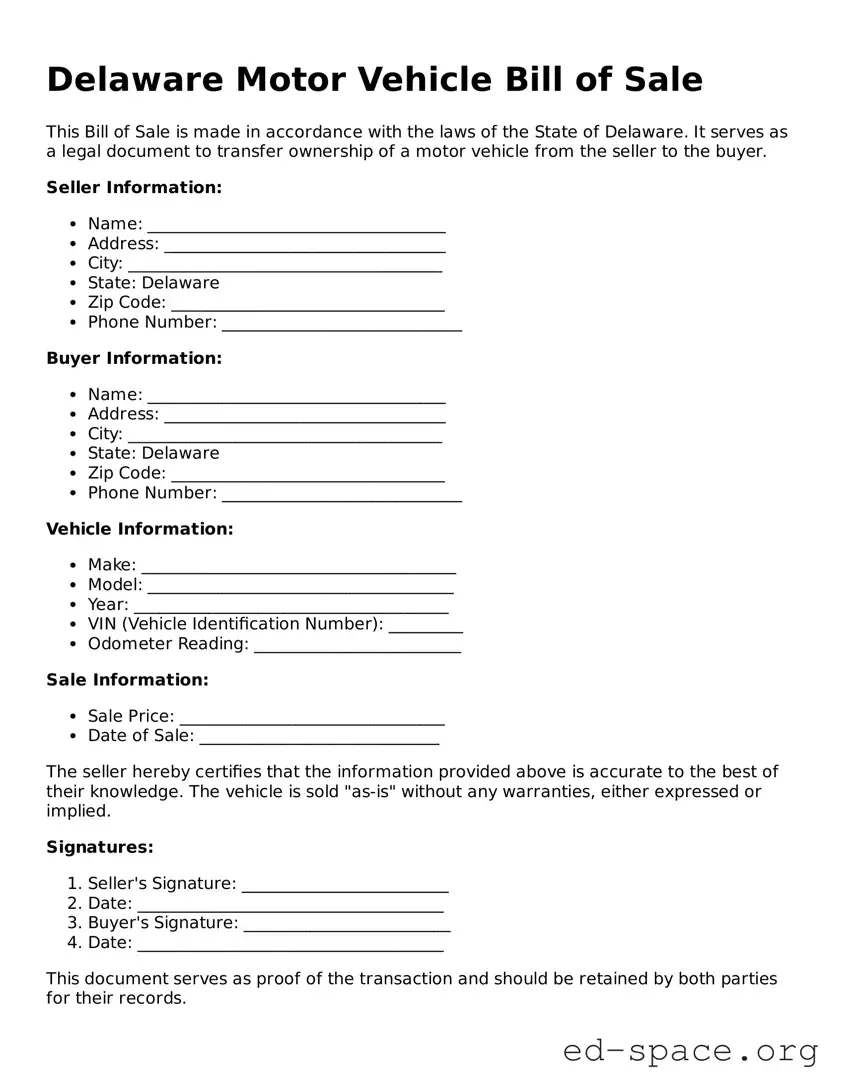
Delaware Motor Vehicle Bill of Sale

This Bill of Sale is made in accordance with the laws of the State of Delaware. It serves as a legal document to transfer ownership of a motor vehicle from the seller to the buyer.

Seller Information:

  • Name: ____________________________________
  • Address: __________________________________
  • City: ______________________________________
  • State: Delaware
  • Zip Code: _________________________________
  • Phone Number: _____________________________

Buyer Information:

  • Name: ____________________________________
  • Address: __________________________________
  • City: ______________________________________
  • State: Delaware
  • Zip Code: _________________________________
  • Phone Number: _____________________________

Vehicle Information:

  • Make: ______________________________________
  • Model: _____________________________________
  • Year: ______________________________________
  • VIN (Vehicle Identification Number): _________
  • Odometer Reading: _________________________

Sale Information:

  • Sale Price: ________________________________
  • Date of Sale: _____________________________

The seller hereby certifies that the information provided above is accurate to the best of their knowledge. The vehicle is sold "as-is" without any warranties, either expressed or implied.

Signatures:

  1. Seller's Signature: _________________________
  2. Date: _____________________________________
  3. Buyer's Signature: _________________________
  4. Date: _____________________________________

This document serves as proof of the transaction and should be retained by both parties for their records.

PDF Form Details

Fact Name Description
Purpose The Delaware Motor Vehicle Bill of Sale form serves as a legal document that records the sale of a motor vehicle between a buyer and a seller.
Governing Law This form is governed by Delaware state law, specifically Title 21 of the Delaware Code, which covers motor vehicles.
Required Information The form typically requires details such as the vehicle identification number (VIN), make, model, year, and the names and addresses of both the buyer and seller.
Notarization While notarization is not always required, having the Bill of Sale notarized can provide additional legal protection for both parties.
Transfer of Ownership Completing the Bill of Sale is essential for transferring ownership of the vehicle and may be needed for registration purposes.

Delaware Motor Vehicle Bill of Sale: Usage Guidelines

After completing the Delaware Motor Vehicle Bill of Sale form, ensure that all parties involved retain a copy for their records. This document serves as proof of the transaction and may be required for future reference.

  1. Begin by entering the date of the sale at the top of the form.
  2. Fill in the seller's name and address in the designated fields.
  3. Provide the buyer's name and address in the appropriate sections.
  4. Clearly describe the vehicle being sold. Include details such as the make, model, year, vehicle identification number (VIN), and odometer reading.
  5. Specify the sale price of the vehicle.
  6. If applicable, indicate whether there are any liens on the vehicle.
  7. Both the seller and buyer should sign and date the form at the bottom.
  8. Make copies of the completed form for both the seller and buyer.

Your Questions, Answered

What is a Delaware Motor Vehicle Bill of Sale?

The Delaware Motor Vehicle Bill of Sale is a legal document that serves as proof of the sale and transfer of ownership of a motor vehicle. It includes essential information such as the vehicle's make, model, year, Vehicle Identification Number (VIN), and the sale price. Both the buyer and seller must sign this document to validate the transaction. This form is particularly important for registering the vehicle in the buyer's name and for tax purposes.

Why is a Bill of Sale necessary in Delaware?

A Bill of Sale is necessary in Delaware for several reasons. First, it provides a clear record of the transaction, which can help resolve disputes regarding ownership or sale terms. Second, it is often required when registering the vehicle with the Delaware Division of Motor Vehicles (DMV). Without this document, the buyer may face difficulties in obtaining a new title or registering the vehicle. Additionally, it serves as a safeguard for both parties, ensuring that the sale is documented and agreed upon.

What information is required on the Bill of Sale?

The Bill of Sale must include specific information to be valid. This includes the full names and addresses of both the seller and buyer, the vehicle's details (make, model, year, and VIN), the sale price, and the date of the transaction. It is also advisable to include any warranties or conditions of the sale, as well as the signatures of both parties. Having this information accurately documented helps prevent future disputes and facilitates a smooth transfer of ownership.

How do I complete a Bill of Sale in Delaware?

To complete a Bill of Sale in Delaware, both the seller and buyer should fill out the form with the required information. This can often be done using a template or form available online. Once all fields are filled in, both parties must sign the document. It's recommended to keep a copy for personal records. After the Bill of Sale is completed and signed, the buyer can use it to register the vehicle with the DMV and obtain a new title.

Is a Bill of Sale required for all vehicle transactions in Delaware?

While a Bill of Sale is not legally required for every vehicle transaction in Delaware, it is highly recommended. For private sales, having a Bill of Sale protects both the buyer and seller by providing a written record of the transaction. In cases of dealer sales, the dealer typically provides the necessary paperwork. However, for private sales, a Bill of Sale is an essential document for ensuring a clear transfer of ownership and for future registration purposes.

Common mistakes

  1. Incomplete Information: One of the most common mistakes is failing to fill out all required fields. Every section of the form must be completed to ensure the sale is valid.

  2. Incorrect Vehicle Details: Providing incorrect information about the vehicle, such as the VIN or model year, can lead to problems in registration and ownership transfer.

  3. Missing Signatures: Both the buyer and seller must sign the form. Omitting a signature can render the document ineffective.

  4. Not Dating the Document: Failing to include the date of the transaction can create confusion about when the sale took place, which is crucial for legal records.

  5. Not Keeping a Copy: After filling out the form, many forget to make a copy for their records. This can be problematic if disputes arise later.

  6. Ignoring Local Regulations: Each state may have specific requirements for a bill of sale. Not checking Delaware's regulations can lead to issues with the transaction.

Documents used along the form

When buying or selling a vehicle in Delaware, the Motor Vehicle Bill of Sale form is essential. However, several other documents often accompany it to ensure a smooth transaction and proper registration. Here’s a list of important forms and documents that may be needed.

  • Title Transfer Form: This document officially transfers ownership of the vehicle from the seller to the buyer. It includes details about the vehicle and must be signed by both parties.
  • Odometer Disclosure Statement: Required for vehicles less than ten years old, this form verifies the mileage on the vehicle at the time of sale, helping to prevent fraud.
  • Vehicle Registration Application: After purchasing a vehicle, the new owner must complete this application to register the vehicle in their name with the state.
  • Proof of Insurance: Before registering a vehicle, buyers must provide proof of insurance. This ensures that the vehicle is covered in case of accidents or damages.
  • Sales Tax Form: This document calculates the sales tax due on the vehicle purchase. It may be required when registering the vehicle or at the time of sale.
  • Emission Inspection Certificate: In some cases, vehicles must pass an emissions test before they can be registered. This certificate proves compliance with state environmental regulations.
  • Power of Attorney: If a seller cannot be present during the sale, this document allows another person to act on their behalf, facilitating the transaction.
  • Affidavit of Non-Ownership: This form may be used when a vehicle is sold without a title, confirming that the seller has the right to sell the vehicle.
  • VIN Verification Form: This document confirms the Vehicle Identification Number (VIN) of the vehicle, ensuring it matches the title and registration.

Having these documents ready can streamline the buying or selling process and help avoid potential issues down the road. Always check with local regulations to ensure compliance and completeness of your paperwork.

Similar forms

  • Vehicle Title: This document proves ownership of a vehicle. Like the Bill of Sale, it contains essential details about the vehicle, including the VIN and the names of the buyer and seller.
  • Purchase Agreement: A purchase agreement outlines the terms of the sale, including price and conditions. It serves as a contract between the buyer and seller, similar to the Bill of Sale, but often more detailed.
  • Lease Agreement: This document is used when a vehicle is leased rather than sold. It includes terms and conditions for use, much like a Bill of Sale outlines the transfer of ownership.
  • Title Transfer Form: Required by many states, this form officially transfers the title from the seller to the buyer. It complements the Bill of Sale by ensuring that ownership is legally recognized.
  • Odometer Disclosure Statement: This statement records the vehicle's mileage at the time of sale. It is often included with the Bill of Sale to provide transparency about the vehicle's condition.
  • Release of Liability: This document protects the seller from future claims related to the vehicle after the sale. It is similar to the Bill of Sale in that it formalizes the end of the seller's responsibility.
  • Service Records: While not a legal document, service records provide proof of maintenance and repairs. They can accompany the Bill of Sale to assure the buyer of the vehicle's condition.
  • Vehicle Registration: This document shows that the vehicle is registered with the state. It is related to the Bill of Sale as both are necessary for legal ownership and operation on public roads.

Dos and Don'ts

When filling out the Delaware Motor Vehicle Bill of Sale form, it's important to follow certain guidelines to ensure accuracy and compliance. Here’s a list of things you should and shouldn’t do:

  • Do provide accurate information about the vehicle, including the make, model, year, and VIN.
  • Do include the purchase price clearly and legibly.
  • Do sign and date the form. Both the buyer and seller must sign.
  • Do keep a copy of the completed Bill of Sale for your records.
  • Don't leave any sections blank. Fill out every required field.
  • Don't use white-out or any form of correction fluid on the document.
  • Don't forge signatures. Both parties must agree and sign.
  • Don't forget to check for any additional requirements specific to your transaction.

Misconceptions

Understanding the Delaware Motor Vehicle Bill of Sale form is essential for anyone involved in buying or selling a vehicle in the state. However, there are several misconceptions that can lead to confusion. Here are eight common misunderstandings:

  1. It is not necessary for the bill of sale to be notarized. Many people believe that notarization is required for a bill of sale to be valid. In Delaware, notarization is not mandatory, but it can provide an extra layer of security.
  2. The bill of sale is only needed for used vehicles. Some individuals think that a bill of sale is only necessary when selling a used vehicle. However, it is also important for new vehicle transactions, as it serves as proof of purchase.
  3. Any written document can serve as a bill of sale. While it is true that a bill of sale can be a simple document, it must include specific information to be effective. This includes details about the buyer, seller, vehicle description, and purchase price.
  4. Once the bill of sale is signed, the transaction is complete. People often assume that signing the bill of sale finalizes the sale. However, the buyer must also complete the vehicle registration process with the Delaware Division of Motor Vehicles.
  5. The bill of sale is only for private sales. Many believe that only private sales require a bill of sale. In reality, even dealerships may provide a bill of sale for transactions, especially for record-keeping purposes.
  6. There is a specific format required for the bill of sale. Some think that the bill of sale must follow a strict format. While it should include essential information, there is flexibility in how it is presented as long as it meets legal requirements.
  7. Once the bill of sale is signed, the seller has no further responsibilities. This is a common misconception. Sellers may still be liable for any issues that arise from the sale, especially if the vehicle has undisclosed problems.
  8. The bill of sale is not needed if the vehicle has a title. Some individuals believe that having a title eliminates the need for a bill of sale. However, the bill of sale provides additional proof of the transaction and is often required for registration.

Being aware of these misconceptions can help ensure that vehicle transactions in Delaware are smooth and legally sound.

Key takeaways

Filling out and using the Delaware Motor Vehicle Bill of Sale form is an important process for both buyers and sellers of vehicles. Here are some key takeaways to keep in mind:

  1. Purpose of the Form: The Bill of Sale serves as a legal document that records the transfer of ownership of a vehicle from the seller to the buyer.
  2. Required Information: Include essential details such as the vehicle's make, model, year, VIN (Vehicle Identification Number), and odometer reading.
  3. Seller and Buyer Information: Both parties must provide their names, addresses, and signatures to validate the transaction.
  4. As-Is Condition: The form typically includes a statement indicating that the vehicle is sold "as-is," meaning the buyer accepts the vehicle in its current state without warranties.
  5. Notarization: While notarization is not always required, having the document notarized can add an extra layer of authenticity and protection for both parties.
  6. Record Keeping: Keep a copy of the completed Bill of Sale for your records. This can be useful for future reference or in case of disputes.
  7. State Requirements: Check Delaware's specific requirements for vehicle sales, as they may vary and affect the use of the Bill of Sale.
  8. Tax Implications: The Bill of Sale may be needed for tax purposes. Ensure that both parties understand any tax obligations related to the sale.
  9. Vehicle Registration: The buyer will need the Bill of Sale to register the vehicle in their name. It is often required by the DMV.
  10. Multiple Copies: It’s advisable to create multiple copies of the Bill of Sale. Each party should retain one for their records.

Understanding these key points can help facilitate a smooth transaction when buying or selling a vehicle in Delaware.