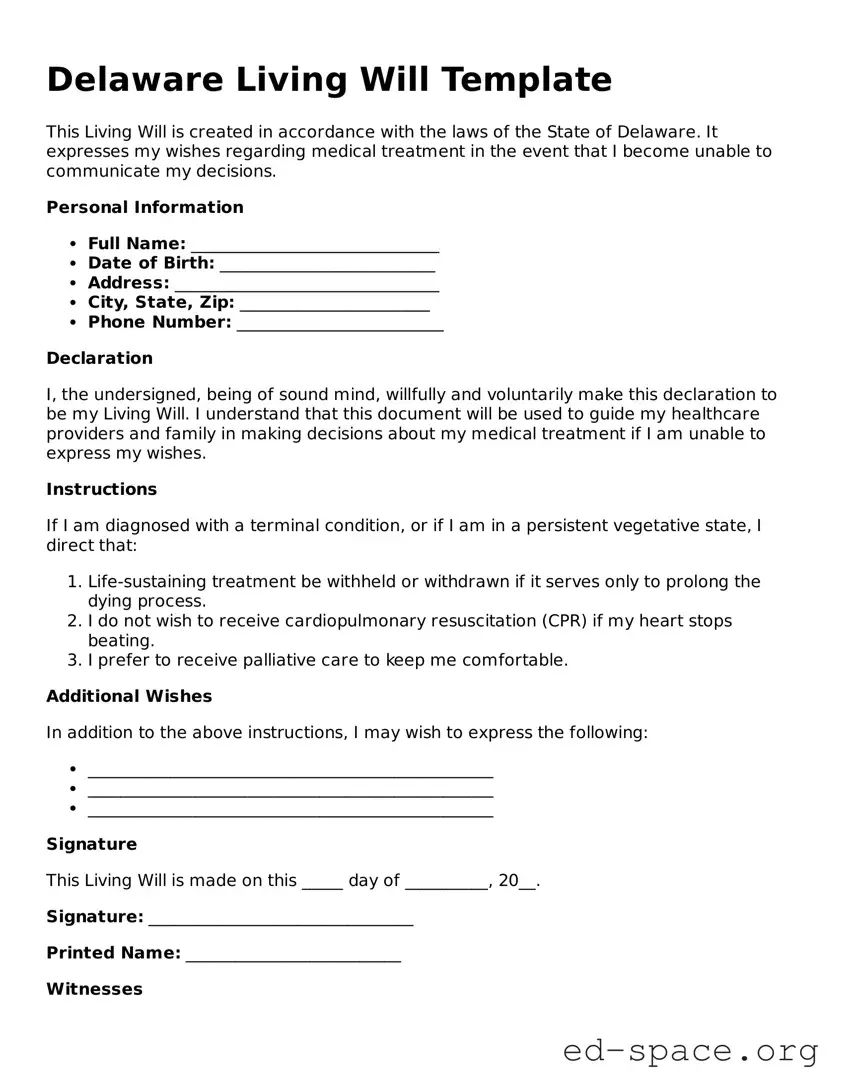
In the state of Delaware, the Living Will form serves as a crucial document that allows individuals to express their preferences regarding medical treatment in situations where they may be unable to communicate their wishes. This form is particularly important for those who wish to ensure that their healthcare aligns with their personal values and beliefs, especially in end-of-life scenarios. Key aspects of the Delaware Living Will include the ability to specify the types of medical interventions one would or would not want, such as resuscitation efforts, mechanical ventilation, and artificial nutrition. Additionally, the form provides a space for individuals to appoint a healthcare representative, someone who can make decisions on their behalf should they become incapacitated. By clearly outlining these preferences, the Living Will empowers individuals to maintain control over their medical care, even when they are unable to voice their choices. It is essential for residents to understand the implications of this document, as it not only facilitates communication among family members and healthcare providers but also alleviates the burden of decision-making during emotionally charged moments.
Delaware Living Will Template
This Living Will is created in accordance with the laws of the State of Delaware. It expresses my wishes regarding medical treatment in the event that I become unable to communicate my decisions.
Personal Information
Declaration
I, the undersigned, being of sound mind, willfully and voluntarily make this declaration to be my Living Will. I understand that this document will be used to guide my healthcare providers and family in making decisions about my medical treatment if I am unable to express my wishes.
Instructions
If I am diagnosed with a terminal condition, or if I am in a persistent vegetative state, I direct that:
Additional Wishes
In addition to the above instructions, I may wish to express the following:
Signature
This Living Will is made on this _____ day of __________, 20__.
Signature: ________________________________
Printed Name: __________________________
Witnesses
Two witnesses must sign this document, both of whom are not related to me by blood or marriage and are not entitled to any part of my estate.
By signing this document, I affirm that I am of sound mind and that this declaration reflects my wishes regarding medical treatment.
| Fact Name | Description |
|---|---|
| Definition | A Delaware Living Will is a legal document that allows individuals to express their wishes regarding medical treatment in the event they become unable to communicate those wishes themselves. |
| Governing Law | The Delaware Living Will is governed by Title 16, Chapter 2501 of the Delaware Code. |
| Eligibility | Any adult who is at least 18 years old can create a Living Will in Delaware. |
| Witness Requirement | The Living Will must be signed in the presence of two witnesses who are not related to the individual and do not stand to inherit anything from the individual. |
| Revocation | A Living Will can be revoked at any time by the individual, either verbally or in writing. |
| Durable Power of Attorney | Individuals may also designate a Durable Power of Attorney for healthcare decisions, which can complement the Living Will. |
| Storage and Accessibility | It is advisable to keep the Living Will in a safe but accessible location and to provide copies to healthcare providers and family members. |
Filling out the Delaware Living Will form is an important step in making your healthcare wishes known. Once you have completed the form, you’ll be ready to share it with your healthcare providers and loved ones, ensuring that your preferences are understood and respected.
What is a Delaware Living Will?
A Delaware Living Will is a legal document that allows individuals to outline their preferences for medical treatment in the event they become unable to communicate their wishes. It typically addresses scenarios such as terminal illness or permanent unconsciousness, specifying whether to receive life-sustaining treatments or to allow for a natural death.
Who should create a Living Will?
Any adult who wishes to ensure their healthcare preferences are honored should consider creating a Living Will. This includes individuals with chronic illnesses, those approaching advanced age, or anyone wanting to make their wishes clear regarding end-of-life care.
How do I create a Living Will in Delaware?
To create a Living Will in Delaware, you can download the form from the state’s official website or consult an attorney for assistance. The form must be completed, signed, and dated in the presence of two witnesses who are not related to you or beneficiaries of your estate. Alternatively, you can have it notarized.
Can I change or revoke my Living Will?
Yes, you can change or revoke your Living Will at any time as long as you are mentally competent. To revoke it, you can destroy the document or create a new one that explicitly states your intent to revoke the previous version. It's advisable to inform your healthcare providers and family members of any changes.
What happens if I do not have a Living Will?
If you do not have a Living Will, medical decisions may be made by your family members or legal representatives, which might not reflect your personal wishes. In some cases, this can lead to disagreements among family members about your care. Having a Living Will helps ensure your preferences are followed.
Is a Living Will the same as a Power of Attorney?
No, a Living Will and a Power of Attorney are different documents. A Living Will focuses specifically on your medical treatment preferences, while a Power of Attorney allows you to designate someone to make healthcare or financial decisions on your behalf if you become incapacitated. Both documents can work together to ensure your wishes are respected.
Where should I keep my Living Will?
Store your Living Will in a safe but accessible location. Inform your family members, healthcare providers, and anyone designated as your Power of Attorney about its location. It’s also a good idea to carry a copy with you, especially if you are undergoing medical treatment or traveling.
Not understanding the purpose of a Living Will. A Living Will is a document that outlines your wishes regarding medical treatment in case you become unable to communicate those wishes yourself. It's important to know this before filling out the form.
Failing to discuss your wishes with loved ones. Many people fill out the form without having a conversation with family members or close friends. This can lead to confusion and disagreements later on.
Leaving sections blank. It's crucial to complete all relevant sections of the form. Leaving parts blank can create ambiguity about your wishes, which may lead to unintended outcomes.
Using outdated forms. Laws can change, and using an old version of the Living Will form may result in invalid or unenforceable wishes. Always ensure you are using the most current version.
Not signing the document properly. A Living Will typically requires your signature and may need to be witnessed or notarized. Failing to follow these requirements can render the document ineffective.
Being vague about your wishes. Specificity is key. If your instructions are unclear or open to interpretation, medical professionals may struggle to honor your true desires.
Neglecting to review and update the document. Life circumstances can change, and so can your preferences regarding medical treatment. Regularly reviewing and updating your Living Will is essential to ensure it reflects your current wishes.
Assuming that a Living Will is the same as a Durable Power of Attorney for Health Care. While both documents are important, they serve different purposes. A Living Will focuses on your treatment preferences, while a Durable Power of Attorney designates someone to make decisions on your behalf.
A Delaware Living Will is an essential document for individuals who want to outline their medical preferences in case they become unable to communicate. However, several other forms and documents can complement a Living Will, ensuring comprehensive planning for healthcare decisions. Here’s a list of commonly used documents that work alongside a Living Will:
Utilizing these documents in conjunction with a Delaware Living Will can provide clarity and assurance regarding your healthcare decisions. Each document serves a unique purpose, ensuring that your wishes are respected and upheld in various medical situations.
A Living Will is an important document that outlines an individual's preferences regarding medical treatment in situations where they are unable to communicate their wishes. Several other documents serve similar purposes. Here’s a brief overview of four documents that are comparable to a Living Will:
When filling out the Delaware Living Will form, it's important to be thorough and careful. Here are some things you should and shouldn't do:
Understanding the Delaware Living Will form can be challenging. Here are some common misconceptions that may arise:
When filling out and using the Delaware Living Will form, it is important to keep the following key points in mind: