For families considering homeschooling in Delaware, understanding the process is crucial. One of the first steps is submitting a Homeschool Letter of Intent form to the state. This form serves as a formal notification to the Delaware Department of Education that you plan to educate your child at home. It includes essential details such as the names and ages of your children, the educational curriculum you intend to use, and your contact information. By completing this form, parents demonstrate their commitment to providing a structured educational experience outside of traditional school settings. Timely submission is important, as it ensures compliance with state regulations and helps families avoid potential legal issues down the line. Whether you're new to homeschooling or transitioning from a public or private school, understanding this form is a key step in your educational journey.
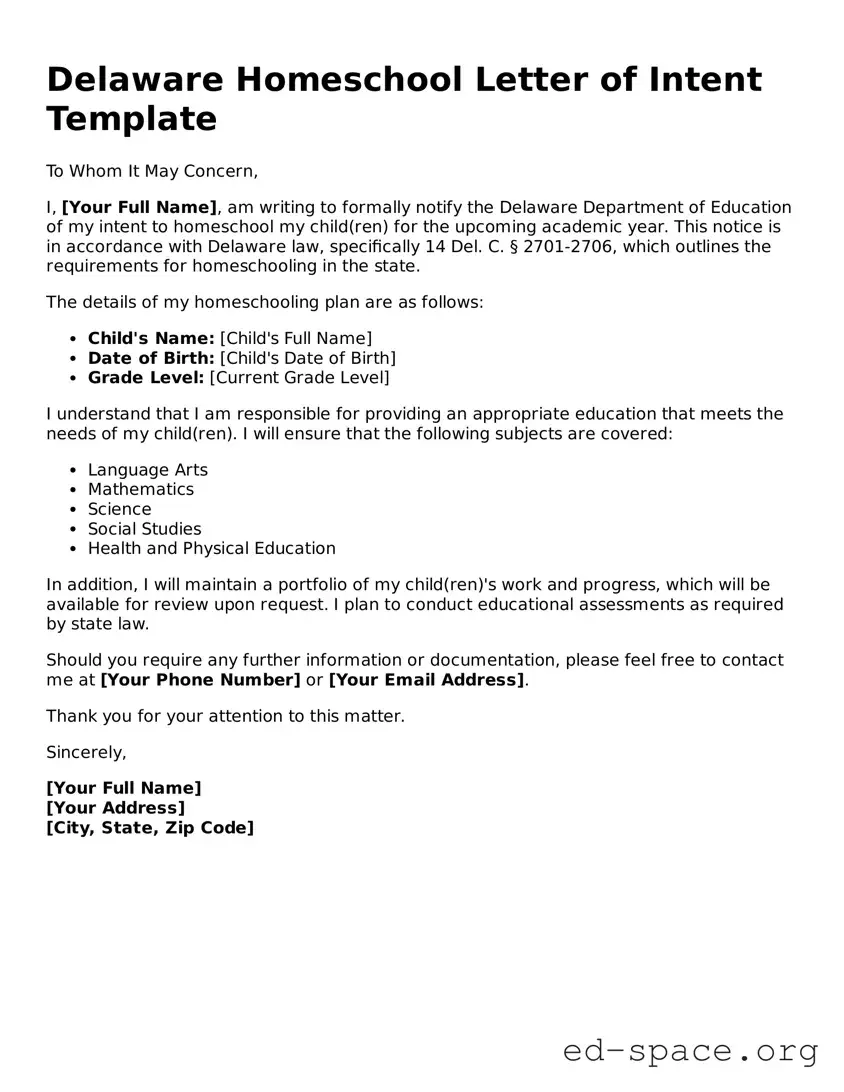
Delaware Homeschool Letter of Intent Template
To Whom It May Concern,
I, [Your Full Name], am writing to formally notify the Delaware Department of Education of my intent to homeschool my child(ren) for the upcoming academic year. This notice is in accordance with Delaware law, specifically 14 Del. C. § 2701-2706, which outlines the requirements for homeschooling in the state.
The details of my homeschooling plan are as follows:
I understand that I am responsible for providing an appropriate education that meets the needs of my child(ren). I will ensure that the following subjects are covered:
In addition, I will maintain a portfolio of my child(ren)'s work and progress, which will be available for review upon request. I plan to conduct educational assessments as required by state law.
Should you require any further information or documentation, please feel free to contact me at [Your Phone Number] or [Your Email Address].
Thank you for your attention to this matter.
Sincerely,
[Your Full Name]
[Your Address]
[City, State, Zip Code]
| Fact Name | Description |
|---|---|
| Purpose | The Delaware Homeschool Letter of Intent form is used to notify the state of a parent's intent to homeschool their child. |
| Governing Law | This form is governed by Delaware Code Title 14, Chapter 270. |
| Eligibility | Parents or guardians of children aged 5 to 18 can submit this form to homeschool their children. |
| Submission Deadline | The form must be submitted within 10 days of beginning homeschooling. |
| Required Information | Parents must provide their name, address, and the names and ages of the children being homeschooled. |
| Annual Updates | Parents are required to submit an updated Letter of Intent each year to continue homeschooling. |
| Record Keeping | While not required to submit, parents should keep copies of the Letter of Intent for their records. |
| Notification of Changes | If there are any changes in the homeschooling status, parents must notify the state promptly. |
| Contact Information | Parents can contact the Delaware Department of Education for assistance regarding the form. |
| Additional Resources | Delaware offers resources and support for homeschooling families, including curriculum options and local groups. |
Once you have the Delaware Homeschool Letter of Intent form ready, it is essential to complete it accurately to ensure compliance with state requirements. After submitting the form, you will receive confirmation, allowing you to proceed with your homeschooling plans.
What is the Delaware Homeschool Letter of Intent form?
The Delaware Homeschool Letter of Intent form is a document that parents or guardians must submit to the local school district when they decide to homeschool their children. This form officially notifies the school district of the intent to provide home-based education for the child. It is an essential first step in the homeschooling process in Delaware.
Who needs to file the Letter of Intent?
Any parent or guardian who wishes to homeschool their child in Delaware must file the Letter of Intent. This requirement applies to children of compulsory school age, typically between the ages of 5 and 18. If you plan to homeschool your child, submitting this form is necessary to comply with state regulations.
When should I submit the Letter of Intent?
The Letter of Intent should be submitted at the beginning of the school year or as soon as you decide to homeschool your child. If you are withdrawing your child from public or private school, it is advisable to file the form before or at the time of withdrawal to ensure a smooth transition to homeschooling.
What information is required on the Letter of Intent?
The Letter of Intent typically requires basic information, including the name and address of the child, the name of the parent or guardian, and the educational plan you intend to follow. Some districts may request additional details, so it is a good idea to check with your local school district for any specific requirements.
Is there a deadline for submitting the Letter of Intent?
While there is no strict deadline for submitting the Letter of Intent, it is recommended to do so as early as possible. If you are starting homeschooling at the beginning of the school year, aim to submit the form before the first day of school. This helps ensure that you meet all legal requirements and can begin your homeschooling journey without delay.
What happens after I submit the Letter of Intent?
After you submit the Letter of Intent, the school district will review your submission. You may receive confirmation from the district acknowledging receipt of your form. It is important to keep a copy of the Letter of Intent for your records. Additionally, you should be prepared to develop an educational plan for your child, as this may be requested by the district later.
Can I change my mind after submitting the Letter of Intent?
Yes, you can change your mind after submitting the Letter of Intent. If you decide to enroll your child back into a public or private school, you should notify the school district. It is advisable to check with the school regarding their enrollment process and any requirements that may apply.
Where can I find the Letter of Intent form?
The Letter of Intent form can typically be obtained from your local school district’s website or office. Many districts provide downloadable forms online. If you cannot find it, consider contacting the district directly for assistance. They can provide you with the necessary form and any additional information you may need.
Incomplete Information: One common mistake is failing to provide all required details. Ensure that every section of the form is filled out completely. Missing information can delay the processing of your intent.
Incorrect Names: Double-check the spelling of names, including the child's name and the parent or guardian's name. Errors can lead to confusion and may require resubmission.
Missing Signatures: It's essential to sign the form. An unsigned letter of intent is not valid. Make sure that all necessary signatures are included before submission.
Failure to Submit on Time: Be aware of deadlines. Submitting the letter late can result in complications with your homeschooling status. Mark your calendar to avoid this mistake.
Not Keeping Copies: Always keep a copy of the submitted form for your records. This practice can help if there are any questions or issues later on.
Ignoring State Requirements: Each state has specific guidelines for homeschooling. Familiarize yourself with Delaware's requirements to ensure compliance. Ignoring these can lead to legal issues.
When families decide to homeschool in Delaware, submitting the Homeschool Letter of Intent is just the first step. Several other documents can help ensure a smooth homeschooling experience. Here’s a brief overview of these essential forms and documents that often accompany the letter of intent.
By preparing these documents alongside the Homeschool Letter of Intent, you can create a solid foundation for your homeschooling journey. Staying organized and informed helps ensure that your child's educational experience is both fulfilling and compliant with state regulations.
When filling out the Delaware Homeschool Letter of Intent form, it’s important to follow certain guidelines to ensure that the process goes smoothly. Here are some dos and don’ts to keep in mind:
By following these guidelines, you can help ensure that your homeschooling journey starts on the right foot.
Many people have misunderstandings about the Delaware Homeschool Letter of Intent form. Here are ten common misconceptions, along with clarifications to help you understand the requirements better.
Understanding these misconceptions will help you navigate the homeschooling process in Delaware with confidence.
Filling out the Delaware Homeschool Letter of Intent form is a crucial step for parents looking to homeschool their children. Here are some key takeaways to keep in mind:
By following these key takeaways, you can navigate the process of filling out and using the Delaware Homeschool Letter of Intent form with confidence and ease.