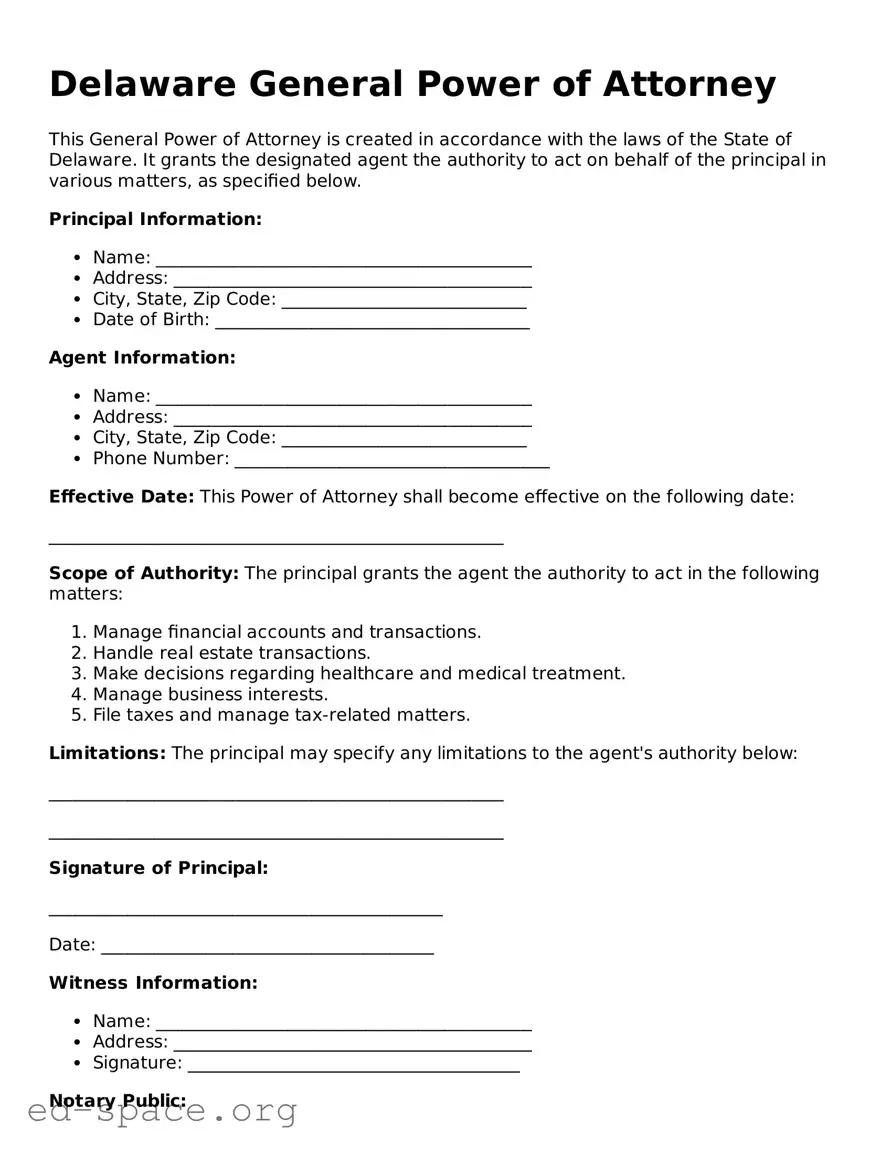
The Delaware General Power of Attorney form is a vital legal document that empowers an individual, known as the principal, to designate another person, referred to as the agent or attorney-in-fact, to make decisions on their behalf. This form covers a wide range of financial and legal matters, allowing the agent to manage the principal’s assets, pay bills, and handle transactions. One of the key features of this document is its flexibility; the principal can specify the powers granted to the agent, whether broad or limited. It’s important to note that the powers granted can include everything from managing bank accounts to selling property, depending on the principal's needs. Additionally, the Delaware General Power of Attorney can remain effective even if the principal becomes incapacitated, providing peace of mind that their affairs will be handled according to their wishes. Understanding this form is essential for anyone looking to ensure their financial matters are managed effectively and responsibly, especially in times of unforeseen circumstances.
Delaware General Power of Attorney
This General Power of Attorney is created in accordance with the laws of the State of Delaware. It grants the designated agent the authority to act on behalf of the principal in various matters, as specified below.
Principal Information:
Agent Information:
Effective Date: This Power of Attorney shall become effective on the following date:
____________________________________________________
Scope of Authority: The principal grants the agent the authority to act in the following matters:
Limitations: The principal may specify any limitations to the agent's authority below:
____________________________________________________
____________________________________________________
Signature of Principal:
_____________________________________________
Date: ______________________________________
Witness Information:
Notary Public:
State of Delaware, County of ______________________
Subscribed and sworn to before me this _____ day of __________, 20__.
_____________________________________________
Notary Public Signature
My commission expires: ________________________
| Fact Name | Description |
|---|---|
| Definition | A Delaware General Power of Attorney form allows an individual to designate another person to make financial and legal decisions on their behalf. |
| Governing Law | The form is governed by the Delaware Uniform Power of Attorney Act, found in Title 18, Chapter 1701 of the Delaware Code. |
| Principal and Agent | The person granting authority is called the "Principal," while the person receiving authority is known as the "Agent" or "Attorney-in-Fact." |
| Durability | This power of attorney can be made durable, meaning it remains effective even if the Principal becomes incapacitated. |
| Revocation | The Principal can revoke the power of attorney at any time, as long as they are mentally competent. |
| Notarization | To be valid, the form typically requires notarization, ensuring authenticity and compliance with state laws. |
| Limitations | While the Agent has broad powers, certain limitations may apply, especially concerning health care decisions. |
| Agent's Responsibilities | The Agent must act in the best interest of the Principal and adhere to any specific instructions provided in the document. |
| Usage | This form is commonly used for financial transactions, property management, and handling legal matters when the Principal is unavailable. |
Filling out the Delaware General Power of Attorney form is a straightforward process. Once completed, this form allows you to designate someone to handle your financial and legal matters on your behalf. It's important to ensure all sections are filled out accurately to avoid any issues later.
What is a Delaware General Power of Attorney?
A Delaware General Power of Attorney is a legal document that allows one person (the "principal") to grant another person (the "agent" or "attorney-in-fact") the authority to act on their behalf. This authority can include handling financial matters, making legal decisions, and managing property. The document is broad in scope, giving the agent extensive powers unless specifically limited by the principal.
How do I create a General Power of Attorney in Delaware?
To create a General Power of Attorney in Delaware, you need to fill out a specific form that meets state requirements. The principal must sign the document in the presence of a notary public. It's advisable to ensure that the form clearly outlines the powers granted to the agent and any limitations. Consulting with a legal professional can help ensure that the document is valid and meets your needs.
What powers can I grant my agent with a General Power of Attorney?
You can grant your agent a wide range of powers, including managing bank accounts, buying or selling real estate, handling investments, and making legal decisions. However, you can also specify certain limitations or exclude particular powers if desired. Be clear about what you want your agent to do to avoid any confusion later.
Can I revoke a General Power of Attorney?
Yes, you can revoke a General Power of Attorney at any time, as long as you are mentally competent. To revoke it, you must create a written document stating your intent to revoke the previous power of attorney. You should also notify your agent and any institutions or individuals who may have relied on the original document to ensure they are aware of the change.
What happens if the principal becomes incapacitated?
If the principal becomes incapacitated, a General Power of Attorney typically becomes ineffective unless it includes a provision for durability. A durable power of attorney remains in effect even if the principal loses mental capacity. If it is not durable, the authority granted to the agent ends when the principal can no longer make decisions.
Do I need a lawyer to create a General Power of Attorney?
While it is not legally required to have a lawyer to create a General Power of Attorney in Delaware, seeking legal advice is highly recommended. A lawyer can help ensure that the document is properly drafted, complies with state laws, and meets your specific needs. This can prevent potential issues in the future.
Is a General Power of Attorney valid in other states?
A General Power of Attorney created in Delaware may be recognized in other states, but this can depend on the laws of those states. It’s important to check the specific requirements of the state where the power will be used. If you plan to use the document outside of Delaware, consider consulting with a legal professional in that state to ensure validity.
Not Specifying the Powers Granted: Many individuals fail to clearly outline the specific powers they wish to grant their agent. This can lead to confusion and potential misuse of authority.
Inadequate Identification of the Agent: It is crucial to provide complete and accurate information about the agent. Omitting details such as the agent's full name or address can create issues in the future.
Not Including Successor Agents: Some people overlook the importance of naming a successor agent. If the primary agent is unable to act, having a backup ensures that your wishes are still honored.
Failing to Date the Document: A common mistake is neglecting to date the Power of Attorney. Without a date, it can be difficult to determine the validity of the document or when it became effective.
Not Signing in the Presence of a Notary: In Delaware, a Power of Attorney must be signed in front of a notary public. Failing to do so can render the document invalid.
Ignoring State-Specific Requirements: Each state has unique requirements for a Power of Attorney. Not adhering to Delaware's specific regulations can lead to complications.
Overlooking Revocation Procedures: Individuals often forget to include information on how to revoke the Power of Attorney. It is important to have a clear plan in place should you decide to change or cancel the authority granted.
When establishing a General Power of Attorney in Delaware, several other forms and documents may be necessary to ensure comprehensive legal authority and clarity. Each of these documents serves a specific purpose and can facilitate various aspects of financial and medical decision-making.
Understanding these documents can help individuals make informed decisions about their legal and healthcare needs. It is essential to consider each form's implications and how they work together to provide comprehensive support for both the principal and their appointed agents.
When filling out the Delaware General Power of Attorney form, it's important to be mindful of certain practices. Here are some dos and don'ts to consider:
The Delaware General Power of Attorney form is a valuable tool for managing financial and legal matters. However, several misconceptions surround its use. Here are six common misunderstandings:
Many believe that a General Power of Attorney is limited to financial transactions. In reality, it can also grant authority over legal decisions, property management, and even healthcare matters, depending on how it is drafted.
Some assume that the power of attorney stays in effect even if the principal is incapacitated. However, a standard General Power of Attorney typically becomes invalid upon the principal's incapacity, unless it is specifically made durable.
While it is true that adults can act as agents, not everyone is suitable. The chosen agent should be trustworthy and capable of handling the responsibilities outlined in the document.
Many people think that a General Power of Attorney is the same for everyone. In fact, the document can be customized to fit specific needs and situations, allowing the principal to specify the powers granted.
While notarization is recommended for added validity, it is not always required in Delaware. The document must be signed by the principal, and witnessing may be needed depending on the circumstances.
Some individuals think they can simply tear up the document to revoke it. In truth, a formal revocation process should be followed to ensure that the agent and third parties are aware that the power has been rescinded.
Understanding these misconceptions can help individuals make informed decisions when creating or using a Delaware General Power of Attorney form.
When filling out and using the Delaware General Power of Attorney form, several important considerations should be kept in mind:
These key points will help ensure that the Delaware General Power of Attorney form is filled out and utilized effectively.