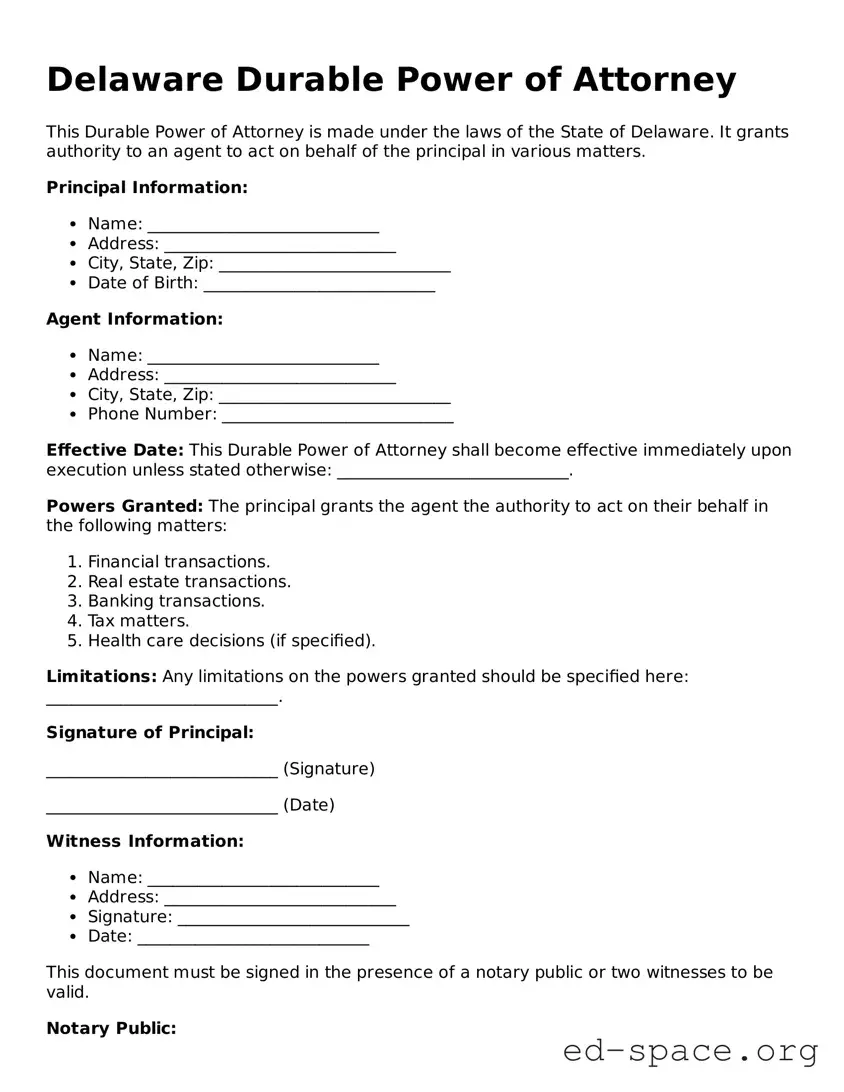
When planning for the future, one important document to consider is the Delaware Durable Power of Attorney form. This legal tool allows individuals to designate someone they trust to make decisions on their behalf, particularly in situations where they may become incapacitated or unable to communicate their wishes. The form covers a wide range of powers, from managing financial affairs to making healthcare decisions, ensuring that the appointed agent can act in the best interest of the individual. It is essential to understand that this document remains effective even if the person who created it becomes incapacitated, hence the term "durable." Additionally, the form must be signed and dated in the presence of a notary public to ensure its validity. By taking the time to complete this form, individuals can gain peace of mind, knowing that their affairs will be handled according to their preferences, even when they are no longer able to express them directly.
Delaware Durable Power of Attorney
This Durable Power of Attorney is made under the laws of the State of Delaware. It grants authority to an agent to act on behalf of the principal in various matters.
Principal Information:
Agent Information:
Effective Date: This Durable Power of Attorney shall become effective immediately upon execution unless stated otherwise: ____________________________.
Powers Granted: The principal grants the agent the authority to act on their behalf in the following matters:
Limitations: Any limitations on the powers granted should be specified here: ____________________________.
Signature of Principal:
____________________________ (Signature)
____________________________ (Date)
Witness Information:
This document must be signed in the presence of a notary public or two witnesses to be valid.
Notary Public:
____________________________ (Signature)
____________________________ (Date)
| Fact Name | Description |
|---|---|
| Definition | A Delaware Durable Power of Attorney is a legal document that allows one person to appoint another to make decisions on their behalf, even if they become incapacitated. |
| Governing Law | This form is governed by the Delaware Uniform Power of Attorney Act, specifically Title 12, Chapter 49 of the Delaware Code. |
| Durability | The term "durable" indicates that the authority granted remains effective even if the principal loses mental capacity. |
| Principal and Agent | The person who creates the power of attorney is known as the principal, while the person designated to act is referred to as the agent or attorney-in-fact. |
| Types of Powers | The document can grant broad or limited powers, allowing the agent to manage finances, make healthcare decisions, or handle real estate matters. |
| Execution Requirements | The form must be signed by the principal and acknowledged before a notary public or witnessed by two individuals who are not named in the document. |
| Revocation | The principal can revoke the Durable Power of Attorney at any time, as long as they are mentally competent to do so. |
| Agent's Duties | The agent has a fiduciary duty to act in the best interest of the principal and must manage the principal's affairs with care and loyalty. |
| Healthcare Decisions | If the document includes healthcare powers, it can authorize the agent to make medical decisions on behalf of the principal when they are unable to do so. |
| Legal Advice | It is advisable for individuals to seek legal counsel when creating a Durable Power of Attorney to ensure it meets their specific needs and complies with state laws. |
Completing the Delaware Durable Power of Attorney form is a straightforward process. After filling out the form, you will need to ensure that it is signed and witnessed according to Delaware law. This will help ensure that your document is valid and can be used as intended.
What is a Delaware Durable Power of Attorney?
A Delaware Durable Power of Attorney is a legal document that allows an individual, known as the principal, to designate another person, called an agent, to make decisions on their behalf. This power remains effective even if the principal becomes incapacitated, ensuring that their financial and legal affairs can be managed without interruption.
Why should I consider creating a Durable Power of Attorney?
Creating a Durable Power of Attorney is essential for anyone who wants to ensure their affairs are handled according to their wishes in the event of incapacity. It provides peace of mind, knowing that a trusted individual can manage your finances, pay bills, and make other critical decisions when you are unable to do so.
Who can be appointed as an agent in a Durable Power of Attorney?
In Delaware, you can appoint anyone you trust as your agent, as long as they are at least 18 years old and mentally competent. This could be a family member, friend, or even a professional such as an attorney or financial advisor. Choosing someone who understands your values and wishes is crucial.
Does a Durable Power of Attorney need to be notarized?
Yes, in Delaware, a Durable Power of Attorney must be signed in the presence of a notary public. This step adds an extra layer of authenticity to the document, ensuring that it is legally binding and recognized by financial institutions and other entities.
Can I revoke my Durable Power of Attorney once it is created?
Absolutely. You have the right to revoke your Durable Power of Attorney at any time, as long as you are mentally competent. To do this, you should create a written revocation document and notify your agent and any institutions that may have a copy of the original document.
What happens if I do not have a Durable Power of Attorney?
If you become incapacitated without a Durable Power of Attorney in place, your loved ones may need to go through a court process to obtain guardianship or conservatorship. This can be time-consuming, costly, and may not reflect your personal wishes, making it essential to have a Durable Power of Attorney prepared in advance.
Are there any limitations to the powers granted in a Durable Power of Attorney?
Yes, you can specify limitations in your Durable Power of Attorney. For example, you might grant your agent the authority to manage your finances but not to make medical decisions. It is important to be clear about what powers you are granting to avoid any confusion later on.
Can I use a Durable Power of Attorney created in another state in Delaware?
Generally, a Durable Power of Attorney created in another state may be recognized in Delaware, provided it complies with the laws of the state where it was created. However, it is advisable to consult with a legal professional to ensure that it meets Delaware's requirements and to avoid any potential issues.
How do I ensure my Durable Power of Attorney is valid?
To ensure your Durable Power of Attorney is valid, it must be signed by you, notarized, and comply with Delaware law. It is also a good idea to discuss your intentions with your agent and provide them with a copy of the document. Keeping the original in a safe place and informing relevant parties about its existence can also help prevent complications.
Failing to specify the powers granted: Individuals often overlook the importance of clearly defining the powers they wish to grant. Without specific language, the agent may not have the authority to act in certain situations.
Not naming an alternate agent: Many people only name one agent, which can lead to complications if that person is unavailable or unwilling to serve. Including an alternate ensures that someone can step in when needed.
Inadequate witness or notarization: Some individuals neglect the requirement for witnesses or notary signatures. Without proper execution, the document may be deemed invalid, rendering the powers ineffective.
Using outdated forms: People sometimes use old versions of the Durable Power of Attorney form. Laws change, and using an outdated form can lead to legal issues.
Not discussing the document with the agent: Failing to communicate with the appointed agent can lead to misunderstandings. It is crucial that the agent understands their responsibilities and the principal's wishes.
Overlooking specific limitations: Some individuals forget to include limitations on the powers granted. Without these limitations, agents may have broader authority than intended.
Neglecting to update the document: Life changes, such as marriage, divorce, or the death of an agent, require updates to the Durable Power of Attorney. Failing to revise the document can lead to complications.
Not considering state-specific laws: Each state has its own rules regarding Durable Power of Attorney forms. Ignoring Delaware's specific requirements can result in an invalid document.
A Durable Power of Attorney (DPOA) is a vital document that allows someone to make decisions on your behalf when you are unable to do so. However, it often works best in conjunction with other legal forms and documents. Here’s a list of related documents that can help ensure your wishes are respected and your affairs are managed smoothly.
Having these documents in place can provide peace of mind. They work together to ensure that your preferences regarding health care, finances, and estate distribution are honored, even when you cannot communicate them yourself.
The Durable Power of Attorney (DPOA) is an important legal document that grants someone the authority to make decisions on your behalf. Several other documents share similarities with the DPOA. Here’s a look at seven of them:
When it comes to filling out a Delaware Durable Power of Attorney form, there are several important considerations to keep in mind. This document can empower someone to make decisions on your behalf, so getting it right is crucial. Here’s a list of things you should and shouldn’t do during the process:
Understanding the Delaware Durable Power of Attorney form is essential for effective estate planning. However, several misconceptions can lead to confusion. Here are six common misunderstandings:
Many believe that a Durable Power of Attorney is limited to financial matters. In reality, it can also grant authority over healthcare decisions, depending on how it is drafted.
Some assume that the document only takes effect upon incapacitation. However, a Durable Power of Attorney can be effective immediately, or it can be set to activate under specific conditions.
People often think that once a Durable Power of Attorney is signed, it remains valid forever. In fact, it should be reviewed regularly and updated as life circumstances change.
While you can choose almost anyone as your agent, it is crucial to select someone trustworthy and capable. Not all individuals are suitable for this responsibility.
Some individuals believe that notarization is mandatory. In Delaware, while notarization is recommended, it is not strictly required if the form is properly signed.
Many think that a Durable Power of Attorney is permanent. However, you can revoke it at any time, as long as you are mentally competent to do so.
Clarifying these misconceptions can help ensure that your Durable Power of Attorney serves its intended purpose effectively.
When it comes to the Delaware Durable Power of Attorney form, understanding its key aspects is crucial for effective use. Here are five important takeaways:
Taking these steps can help ensure that your Durable Power of Attorney serves your needs effectively.