Homepage Free Do Not Resuscitate Order Form for Delaware
Content Overview

In Delaware, the Do Not Resuscitate (DNR) Order form serves as a crucial legal document that allows individuals to express their wishes regarding medical treatment in the event of a life-threatening situation. This form is particularly important for patients who may not want to undergo cardiopulmonary resuscitation (CPR) or other life-saving measures if their heart stops or they stop breathing. The DNR Order is designed to ensure that healthcare providers respect these wishes, thereby preventing unwanted medical interventions. It is typically completed by a patient in consultation with their healthcare provider, and it requires the signatures of both the patient and a physician to be valid. The form must be easily accessible, as it should be presented to medical personnel in emergencies. Additionally, Delaware law provides specific guidelines on how this order can be revoked or modified, ensuring that individuals have control over their healthcare decisions. Understanding the DNR Order form and its implications is essential for anyone considering end-of-life care options.

Document Preview

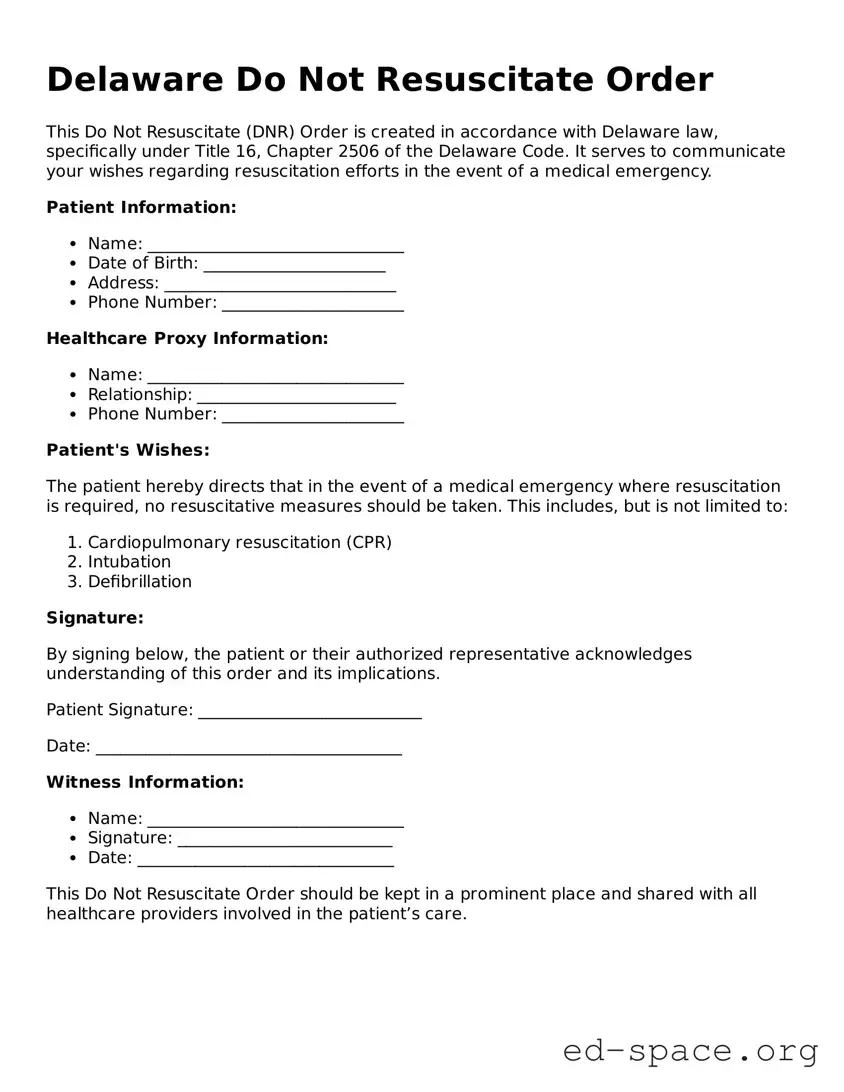
Delaware Do Not Resuscitate Order

This Do Not Resuscitate (DNR) Order is created in accordance with Delaware law, specifically under Title 16, Chapter 2506 of the Delaware Code. It serves to communicate your wishes regarding resuscitation efforts in the event of a medical emergency.

Patient Information:

  • Name: _______________________________
  • Date of Birth: ______________________
  • Address: ____________________________
  • Phone Number: ______________________

Healthcare Proxy Information:

  • Name: _______________________________
  • Relationship: ________________________
  • Phone Number: ______________________

Patient's Wishes:

The patient hereby directs that in the event of a medical emergency where resuscitation is required, no resuscitative measures should be taken. This includes, but is not limited to:

  1. Cardiopulmonary resuscitation (CPR)
  2. Intubation
  3. Defibrillation

Signature:

By signing below, the patient or their authorized representative acknowledges understanding of this order and its implications.

Patient Signature: ___________________________

Date: _____________________________________

Witness Information:

  • Name: _______________________________
  • Signature: __________________________
  • Date: _______________________________

This Do Not Resuscitate Order should be kept in a prominent place and shared with all healthcare providers involved in the patient’s care.

PDF Form Details

Fact Name Details
Governing Law The Delaware Do Not Resuscitate Order form is governed by Delaware Code Title 16, Chapter 2503.
Purpose This form allows individuals to express their wishes regarding resuscitation efforts in the event of a medical emergency.
Eligibility Any adult resident of Delaware can complete a Do Not Resuscitate Order, provided they are of sound mind.
Signature Requirements The form must be signed by the individual and witnessed by two adults who are not related to the individual.

Delaware Do Not Resuscitate Order: Usage Guidelines

Completing the Delaware Do Not Resuscitate Order form is an important step in ensuring that your medical wishes are respected in emergency situations. This process involves careful consideration and clear communication of your preferences. Below are the steps to fill out the form accurately.

  1. Obtain the Delaware Do Not Resuscitate Order form. This can typically be found online or through your healthcare provider.
  2. Read the instructions carefully to understand the requirements of the form.
  3. Provide your full name, date of birth, and any other personal information requested on the form.
  4. Indicate your wishes regarding resuscitation by checking the appropriate box. Make sure to review the options thoroughly.
  5. Include the name of your healthcare provider. This may be a doctor or another medical professional who is familiar with your health status.
  6. Sign and date the form. Your signature is essential for the document to be valid.
  7. Have the form witnessed by two individuals who are not related to you and who will not benefit from your estate. Their signatures are necessary to confirm that you signed the form voluntarily.
  8. Make copies of the completed form. Keep one for your records and provide copies to your healthcare provider and any family members involved in your care.

Once you have filled out the form, ensure that it is stored in a safe place where it can be easily accessed by your healthcare team. Communicate your wishes with family members to ensure everyone is informed and understands your preferences.

Your Questions, Answered

What is a Delaware Do Not Resuscitate Order (DNR) form?

A Delaware Do Not Resuscitate Order (DNR) form is a legal document that allows a person to refuse cardiopulmonary resuscitation (CPR) and other life-sustaining treatments in the event of a medical emergency. This order is typically used by individuals with serious health conditions who wish to avoid aggressive medical interventions that may not align with their personal wishes regarding end-of-life care.

Who can complete a DNR form in Delaware?

In Delaware, any adult who is capable of making their own healthcare decisions can complete a DNR form. This includes individuals who are facing terminal illnesses or have serious medical conditions. If the person is unable to complete the form due to incapacity, a legally authorized representative, such as a healthcare proxy or family member, may be able to sign on their behalf.

How do I obtain a DNR form in Delaware?

You can obtain a DNR form from various sources, including healthcare providers, hospitals, and the Delaware Division of Public Health. Many healthcare facilities have the forms readily available. You can also download the form from the Delaware Division of Public Health's website. Ensure that you have the most current version of the form.

What steps do I need to take to ensure my DNR order is valid?

To ensure your DNR order is valid, you must complete the form accurately and sign it. It should be signed by you and a physician. Once completed, provide copies to your healthcare providers, family members, and anyone else who may be involved in your care. Keep the original document in an easily accessible location, such as a medical file or with your advance healthcare directive.

Can I change or revoke my DNR order?

Yes, you can change or revoke your DNR order at any time. If you wish to revoke it, simply destroy the original document and inform your healthcare providers and family members of your decision. If you want to make changes, complete a new DNR form and follow the same steps to distribute it. Always ensure that your healthcare team is aware of your current wishes.

What should I do if I am traveling outside of Delaware with my DNR order?

If you are traveling outside of Delaware, it is advisable to carry a copy of your DNR order with you. Different states have varying laws regarding DNR orders, so check the regulations of the state you are visiting. Some states may honor Delaware’s DNR form, while others may require you to complete their specific form. Always communicate your wishes clearly to any healthcare providers you may encounter while traveling.

Common mistakes

  1. Not using the most current version of the Delaware Do Not Resuscitate Order form. Always check for updates to ensure compliance with state regulations.

  2. Failing to properly complete all required fields. Omitting information can lead to confusion or invalidation of the order.

  3. Not signing the form. The signature of the patient or their authorized representative is essential for the order to be valid.

  4. Neglecting to have the form witnessed. Delaware law requires that the form be signed in the presence of two witnesses.

  5. Using unclear or ambiguous language. The instructions and choices must be clearly stated to avoid misinterpretation.

  6. Not providing copies to relevant parties. It is important to distribute copies of the completed form to healthcare providers and family members.

  7. Failing to review the form periodically. Changes in health status or personal wishes may necessitate updates to the order.

Documents used along the form

In addition to the Delaware Do Not Resuscitate (DNR) Order form, several other documents may be relevant for individuals planning their healthcare preferences. These documents help ensure that a person’s wishes regarding medical treatment and end-of-life care are understood and respected. Below is a list of commonly used forms and documents that often accompany a DNR order.

  • Advance Healthcare Directive: This document allows individuals to outline their preferences for medical treatment in case they become unable to communicate their wishes. It can include instructions about life-sustaining treatments and designate a healthcare proxy.
  • Living Will: A living will is a specific type of advance directive that details the types of medical treatments a person wishes to receive or avoid at the end of life, particularly in terminal situations.
  • Healthcare Power of Attorney: This legal document designates a person to make healthcare decisions on behalf of someone else if they are unable to do so. It grants authority to the appointed individual to act in the best interest of the patient.
  • Physician Orders for Life-Sustaining Treatment (POLST): POLST is a medical order that outlines a patient’s preferences for treatment in emergency situations. It is often used for individuals with serious illnesses or advanced age.
  • Do Not Intubate (DNI) Order: This order specifies that a patient should not be placed on a ventilator or have their airway artificially managed. It is sometimes used alongside a DNR order to clarify treatment preferences.
  • Organ Donation Form: This document expresses an individual’s wishes regarding organ and tissue donation after death. It can be included in advance directives or completed separately.
  • Emergency Medical Services (EMS) Form: Some states provide forms that inform EMS personnel of a patient’s DNR status or other treatment preferences during emergencies. This ensures that emergency responders are aware of the patient’s wishes.
  • Patient Identification Card: A small card that indicates a person’s DNR status can be carried by the individual. It serves as a quick reference for medical personnel in emergencies.
  • Family Caregiver Agreement: This document outlines the roles and responsibilities of family members or caregivers in providing care. It can help clarify expectations and support for the patient’s wishes.

Understanding these documents and their purposes can empower individuals to make informed decisions about their healthcare. It is crucial to discuss these preferences with family members and healthcare providers to ensure that everyone is aware of the person’s wishes, especially in critical situations.

Similar forms

A Do Not Resuscitate (DNR) Order is an important document that outlines a person's wishes regarding medical treatment in the event of cardiac arrest. There are several other documents that serve similar purposes, helping individuals express their healthcare preferences. Here are seven documents that are similar to a DNR Order:

  • Living Will: This document allows individuals to specify their preferences for medical treatment in situations where they are unable to communicate their wishes. It often addresses end-of-life care and interventions.
  • Healthcare Power of Attorney: This legal document designates someone to make medical decisions on behalf of an individual if they become incapacitated. It empowers a trusted person to ensure that the individual's wishes are respected.
  • Advance Directive: An advance directive combines elements of both a living will and a healthcare power of attorney. It provides guidance on medical treatment preferences and designates a decision-maker.
  • Physician Orders for Life-Sustaining Treatment (POLST): This form translates a patient’s wishes regarding life-sustaining treatments into actionable medical orders. It is often used for patients with serious illnesses.
  • Do Not Intubate (DNI) Order: Similar to a DNR, a DNI specifically instructs healthcare providers not to place a breathing tube in the event of respiratory failure, while still allowing other forms of treatment.
  • Comfort Care Order: This document focuses on providing comfort and alleviating pain rather than prolonging life. It outlines preferences for palliative care and symptom management.
  • Organ Donation Consent: This document expresses an individual’s wishes regarding organ donation after death. It ensures that their preferences are known and respected by healthcare providers and family members.

Each of these documents plays a vital role in ensuring that an individual's healthcare preferences are honored. Understanding these options can provide peace of mind for both patients and their loved ones.

Dos and Don'ts

When filling out the Delaware Do Not Resuscitate (DNR) Order form, it is essential to approach the process with care and consideration. Here are some important guidelines to follow, as well as some common pitfalls to avoid.

  • Do ensure you understand the implications of a DNR order. This document indicates your wishes regarding resuscitation efforts in the event of cardiac arrest or respiratory failure.
  • Do consult with your healthcare provider. Discussing your wishes with a medical professional can help clarify your decisions and ensure that your choices are well-informed.
  • Do have the form signed by a physician. A valid DNR order requires a physician's signature to be legally recognized.
  • Do keep a copy of the completed form in an accessible place. Make sure that family members and caregivers are aware of its location.
  • Don't rush the decision-making process. Take your time to consider your values and preferences regarding end-of-life care.
  • Don't forget to review and update the form as needed. Life circumstances and medical conditions can change, so it is important to ensure that your DNR order reflects your current wishes.
  • Don't assume that verbal instructions are sufficient. A written DNR order is necessary to communicate your wishes clearly to healthcare providers.

Misconceptions

Misconceptions surrounding the Delaware Do Not Resuscitate (DNR) Order form can lead to confusion and unintended consequences. The following list addresses six common misunderstandings:

  1. A DNR means that no medical care will be provided. Many believe that signing a DNR order indicates a refusal of all medical treatment. In reality, a DNR specifically pertains to resuscitation efforts in the event of cardiac arrest or respiratory failure, while other medical care continues as necessary.
  2. A DNR is only for terminally ill patients. This misconception suggests that only individuals with terminal illnesses can have a DNR. In fact, anyone can choose to have a DNR, regardless of their health status, based on their personal preferences regarding end-of-life care.
  3. A DNR is permanent and cannot be changed. Some individuals think that once a DNR is signed, it cannot be altered. However, a DNR order can be revoked or modified at any time by the individual or their legal representative, provided they are of sound mind.
  4. Emergency responders will ignore a DNR order. There is a belief that emergency medical personnel will disregard a DNR. In Delaware, emergency responders are trained to respect valid DNR orders, ensuring that the patient's wishes are honored in emergency situations.
  5. Having a DNR means giving up on life. This misconception implies that choosing a DNR signifies a desire to end life prematurely. In truth, a DNR reflects a person's values and preferences regarding the quality of life and the types of interventions they wish to receive.
  6. A DNR is only applicable in hospitals. Some people think that DNR orders are only recognized in hospital settings. However, a DNR can be applicable in various settings, including at home or in long-term care facilities, as long as it is properly documented and communicated.

Understanding these misconceptions can help individuals make informed decisions about their healthcare preferences and ensure that their wishes are respected.

Key takeaways

When considering the Delaware Do Not Resuscitate (DNR) Order form, it is essential to understand its implications and proper usage. Here are key takeaways to keep in mind:

  • The DNR Order is a legal document that instructs medical personnel not to perform cardiopulmonary resuscitation (CPR) in the event of cardiac or respiratory arrest.
  • To be valid, the DNR Order must be signed by a physician and the patient or their legal representative.
  • The form should be completed in advance of any medical emergencies to ensure that the patient's wishes are known and respected.
  • It is crucial to discuss the DNR Order with family members and healthcare providers to ensure everyone understands the patient's wishes.
  • The DNR Order should be easily accessible in emergency situations. Consider keeping a copy in a visible location at home and providing one to your healthcare provider.
  • Patients can revoke or modify the DNR Order at any time, provided they communicate their wishes clearly to their healthcare team.
  • In Delaware, the DNR Order is recognized by all healthcare facilities and emergency medical services, ensuring consistency in its application.
  • Understanding local laws regarding DNR Orders can help avoid confusion and ensure that the patient's rights are upheld.
  • Reviewing the DNR Order periodically is advisable, especially if there are changes in health status or treatment preferences.