When navigating the often complex waters of divorce, having a clear and comprehensive Divorce Settlement Agreement form can be a crucial step toward achieving a fair resolution. This form serves as a written document that outlines the terms agreed upon by both spouses, addressing key aspects such as the division of property, child custody arrangements, and financial support obligations. It helps ensure that both parties understand their rights and responsibilities moving forward. By detailing how assets and debts will be divided, it minimizes potential disputes and provides a framework for post-divorce life. Additionally, the form may include provisions for spousal support, which can be vital for one partner’s financial stability. Understanding the components of this agreement is essential for anyone going through a divorce in Delaware, as it not only formalizes the couple's decisions but also serves as a legal reference in the future.
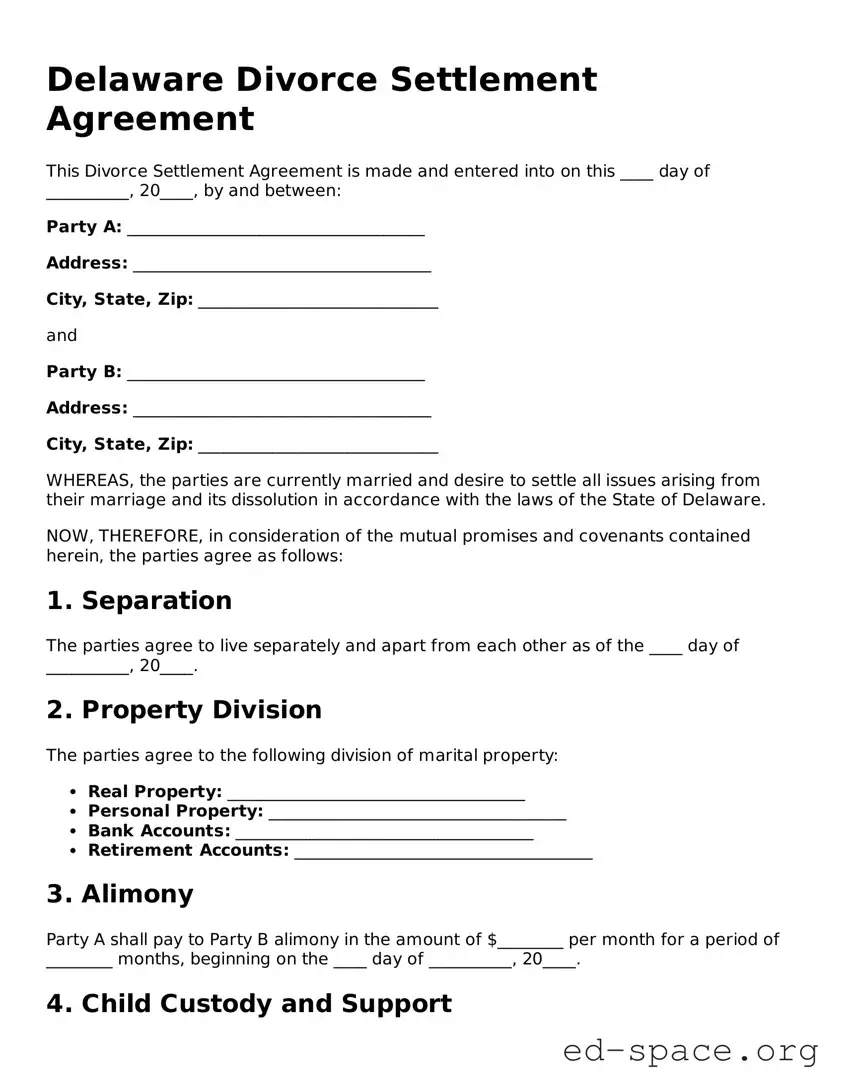
Delaware Divorce Settlement Agreement
This Divorce Settlement Agreement is made and entered into on this ____ day of __________, 20____, by and between:
Party A: ____________________________________
Address: ____________________________________
City, State, Zip: _____________________________
and
Party B: ____________________________________
Address: ____________________________________
City, State, Zip: _____________________________
WHEREAS, the parties are currently married and desire to settle all issues arising from their marriage and its dissolution in accordance with the laws of the State of Delaware.
NOW, THEREFORE, in consideration of the mutual promises and covenants contained herein, the parties agree as follows:
1. Separation
The parties agree to live separately and apart from each other as of the ____ day of __________, 20____.
2. Property Division
The parties agree to the following division of marital property:
3. Alimony
Party A shall pay to Party B alimony in the amount of $________ per month for a period of ________ months, beginning on the ____ day of __________, 20____.
4. Child Custody and Support
The parties agree to the following arrangements regarding their children:
5. Debt Division
The parties agree to the following division of debts:
6. Miscellaneous
This Agreement constitutes the entire understanding between the parties. Any modifications must be made in writing and signed by both parties.
IN WITNESS WHEREOF, the parties have executed this Divorce Settlement Agreement as of the date first above written.
Party A Signature: ___________________________
Date: ____________________________________
Party B Signature: ___________________________
Date: ____________________________________
| Fact Name | Description |
|---|---|
| Governing Law | The Delaware Divorce Settlement Agreement is governed by Title 13 of the Delaware Code, which outlines the laws pertaining to family law and divorce proceedings. |
| Purpose | This form is used to outline the terms of the divorce settlement between parties, including division of assets, alimony, child custody, and support arrangements. |
| Filing Requirements | Both parties must sign the agreement, and it must be filed with the Family Court of Delaware to be legally binding. |
| Modification | The agreement can be modified post-divorce, but any changes must be approved by the court to ensure they are enforceable. |
Once you have gathered all necessary information and documents, you can begin filling out the Delaware Divorce Settlement Agreement form. This form is essential for outlining the terms of your divorce, including asset division, child custody, and support arrangements. Completing it accurately will help facilitate the divorce process.
After completing the form, review it thoroughly for accuracy. Make copies for your records and submit the original to the appropriate court. Follow any additional instructions provided by the court to ensure the form is processed correctly.
What is a Delaware Divorce Settlement Agreement?
A Delaware Divorce Settlement Agreement is a legal document that outlines the terms agreed upon by both parties during a divorce. This agreement typically addresses various aspects such as the division of property, custody arrangements for children, child support, and spousal support. It serves to ensure that both parties have a clear understanding of their rights and responsibilities following the dissolution of their marriage. Once signed, this document becomes part of the court record and is enforceable by law.
How do I create a Divorce Settlement Agreement in Delaware?
To create a Divorce Settlement Agreement in Delaware, both spouses should first discuss and negotiate the terms of the settlement. It is often beneficial to consult with legal counsel to ensure that the agreement complies with state laws and adequately protects each party’s interests. Once the terms are agreed upon, the document should be drafted, detailing all aspects of the settlement. Both parties must sign the agreement, and it should then be submitted to the court for approval as part of the divorce proceedings.
Can I modify a Divorce Settlement Agreement after it has been signed?
Yes, a Divorce Settlement Agreement can be modified after it has been signed, but such changes require mutual consent from both parties. If circumstances change significantly—such as a change in income, relocation, or changes in the needs of children—either party may request a modification. It is important to file a motion with the court to formalize any changes, as informal agreements may not be enforceable. Legal advice is recommended to navigate this process effectively.
What happens if one party does not comply with the Divorce Settlement Agreement?
If one party fails to comply with the terms outlined in the Divorce Settlement Agreement, the other party may take legal action to enforce the agreement. This could involve filing a motion with the court, which may result in a hearing to address the non-compliance. The court has the authority to enforce the agreement, which may include ordering compliance, modifying the terms, or even imposing penalties. It is crucial for individuals to keep detailed records of any violations to support their case.
Failing to provide complete personal information. This includes names, addresses, and contact information for both parties. Incomplete details can delay the processing of the agreement.
Not specifying the date of marriage and separation. This information is crucial for legal records and can impact the division of assets.
Overlooking the financial disclosures. Both parties must fully disclose their income, assets, and debts. Omitting this information can lead to disputes later on.
Using vague language when describing asset division. Clear and specific terms help prevent misunderstandings and ensure both parties are on the same page.
Neglecting to address child custody and support arrangements. If children are involved, outlining custody, visitation, and support is essential for their well-being.
Not including a plan for health insurance coverage. This is particularly important if children are involved, as it impacts their access to necessary medical care.
Forgetting to sign and date the agreement. An unsigned document may be considered invalid, which can lead to complications in the divorce process.
Failing to seek legal advice. Even if both parties agree on terms, consulting with a lawyer can help ensure that the agreement is fair and legally binding.
Not keeping copies of the signed agreement. It’s important for both parties to retain a copy for their records, as it may be needed in the future.
Rushing through the process. Taking the time to carefully review each section can prevent mistakes that may require additional time and effort to correct later.
When navigating a divorce in Delaware, several documents often accompany the Divorce Settlement Agreement. Each of these documents serves a specific purpose and helps ensure that all aspects of the divorce are addressed. Here’s a brief overview of these essential forms:
Understanding these documents can help streamline the divorce process. Each form plays a vital role in ensuring that all legal obligations are met and that both parties have a clear understanding of their rights and responsibilities.
When filling out the Delaware Divorce Settlement Agreement form, it is important to approach the task with care. Here are some key do's and don'ts to keep in mind:
By following these guidelines, you can help facilitate a smoother process in finalizing your divorce settlement.
When dealing with a Delaware Divorce Settlement Agreement form, several misconceptions can arise. Understanding these misconceptions can help individuals navigate the process more smoothly. Here are nine common misunderstandings:
Being aware of these misconceptions can help individuals approach the divorce process with a clearer understanding and better preparation.
Filling out and using the Delaware Divorce Settlement Agreement form is an important step in the divorce process. Here are some key takeaways to keep in mind:
By keeping these points in mind, you can navigate the divorce settlement process more effectively.