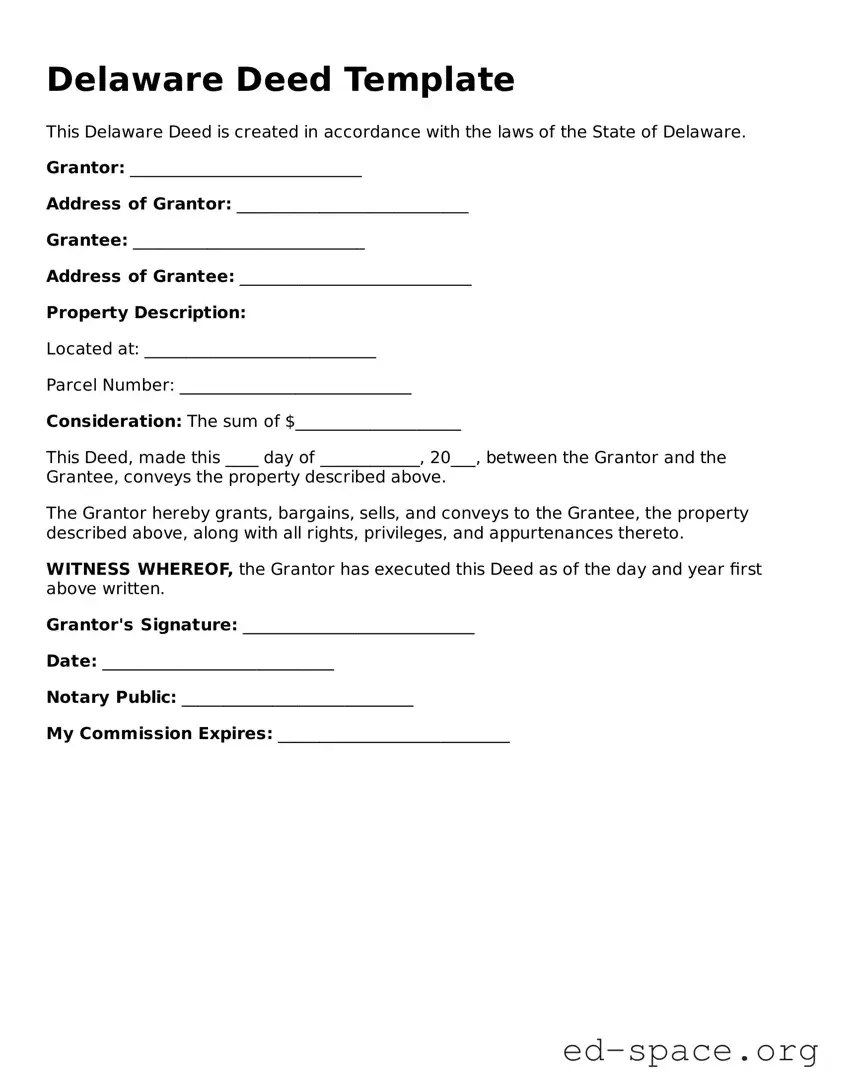
The Delaware Deed form is a crucial document for anyone involved in real estate transactions within the state. It serves as the official record of property ownership transfer, ensuring that the rights of the buyer and seller are protected. This form typically includes essential details such as the names of the parties involved, a clear description of the property being transferred, and the terms of the sale. Additionally, it may require notarization to validate the signatures, providing an extra layer of security and authenticity. Understanding the components of the Delaware Deed form is vital for both buyers and sellers, as any errors or omissions can lead to complications down the line. Timely and accurate completion of this form is necessary to avoid potential disputes and ensure a smooth transfer of property rights.
Delaware Deed Template
This Delaware Deed is created in accordance with the laws of the State of Delaware.
Grantor: ____________________________
Address of Grantor: ____________________________
Grantee: ____________________________
Address of Grantee: ____________________________
Property Description:
Located at: ____________________________
Parcel Number: ____________________________
Consideration: The sum of $____________________
This Deed, made this ____ day of ____________, 20___, between the Grantor and the Grantee, conveys the property described above.
The Grantor hereby grants, bargains, sells, and conveys to the Grantee, the property described above, along with all rights, privileges, and appurtenances thereto.
WITNESS WHEREOF, the Grantor has executed this Deed as of the day and year first above written.
Grantor's Signature: ____________________________
Date: ____________________________
Notary Public: ____________________________
My Commission Expires: ____________________________
| Fact Name | Description |
|---|---|
| Governing Law | The Delaware Deed form is governed by Delaware state law, specifically Title 25 of the Delaware Code. |
| Types of Deeds | Delaware recognizes several types of deeds, including warranty deeds, quitclaim deeds, and special purpose deeds. |
| Recording Requirement | All deeds must be recorded in the county where the property is located to provide public notice of ownership. |
| Signature Requirement | The deed must be signed by the grantor in the presence of a notary public or two witnesses. |
| Legal Description | A complete legal description of the property must be included in the deed to ensure clarity and avoid disputes. |
Once you have the Delaware Deed form in hand, you are ready to fill it out. This process involves providing specific information about the property and the parties involved. After completing the form, it will need to be signed and submitted according to Delaware state requirements.
What is a Delaware Deed form?
A Delaware Deed form is a legal document used to transfer ownership of real estate in the state of Delaware. It serves as proof of the transaction between the seller (grantor) and the buyer (grantee). The form must include specific details such as the names of the parties involved, a description of the property, and the signature of the grantor. Depending on the type of deed, additional information may be required.
What types of deeds are available in Delaware?
Delaware recognizes several types of deeds, including warranty deeds, quitclaim deeds, and special warranty deeds. A warranty deed offers the highest level of protection to the buyer, ensuring that the seller has clear title to the property. A quitclaim deed, on the other hand, transfers whatever interest the seller may have without any guarantees. Special warranty deeds provide limited protection, covering only the time the seller owned the property.
How do I complete a Delaware Deed form?
Completing a Delaware Deed form involves filling out the required fields accurately. Start by entering the names of the grantor and grantee. Next, provide a legal description of the property, which can often be found in previous deeds or property records. The grantor must then sign the deed in the presence of a notary public. It is essential to ensure that all information is correct to avoid complications in the future.
Is a Delaware Deed form required to be recorded?
Yes, it is strongly recommended to record the Delaware Deed form with the appropriate county recorder's office. Recording the deed provides public notice of the property transfer and protects the grantee's ownership rights. Failure to record the deed may lead to disputes over ownership, especially if subsequent transfers occur.
Are there any fees associated with filing a Delaware Deed form?
Yes, there are typically fees associated with filing a Delaware Deed form. These fees can vary by county and may include recording fees, transfer taxes, and possibly other charges. It is advisable to check with the local recorder's office for the specific fees applicable to your situation. Planning for these costs in advance can help facilitate a smoother transaction.
What happens if I make a mistake on the Delaware Deed form?
If a mistake is made on the Delaware Deed form, it is important to address it promptly. Minor errors may be corrected through an amendment or corrective deed, but significant mistakes may require more formal processes. In some cases, it may be necessary to consult a legal professional to ensure that the correction is valid and properly executed. Taking immediate action can help prevent future disputes regarding the property.
Not providing accurate property descriptions. A clear and precise description of the property is essential. Failing to include the correct details can lead to legal complications.
Forgetting to include all necessary parties. Both the grantor (seller) and grantee (buyer) must be clearly identified. Omitting any party can invalidate the deed.
Neglecting to sign the deed. All required signatures must be present. Without the proper signatures, the deed cannot be legally recognized.
Not having the deed notarized. In Delaware, a deed typically requires notarization. Failing to have it notarized can affect its enforceability.
Using incorrect or outdated forms. Always ensure you are using the most current version of the Delaware Deed form. Using outdated forms can lead to errors and delays.
Ignoring state-specific requirements. Each state has its own regulations regarding deeds. Familiarize yourself with Delaware's specific rules to avoid mistakes.
When completing a property transaction in Delaware, several forms and documents may accompany the Delaware Deed form. Each of these documents serves a specific purpose in ensuring that the transfer of property is legally sound and properly recorded. Below is a list of commonly used documents that often accompany the Delaware Deed.
These documents collectively contribute to a transparent and efficient property transfer process in Delaware. Understanding their roles can help all parties involved navigate the complexities of real estate transactions with greater confidence.
When filling out the Delaware Deed form, attention to detail is crucial. Here are ten important do's and don'ts to ensure your form is completed correctly.
There are several misconceptions about the Delaware Deed form that can lead to confusion. Understanding these can help ensure a smoother property transaction process.
By clearing up these misconceptions, individuals can approach the deed preparation process with more confidence and clarity.
Filling out and utilizing the Delaware Deed form is a crucial step in property transactions. Understanding the nuances of this process can make a significant difference in ensuring everything is executed properly. Here are some key takeaways to consider:
By following these guidelines, individuals can navigate the Delaware Deed process with greater confidence and clarity. Understanding each step ensures that property transactions are completed smoothly and legally.