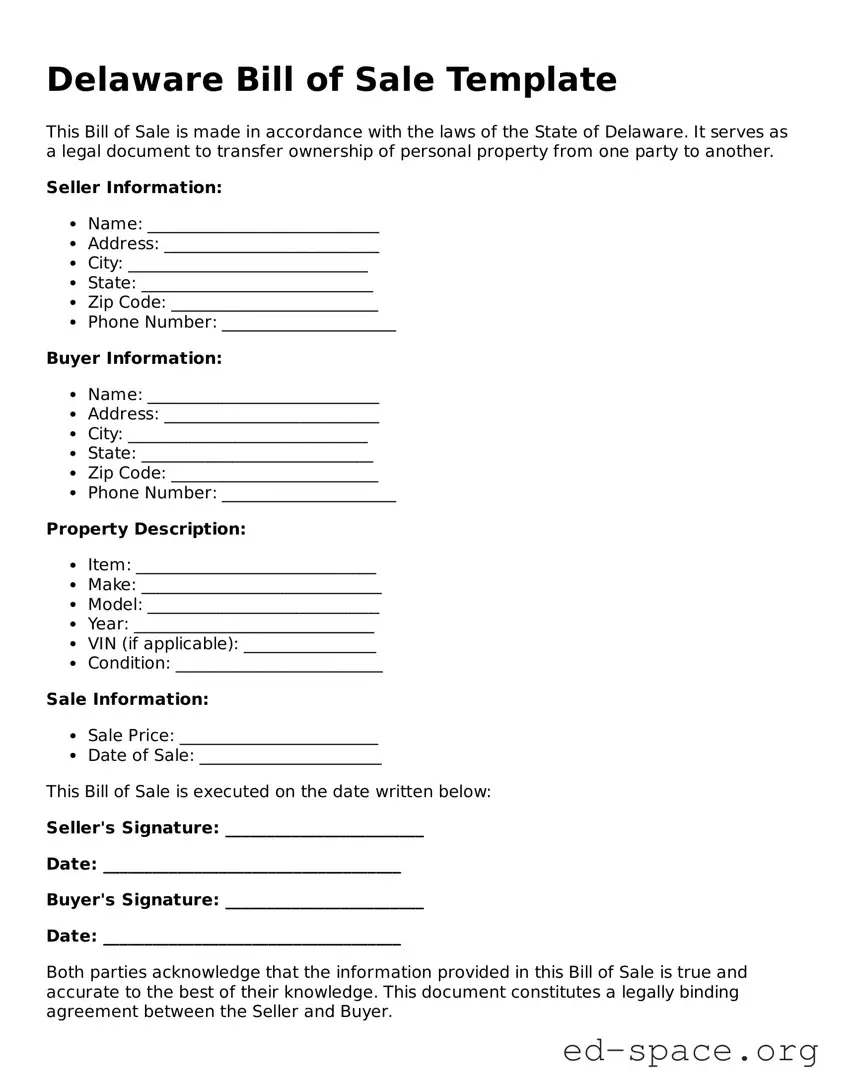
When it comes to transferring ownership of personal property in Delaware, a Bill of Sale is an essential document that ensures a smooth and legally recognized transaction. This form serves as proof that a sale has occurred, detailing important information about the buyer, the seller, and the item being sold. It typically includes the names and addresses of both parties, a description of the item, the sale price, and the date of the transaction. In Delaware, having a properly completed Bill of Sale can protect both the buyer and seller by providing a clear record of the exchange. Whether you're selling a vehicle, equipment, or other personal property, understanding the importance of this form can help you navigate the sales process with confidence and peace of mind.
Delaware Bill of Sale Template
This Bill of Sale is made in accordance with the laws of the State of Delaware. It serves as a legal document to transfer ownership of personal property from one party to another.
Seller Information:
Buyer Information:
Property Description:
Sale Information:
This Bill of Sale is executed on the date written below:
Seller's Signature: ________________________
Date: ____________________________________
Buyer's Signature: ________________________
Date: ____________________________________
Both parties acknowledge that the information provided in this Bill of Sale is true and accurate to the best of their knowledge. This document constitutes a legally binding agreement between the Seller and Buyer.
| Fact Name | Description |
|---|---|
| Definition | A Delaware Bill of Sale is a legal document that transfers ownership of personal property from one party to another. |
| Types of Property | This form can be used for various types of personal property, including vehicles, equipment, and other tangible goods. |
| Governing Law | The Bill of Sale is governed by Delaware state law, specifically Title 6, Chapter 2701 of the Delaware Code. |
| Requirements | While not always required, it is advisable to have the Bill of Sale signed by both parties and notarized for added legal protection. |
| Consideration | The document should specify the consideration, or payment, exchanged for the property, which can be monetary or non-monetary. |
| As-Is Clause | Many Bills of Sale include an "as-is" clause, indicating that the buyer accepts the property in its current condition without warranties. |
| Record Keeping | Both the buyer and seller should keep a copy of the Bill of Sale for their records, as it serves as proof of the transaction. |
| Vehicle Sales | For vehicle sales, additional paperwork may be required by the Delaware Division of Motor Vehicles to complete the transfer. |
| Not a Title Transfer | A Bill of Sale does not transfer title for vehicles; a separate title transfer document must be completed for that purpose. |
| Use in Disputes | In case of disputes, the Bill of Sale can serve as evidence of the agreement and terms between the buyer and seller. |
After obtaining the Delaware Bill of Sale form, you will need to fill it out accurately to ensure a smooth transaction. Follow these steps carefully to complete the form.
Once the form is completed and signed, keep a copy for your records. The buyer should also retain a copy for their documentation. This form serves as proof of the transaction and may be required for registration or title transfer in the future.
What is a Delaware Bill of Sale?
A Delaware Bill of Sale is a legal document that serves as proof of the transfer of ownership of personal property from one party to another. This form is often used for transactions involving vehicles, boats, or other tangible items. It outlines the details of the sale, including the buyer, seller, and item description.
Is a Bill of Sale required in Delaware?
While a Bill of Sale is not legally required for all transactions in Delaware, it is highly recommended. This document provides evidence of the sale and can protect both the buyer and seller in case of disputes. For vehicle sales, a Bill of Sale is necessary for registration and title transfer.
What information should be included in a Delaware Bill of Sale?
A comprehensive Delaware Bill of Sale should include the following information: the names and addresses of both the buyer and seller, a description of the item being sold (including make, model, year, and Vehicle Identification Number for vehicles), the sale price, and the date of the transaction. Both parties should sign the document to validate the agreement.
Can a Bill of Sale be used for any type of property?
Yes, a Bill of Sale can be used for various types of personal property, including vehicles, boats, furniture, and equipment. However, for certain items, such as real estate, different documents are required. Always ensure that the Bill of Sale is appropriate for the type of property being sold.
Do I need to have the Bill of Sale notarized?
Notarization is not required for a Bill of Sale in Delaware, but it can add an extra layer of authenticity. Having the document notarized can be beneficial if there are any disputes or if the buyer or seller needs to prove the transaction in the future.
How do I obtain a Bill of Sale form in Delaware?
Bill of Sale forms can be obtained from various sources. You can find templates online, at office supply stores, or through legal document preparation services. Ensure that the form you choose complies with Delaware laws and includes all necessary information for your specific transaction.
What should I do after completing the Bill of Sale?
Once the Bill of Sale is completed and signed by both parties, each should keep a copy for their records. If the sale involves a vehicle, the buyer should take the Bill of Sale to the Department of Motor Vehicles (DMV) to complete the title transfer and registration process.
What if there are issues after the sale?
If issues arise after the sale, such as disputes over payment or the condition of the item sold, the Bill of Sale serves as a crucial piece of evidence. It outlines the terms of the agreement and can help resolve conflicts. In some cases, legal advice may be necessary to address the situation appropriately.
Incomplete Information: Failing to provide all required details can lead to complications. Ensure that names, addresses, and item descriptions are fully filled out.
Incorrect Item Description: Providing a vague or inaccurate description of the item can cause confusion. Always include specific details like make, model, and serial number.
Missing Signatures: Both the seller and buyer must sign the document. Omitting one or both signatures renders the Bill of Sale invalid.
Not Dating the Document: Failing to include the date of the transaction can lead to disputes later. Always write the date clearly.
Ignoring State Requirements: Each state has specific laws regarding Bills of Sale. Familiarize yourself with Delaware's requirements to avoid legal issues.
Using Incorrect Forms: Ensure you are using the correct version of the Bill of Sale form. Different transactions may require different forms.
Not Keeping Copies: Failing to retain a copy for your records can be problematic. Always keep a signed copy for both parties involved.
Overlooking Payment Details: If payment is involved, specify the amount and method of payment. This helps clarify the terms of the sale.
Neglecting to Verify Buyer’s Identity: It’s crucial to confirm the identity of the buyer. This step can prevent potential fraud or disputes in the future.
The Delaware Bill of Sale form serves as a crucial document in the transfer of ownership for various types of property, particularly vehicles and personal goods. However, it is often accompanied by several other forms and documents that help facilitate the transaction and provide additional legal protection for both the buyer and the seller. Below is a list of commonly used documents that complement the Delaware Bill of Sale.
Using these documents alongside the Delaware Bill of Sale can help ensure a smooth transaction and provide legal safeguards for both parties involved. Proper documentation is key to protecting one's interests and ensuring compliance with applicable laws.
Purchase Agreement: This document outlines the terms and conditions of a sale, detailing what is being sold, the price, and any warranties. Like a Bill of Sale, it serves as proof of the transaction.
Lease Agreement: A lease agreement allows one party to use property owned by another for a specified time in exchange for payment. Both documents establish the rights and responsibilities of each party involved.
Title Transfer Document: When ownership of a vehicle or property changes hands, a title transfer document is required. This document, similar to a Bill of Sale, officially records the new owner.
Gift Deed: A gift deed transfers ownership of property without any exchange of money. Like a Bill of Sale, it provides legal proof of the transfer of ownership.
Service Agreement: This document details the terms under which services will be provided. While it involves services rather than goods, it similarly formalizes an agreement between parties.
Promissory Note: A promissory note is a written promise to pay a specified amount of money at a certain time. It is similar to a Bill of Sale in that it documents a financial transaction.
Warranty Deed: A warranty deed guarantees that the seller has clear title to the property and the right to sell it. This document serves a similar purpose in confirming ownership as a Bill of Sale.
Escrow Agreement: This agreement involves a third party holding funds or assets until certain conditions are met. Like a Bill of Sale, it ensures that both parties fulfill their obligations before the transaction is completed.
Sales Receipt: A sales receipt provides proof of purchase and details the items bought, similar to how a Bill of Sale records the transaction of goods.
Contract for Deed: This is a type of seller financing where the buyer makes payments directly to the seller. It is akin to a Bill of Sale in that it outlines the terms of ownership transfer.
When filling out the Delaware Bill of Sale form, it's important to follow certain guidelines to ensure accuracy and compliance. Below is a list of things you should and shouldn't do.
Following these guidelines will help ensure that the transaction is valid and legally binding.
Understanding the Delaware Bill of Sale form is crucial for anyone involved in buying or selling personal property. Unfortunately, several misconceptions can lead to confusion. Here are seven common misconceptions about this important document.
Many believe that a Bill of Sale is only necessary when selling a vehicle. In reality, this document is required for various types of transactions involving personal property, including boats, trailers, and even certain types of equipment.
Some people think a Bill of Sale is valid without a notary. While notarization is not always required, having the document notarized can provide an additional layer of protection and legitimacy.
A Bill of Sale is not the same as a title transfer. The Bill of Sale serves as proof of the transaction, while the title is the legal document that proves ownership of the property.
Some individuals think that only private sales require a Bill of Sale. However, even transactions conducted through dealerships or businesses may benefit from having this document to clarify the terms of the sale.
Not all Bill of Sale forms are the same. Different types of property may require specific details to be included in the document. Tailoring the form to fit the transaction is essential.
Some people believe that a Bill of Sale offers no protection against future claims. In fact, it serves as a legal record of the transaction, which can be beneficial if disputes arise later.
Many assume that a Bill of Sale is only important for high-value items. However, documenting any sale, regardless of value, can help clarify ownership and prevent misunderstandings.
Being aware of these misconceptions can help ensure that you are properly informed when engaging in transactions that require a Bill of Sale in Delaware.
When filling out and using the Delaware Bill of Sale form, keep these key points in mind: