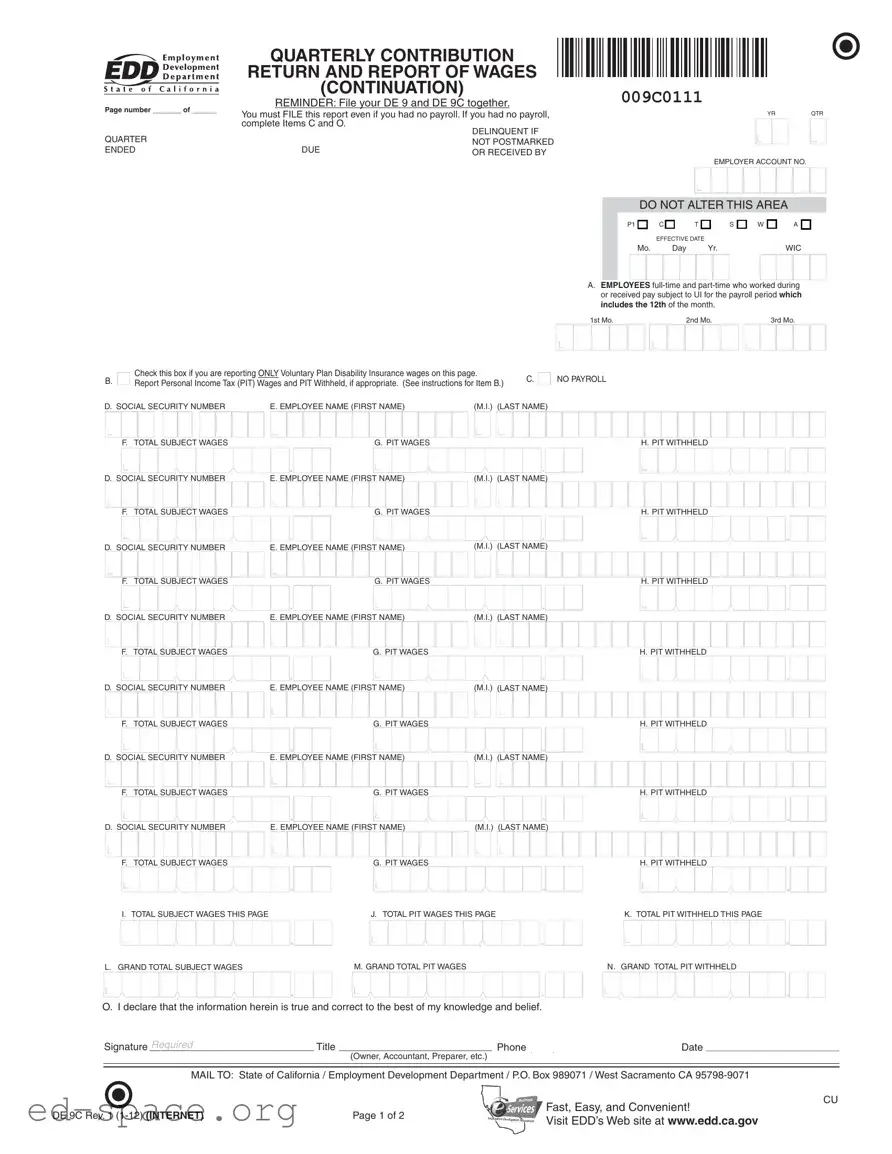
The DE 9C form plays a crucial role in California's employment landscape, serving as a quarterly contribution return and report of wages for employers. This form must be filed alongside the DE 9 form, even if there were no payroll activities during the quarter. Employers are required to report various details, including the number of employees who worked or received pay subject to Unemployment Insurance (UI) during the payroll period that includes the 12th of the month. Additionally, the DE 9C captures information on Personal Income Tax (PIT) wages and any PIT withheld, ensuring compliance with state tax regulations. Employers also have the option to report wages for employees covered under a Voluntary Plan for Disability Insurance. Each employee's Social Security number, name, and total subject wages must be meticulously documented. The form requires employers to declare the accuracy of the information provided, underscoring the importance of diligence in reporting. With the ability to file online, the process has become more streamlined, allowing for easier compliance with California's employment laws.
Page number _______ of ______
QUARTER
ENDED
QUARTERLY CONTRIBUTION |
|
RETURN AND REPORT OF WAGES |
|
(CONTINUATION) |
009C0111 |
REMINDER: File your DE 9 and DE 9C together. |
You must FILE this report even if you had no payroll. If you had no payroll, complete Items C and O.
DUE
YRQTR
EMPLOYER ACCOUNT NO.
B.
Check this box if you are reporting ONLY Voluntary Plan Disability Insurance wages on this page. |
C. |
|
Report Personal Income Tax (PIT) Wages and PIT Withheld, if appropriate. (See instructions for Item B.) |
||
|
DO NOT ALTER THIS AREA
P1 |
C |
T |
S |
W |
A |
|
EFFECTIVE DATE |
|
|
|
|
Mo. |
|
Day |
Yr. |
|
WIC |
A.EMPLOYEES
|
|
|
1st Mo. |
|
|
|
|
|
2nd Mo. |
|
|
|
3rd Mo. |
||||||||
|
|
|
|
|
|
|
|
|
|
|
|
|
|
|
|
|
|
|
|
|
|
|
|
|
|
|
|
|
|
|
|
|
|
|
|
|
|
|
|
|
|
|
|
NO PAYROLL
D. SOCIAL SECURITY NUMBER |
E. EMPLOYEE NAME (FIRST NAME) |
||||||||||||||||||||||||||||||||||||||
|
|
|
|
|
|
|
|
|
|
|
|
|
|
|
|
|
|
|
|
|
|
|
|
|
|
|
|
|
|
|
|
|
|
|
|
|
|
|
|
|
|
|
|
|
|
|
|
|
|
|
|
|
|
|
|
|
|
|
|
|
|
|
|
|
|
|
|
|
|
|
|
|
|
|
|
|
|
|
|
|
|
|
|
|
|
|
|
|
|
|
|
|
|
|
|
|
|
|
|
|
|
|
|
|
|
|
|
|
|
|
|
|
|
|
|
|
|
|
|
|
|
|
F. TOTAL SUBJECT WAGES |
|
|
|
|
|
|
|
|
|
|
|
G. PIT WAGES |
||||||||||||||||||||||||
|
|
|
|
|
|
|
|
|
|
|
|
|
|
|
|
|
|
. |
|
|
|
|
|
|
|
|
|
|
|
|
|
|
|
|
|
|
|
||
|
|
|
|
|
|
|
|
|
|
|
|
|
|
|
|
|
|
|
|
|
|
|
|
|
|
|
|
|
|
|
|
|
|
|
|
|
|||
D. SOCIAL SECURITY NUMBER |
E. EMPLOYEE NAME (FIRST NAME) |
||||||||||||||||||||||||||||||||||||||
|
|
|
|
|
|
|
|
|
|
|
|
|
|
|
|
|
|
|
|
|
|
|
|
|
|
|
|
|
|
|
|
|
|
|
|
|
|
|
|
|
|
|
|
|
|
|
|
|
|
|
|
|
|
|
|
|
|
|
|
|
|
|
|
|
|
|
|
|
|
|
|
|
|
|
|
|
|
|
|
|
|
|
|
|
|
|
|
|
|
|
|
|
|
|
|
|
|
|
|
|
|
|
|
|
|
|
|
|
|
|
|
|
|
|
|
|
|
|
|
|
|
|
F. TOTAL |
SUBJECT WAGES |
|
|
|
|
|
|
|
|
|
|
|
G. PIT WAGES |
|||||||||||||||||||||||
|
|
|
|
|
|
|
|
|
|
|
|
|
|
|
|
|
|
. |
|
|
|
|
|
|
|
|
|
|
|
|
|
|
|
|
|
|
|
||
|
|
|
|
|
|
|
|
|
|
|
|
|
|
|
|
|
|
|
|
|
|
|
|
|
|
|
|
|
|
|
|
|
|
|
|
|
|||
D. SOCIAL SECURITY NUMBER |
E. EMPLOYEE NAME (FIRST NAME) |
||||||||||||||||||||||||||||||||||||||
|
|
|
|
|
|
|
|
|
|
|
|
|
|
|
|
|
|
|
|
|
|
|
|
|
|
|
|
|
|
|
|
|
|
|
|
|
|
|
|
|
|
|
|
|
|
|
|
|
|
|
|
|
|
|
|
|
|
|
|
|
|
|
|
|
|
|
|
|
|
|
|
|
|
|
|
|
|
|
|
|
|
|
|
|
|
|
|
|
|
|
|
|
|
|
|
|
|
|
|
|
|
|
|
|
|
|
|
|
|
|
|
|
|
|
|
|
|
|
|
|
|
|
F. TOTAL |
SUBJECT WAGES |
|
|
|
|
|
|
|
|
|
|
|
G. PIT WAGES |
|||||||||||||||||||||||
(M.I.) (LAST NAME)
|
H. PIT WITHHELD |
. |
. |
(M.I.) (LAST NAME)
|
H. PIT WITHHELD |
. |
. |
(M.I.) (LAST NAME)
H. PIT WITHHELD
|
. |
D. SOCIAL SECURITY NUMBER |
E. EMPLOYEE NAME (FIRST NAME) |
F. TOTAL SUBJECT WAGES |
G. PIT WAGES |
|
. |
D. SOCIAL SECURITY NUMBER |
E. EMPLOYEE NAME (FIRST NAME) |
F. TOTAL SUBJECT WAGES |
G. PIT WAGES |
|
. |
D. SOCIAL SECURITY NUMBER |
E. EMPLOYEE NAME (FIRST NAME) |
F. TOTAL SUBJECT WAGES |
G. PIT WAGES |
|
. |
D. SOCIAL SECURITY NUMBER |
E. EMPLOYEE NAME (FIRST NAME) |
F. TOTAL SUBJECT WAGES |
G. PIT WAGES |
|
. |
. |
. |
(M.I.) (LAST NAME)
|
H. PIT WITHHELD |
. |
. |
(M.I.) (LAST NAME)
|
H. PIT WITHHELD |
. |
. |
(M.I.) (LAST NAME)
|
H. PIT WITHHELD |
. |
. |
(M.I.) (LAST NAME)
|
H. PIT WITHHELD |
. |
. |
I. TOTAL SUBJECT WAGES THIS PAGE |
J. TOTAL PIT WAGES THIS PAGE |
K. TOTAL PIT WITHHELD THIS PAGE |
.
.
.
L. GRAND TOTAL SUBJECT WAGES |
M. GRAND TOTAL PIT WAGES |
N. GRAND TOTAL PIT WITHHELD |
..
O. I declare that the information herein is true and correct to the best of my knowledge and belief.
.
|
Signature Required |
Title ___________________________ Phone ( |
) _____________________ Date _________________________________ |
|
|
|
(Owner, Accountant, Preparer, etc.) |
|
|
|
|
|
||
|
MAIL TO: State of California / Employment Development Department / P.O. Box 989071 / West Sacramento CA |
|
||
|
|
|
Fast, Easy, and Convenient! |
CU |
DE 9C Rev. 1 |
Page 1 of 2 |
|
||
Visit EDD’s Web site at www.edd.ca.gov |
|
|||
|
|
|
|
|
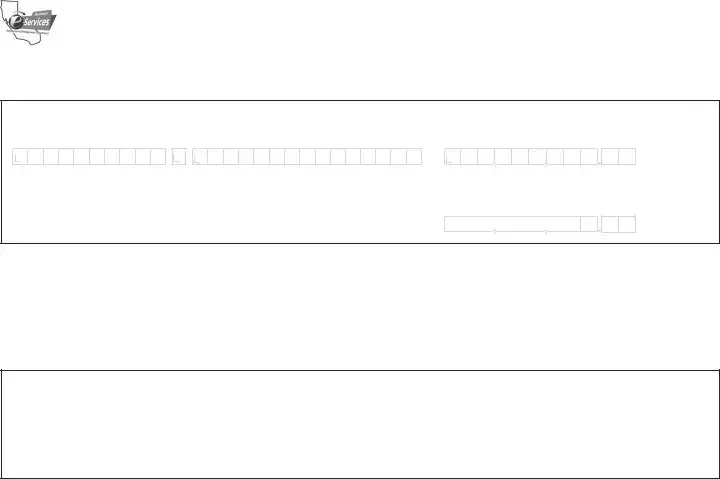
INSTRUCTIONS FOR COMPLETING THE
QUARTERLY CONTRIBUTION RETURN AND REPORT OF WAGES (CONTINUATION) (DE 9C)
PLEASE TYPE ALL INFORMATION
Did you know you can file this form online using the EDD’s
For a faster, easier, and more convenient method of reporting your DE 9C information, visit the EDD’s website at www.edd.ca.gov.
Contact the Taxpayer Assistance Center at (888)
reporting wages or the subject status of employees. Refer to the California Employer’s Guide (DE 44) for additional information.
Please record information in the spaces provided. If you use a typewriter or printer, ignore the boxes and type in UPPER CASE as shown.
Do not use dollar signs, dashes, commas, or slashes ($
EMPLOYEE (FIRST NAME) |
M.I. |
(LAST NAME) |
TOTAL SUBJECT WAGES |
IMOGENE |
A |
SAMPLE |
12345.67 |
If you must hand write this form, print each letter or number in a separate box as shown.
Do not use dollar signs, dashes, commas, decimal points, or slashes ($
EMPLOYEE (FIRST NAME) |
M.I. (LAST NAME) |
TOTAL SUBJECT WAGES |
||||||||||||||||||||||||||||||||||||||||||
|
|
|
|
|
|
|
|
|
|
|
|
|
|
|
|
|
|
|
|
|
|
|
|
|
|
|
|
|
|
|
|
|
|
|
1 |
|
2 |
|
3 |
|
4 |
|||
|
|
I |
M |
O |
G |
E |
N |
E |
|
|
|
|
A |
|
S |
A |
M |
P |
L |
E |
|
|
|
|
|
|
|
|
|
|
|
|
|
|
|
|
|
|
||||||
|
|
|
|
|
|
|
|
|
|
|
|
|
|
|
|
|
|
|
|
|
|
|
||||||||||||||||||||||
5
6 7
Retain a copy of the DE 9C form(s) for your records. If you have more than seven employees, use additional pages or a format approved by the Employment Development Department (EDD). If using more than one page, number the pages consecutively at the top of the form. If the form is not preprinted, enter your account number, business name and address, the year and quarter, and the quarter ended date. For information, specifications, and approvals of alternate forms, contact the Alternate Forms Coordinator at (916)
ITEM A. NUMBER OF EMPLOYEES: Page 1 only: Enter the number of
Blank fields will be identified as missing data.
ITEM B. Check this box ONLY if the employees reported are covered by an employer sponsored Voluntary Plan for the payment of disability benefits. If you also have employees covered under the State Plan for disability benefits, report their wages and withholdings separately on another page of the DE 9C.
WAGES AND WITHHOLDINGS TO REPORT ON A SEPARATE DE 9C
Prepare a DE 9C to report the types of exemptions listed below. All three exemptions can be reported on one DE 9C. Write the exemption title(s) at the top of the form (e.g., SOLE SHAREHOLDER), and report only those individuals under these categories. Report all other employees or individuals without exemptions on a separate
DE 9C.
•Religious Exemption: Employees who file and are approved by the EDD for an exemption from State Disability Insurance (SDI) taxes under Section 2902 of the California Unemployment Insurance Code (CUIC).
•Sole Shareholder: An individual who elects and is approved by the EDD to be excluded from SDI coverage for benefits and taxes under Section 637.1 of the CUIC.
•
ITEM C. NO PAYROLL: Check this box if you had no payroll this quarter. Please sign and complete the information in Item O.
ITEM D. SOCIAL SECURITY NUMBER (SSN): Enter the SSN of each employee or individual to whom you paid wages in subject employment, paid Personal Income Tax (PIT) wages, and/or from whom you withheld PIT during the quarter. If someone does not have an SSN, report their name, wages, and/or withholdings without the SSN and TAKE IMMEDIATE STEPS TO SECURE ONE. Report the correct SSN to the EDD as soon as possible on a Quarterly Contribution and Wage Adjustment Form (DE 9ADJ).
ITEM E. EMPLOYEE NAME: Enter the name of each employee or individual to whom you paid wages in subject employment, paid PIT wages, and/or from whom you withheld PIT during the quarter.
ITEM F. TOTAL SUBJECT WAGES: Enter the total subject wages paid (including cents) to each employee during the quarter. Generally, most wages are considered “subject” wages. For special classes of employment and payments considered subject wages, refer to the California Employer’s Guide
(DE 44) under “Types of Employment” and “Types of Payments.”
ITEM G. PIT WAGES: Enter the amount of wages paid (including cents) that are subject to PIT, even if you do not withhold PIT from the
wages. You must enter PIT wages even if they are the same as total subject wages. For additional information regarding PIT wages, refer to the Information Sheet: Personal Income Tax Wages Reported on the Quarterly Contribution Return and Report of Wages (Continuation) (DE 9C) (DE 231PIT).
ITEM H. PIT WITHHELD: Enter the amount of PIT withheld from each individual during the quarter.
ITEM I. Enter the total subject wages paid (Item F) for each separate page. Do not carry this total forward from page to page.
ITEM J. Enter the total amount of PIT wages (Item G) for each separate page. Do not carry this total forward from page to page.
ITEM K. Enter the total PIT withheld (Item H) for each separate page. Do not carry this total forward from page to page.
ITEM L. ON PAGE 1 or the last page, enter the grand total of total subject wages paid (Item I) for all pages for the quarter.*
ITEM M. ON PAGE 1 or the last page, enter the grand total of PIT wages (Item J) for all pages for the quarter.*
ITEM N. ON PAGE 1 or the last page, enter the grand total of PIT withheld (Item K) for all pages for the quarter.*
*NOTE: Provide separate grand totals for Voluntary Plan Disability Insurance reporting and special exemption reporting (Religious Exemption, Sole Shareholder,
pages to arrive at the grand totals for Items L, M, and N.
ITEM O. ON PAGE 1 ONLY, signature of preparer or responsible individual, including title, telephone number, and signature date.
DE 9C Rev. 1 |
Page 2 of 2 |
| Fact Name | Description |
|---|---|
| Purpose | The DE 9C form is used for reporting wages and contributions for California employers. |
| Filing Requirement | Employers must file the DE 9C even if there were no payroll during the quarter. |
| Voluntary Plan Reporting | Employers can check a box to indicate if they are reporting only Voluntary Plan Disability Insurance wages. |
| Personal Income Tax (PIT) | Employers must report PIT wages and PIT withheld when applicable. |
| Employee Information | Each employee’s Social Security number, name, and wages must be reported on the form. |
| Grand Totals | Employers must calculate and report grand totals for subject wages, PIT wages, and PIT withheld. |
| Signature Requirement | The form must be signed by the preparer or responsible individual, including their title and contact information. |
| Governing Law | The DE 9C form is governed by the California Unemployment Insurance Code (CUIC). |
Filling out the DE 9C form is essential for employers in California to report wages and withholdings for their employees. This form requires accurate information about each employee and the total wages paid during the quarter. Ensure you have all necessary details at hand before starting the process. After completing the form, you will need to submit it to the Employment Development Department (EDD) by mail.
After completing the form, make a copy for your records. Mail the original to the address provided on the form to ensure timely processing. If you have more than seven employees, use additional pages as needed, numbering them consecutively. For any questions or assistance, consider reaching out to the EDD or consult the California Employer’s Guide.
What is the DE 9C form and why is it important?
The DE 9C form, also known as the Quarterly Contribution Return and Report of Wages (Continuation), is a crucial document for employers in California. It is used to report wages paid to employees during a specific quarter, along with any Personal Income Tax (PIT) that has been withheld. This form must be filed even if there was no payroll during the quarter. By submitting the DE 9C, employers ensure compliance with state regulations and contribute to the funding of unemployment insurance and other benefits. Failure to file can result in penalties and complications for both the employer and employees.
Who needs to file the DE 9C form?
All employers in California who have employees that received wages subject to Unemployment Insurance (UI) must file the DE 9C form. This includes both full-time and part-time employees. Even if no wages were paid during the quarter, the employer is still required to submit the form, marking the appropriate box to indicate there was no payroll. This requirement helps maintain accurate records for state agencies and ensures that all employers are accounted for in the system.
What information must be included on the DE 9C form?
The DE 9C form requires several key pieces of information. Employers must report the number of employees who worked or received pay during the quarter, their Social Security numbers, names, total subject wages, PIT wages, and any PIT withheld. Each employee's information should be entered clearly, and if there are more than seven employees, additional pages should be used. The form also requires the employer to declare that the information provided is accurate and complete, underscoring the importance of careful data entry.
What should I do if I made a mistake on the DE 9C form?
If an error is discovered after the DE 9C form has been submitted, it is essential to correct it as soon as possible. Employers can file a Quarterly Contribution and Wage Adjustment Form (DE 9ADJ) to amend the previously submitted information. This adjustment form allows employers to report any changes in wages or employee information. Timely corrections help avoid potential penalties and ensure that employee records remain accurate. Keeping copies of all forms submitted is also advisable for reference and verification.
Not filing the DE 9C form: Some employers forget to file the DE 9C form even if they had no payroll during the quarter. It's important to file this form regardless of payroll activity.
Missing employee information: Failing to provide complete employee names or Social Security numbers can lead to complications. Each employee's information must be accurate and complete.
Incorrect wage reporting: Reporting incorrect total subject wages can result in discrepancies. Ensure that the total wages reported match what was actually paid to each employee.
Not checking the correct boxes: Some people forget to check the appropriate boxes, such as for voluntary plan disability insurance. This can lead to confusion regarding the type of wages being reported.
Omitting PIT wages: Not reporting Personal Income Tax (PIT) wages can create issues. Even if no PIT was withheld, PIT wages must still be reported if applicable.
Not signing the form: A common mistake is failing to sign the DE 9C form. The signature of the preparer or responsible individual is required for the form to be valid.
Carrying totals incorrectly: Some individuals mistakenly carry totals from one page to another. Each page should report its totals independently.
Using incorrect formatting: Handwriting the form incorrectly, such as using dollar signs, commas, or slashes, can lead to rejection. Follow the formatting instructions carefully.
Not retaining a copy: Forgetting to keep a copy of the DE 9C form for records is a mistake. Retaining a copy is essential for future reference and verification.
The DE 9C form is a crucial document for employers in California, detailing quarterly contributions and wages. Alongside this form, several other documents often come into play to ensure compliance with employment and tax regulations. Below is a list of these related forms and documents, each serving a specific purpose.
Each of these documents plays a significant role in the overall reporting and compliance process for employers. Understanding their functions and how they relate to the DE 9C form can help ensure accurate and timely submissions, ultimately contributing to smoother business operations.
When filling out the DE 9C form, it's essential to follow specific guidelines to ensure accuracy and compliance. Here’s a helpful list of things to do and avoid:
Following these guidelines will help ensure that your DE 9C form is filled out correctly, reducing the likelihood of delays or issues with your submission.
This is incorrect. You must file the DE 9C form even if you had no payroll during the quarter. Simply complete the required sections to indicate that.
Actually, you need to file the DE 9 and DE 9C together. They are linked, and both are necessary for accurate reporting.
There are strict deadlines. The form must be postmarked or received by the due date for the quarter. Missing this can lead to penalties.
The DE 9C form has a specific format that must be followed. Using alternate formats may result in rejection of your submission.
If you have employees who qualify for exemptions, you must report them separately on the DE 9C form. Ignoring this can lead to issues.
Both full-time and part-time employees who worked during the reporting period must be included. This ensures accurate records for all workers.
Leaving fields blank can be seen as missing data. It’s best to provide as much information as possible to avoid complications.
If you handwrite the form, you must follow specific instructions, such as printing in separate boxes and avoiding certain symbols. This helps maintain clarity.
Each page must have its totals calculated independently. You cannot carry totals from one page to another.
It’s important to retain a copy of the DE 9C for your records. This can be helpful for future reference or in case of audits.
Filing Requirement: The DE 9C form must be filed even if there is no payroll for the quarter. In such cases, complete Items C and O to indicate no payroll.
Employee Reporting: Report all employees who worked or received pay subject to Unemployment Insurance during the payroll period that includes the 12th of the month. This includes both full-time and part-time employees.
Accurate Information: Ensure that all employee names, Social Security Numbers, and wage amounts are accurately entered. Incomplete or incorrect information may lead to delays or penalties.
Separate Reporting: If you have employees under a Voluntary Plan for Disability Insurance, report their wages separately from those under the State Plan. Use a separate DE 9C for exemptions such as Religious Exemption or Sole Shareholder.
Signature Requirement: The form must be signed by the preparer or responsible individual. Include their title, phone number, and the date of signing to validate the submission.
Retention of Records: Keep a copy of the DE 9C form for your records. This is essential for future reference and compliance with state regulations.