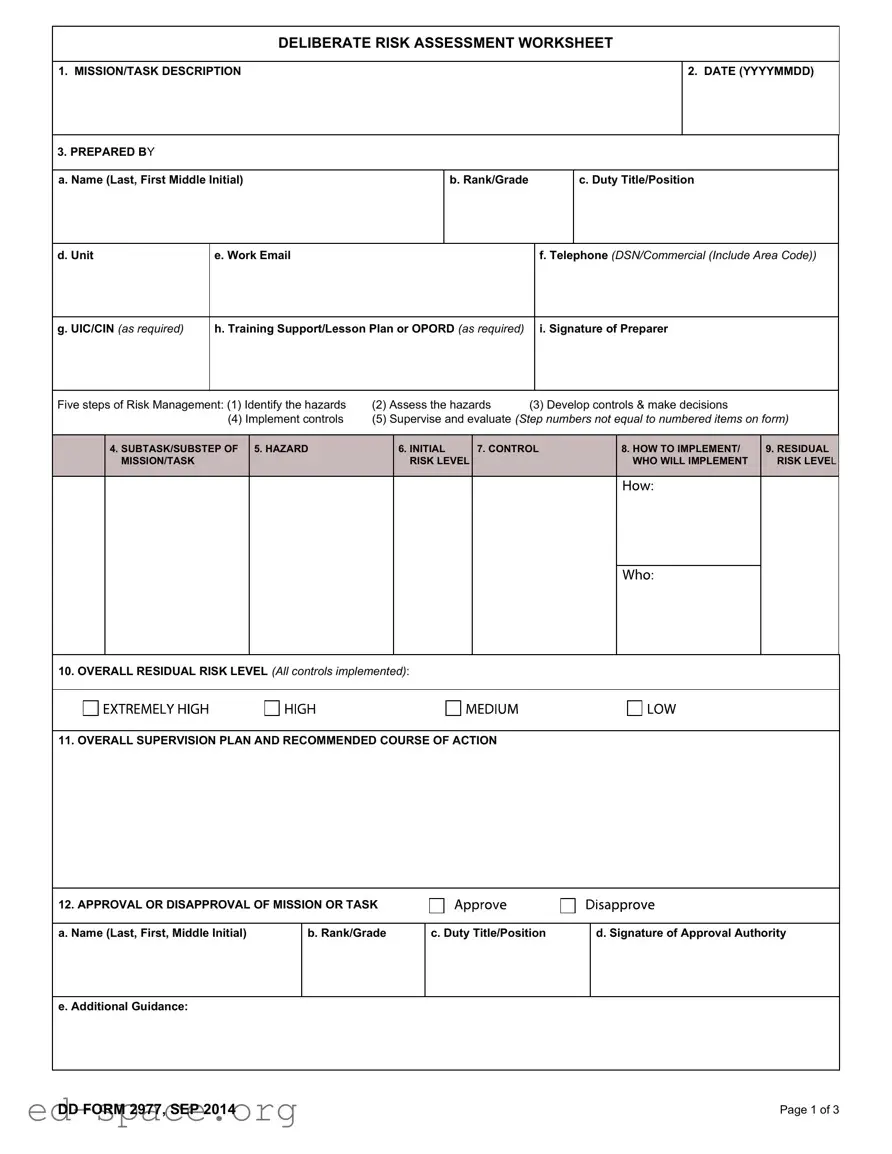
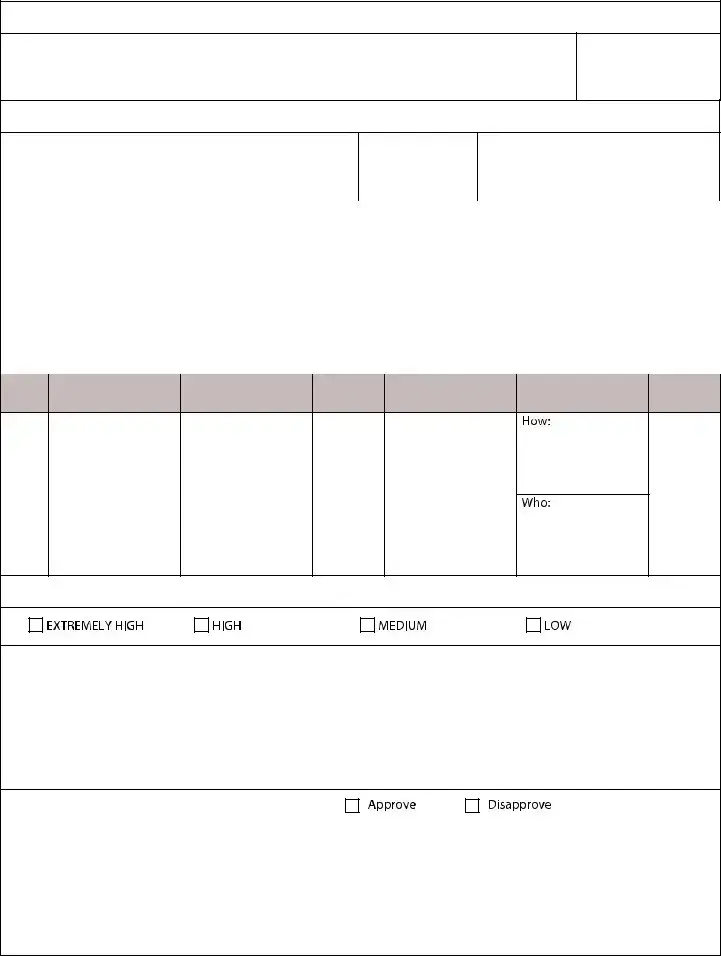
The DD Form 2977, known as the Deliberate Risk Assessment Worksheet, plays a crucial role in ensuring the safety and effectiveness of military operations. This form is designed to guide personnel through a structured process for identifying and managing risks associated with specific missions or tasks. It begins with a detailed description of the mission and requires essential information about the preparer, including their name, rank, and unit. The form outlines five key steps of risk management: identifying hazards, assessing those hazards, developing and implementing controls, and finally supervising and evaluating the effectiveness of those controls. Each hazard is assessed for its initial risk level based on probability and severity, allowing teams to understand the potential impacts on mission success. The form also provides a systematic way to document controls, assign responsibilities for implementation, and evaluate residual risks after controls are put in place. Furthermore, it incorporates a review process for ongoing operations and encourages feedback and lessons learned to continuously improve risk management practices. By utilizing the DD Form 2977, military personnel can enhance their decision-making and ensure a safer operational environment.
DELIBERATE RISK ASSESSMENT WORKSHEET
1. MISSION/TASK DESCRIPTION
2. DATE (YYYYMMDD)
3. PREPARED BY
a. Name (Last, First Middle Initial) |
b. Rank/Grade |
c. Duty Title/Position |
d. Unit |
e. Work Email |
|
|
f. Telephone (DSN/Commercial (Include Area Code)) |
|
|
|
|
|
g. UIC/CIN (as required) |
h. Training Support/Lesson Plan or OPORD (as required) |
|
i. Signature of Preparer |
|
|
|
|
|
|
Five steps of Risk Management: (1) Identify the hazards |
(2) Assess the hazards |
(3) Develop controls & make decisions |
||
|
(4) Implement controls |
(5) Supervise and evaluate (Step numbers not equal to numbered items on form) |
||
|
|
|
|
|
4. SUBTASK/SUBSTEP OF 5. HAZARD MISSION/TASK
6.INITIAL RISK LEVEL
7. CONTROL
8.HOW TO IMPLEMENT/ WHO WILL IMPLEMENT
9.RESIDUAL RISK LEVEL
10.OVERALL RESIDUAL RISK LEVEL (All controls implemented):
11.OVERALL SUPERVISION PLAN AND RECOMMENDED COURSE OF ACTION
12. APPROVAL OR DISAPPROVAL OF MISSION OR TASK
a. Name (Last, First, Middle Initial) |
b. Rank/Grade |
c. Duty Title/Position |
d. Signature of Approval Authority |
|
|
|
|
e. Additional Guidance:
DD FORM 2977, SEP 2014 |
Page 1 of 3 |

|
|
Probability (expected frequency) |
|
|
|
||
|
|
|
|
|
|
|
|
|
|
Frequent: |
Likely: |
Occasional: |
Seldom: |
Unlikely: |
|
Risk Assessment Matrix |
|
Continuous, |
Several or |
Sporadic or |
Infrequent |
Possible |
|
|
regular, or |
numerous |
intermittent |
occurrences |
occurrences |
||
|
|
inevitable |
occurrences |
occurrences |
|
but improbable |
|
|
|
occurrences |
|
|
|
|
|
Severity (expected consequence) |
|
A |
B |
C |
D |
E |
|
|
|
|
|
|
|
|
|
Catastrophic: Mission failure, unit readiness eliminated; |
I |
EH |
EH |
H |
H |
M |
|
death, unacceptable loss or damage |
|||||||
|
|
|
|
|
|
||
|
|
|
|
|
|
|
|
Critical: Significantly degraded unit readiness or mission |
II |
EH |
H |
H |
M |
L |
|
capability; severe injury, illness, loss or damage |
|||||||
|
|
|
|
|
|
||
|
|
|
|
|
|
|
|
Moderate: Somewhat degraded unit readiness or mission |
III |
H |
M |
M |
L |
L |
|
capability; minor injury, illness, loss, or damage |
|||||||
|
|
|
|
|
|
||
|
|
|
|
|
|
|
|
Negligible: Little or no impact to unit readiness or mission |
IV |
M |
L |
L |
L |
L |
|
capability; minimal injury, loss, or damage |
|||||||
|
|
|
|
|
|
||
|
|
|
|
|
|
|
|
Legend: EH - Extremely High Risk H - High Risk M - Medium Risk |
L - Low Risk |
|
|
|
|||
|
|
|
|
|
|
|
|
13.RISK ASSESSMENT REVIEW (Required when assessment applies to ongoing operations or activities)
a. Date |
b. Last Name |
c. Rank/Grade |
d. Duty Title/Position |
e. Signature of Reviewer |
|
|
|
|
|
|
|
|
|
|
|
|
|
|
|
14. FEEDBACK AND LESSONS LEARNED
15. ADDITIONAL COMMENTS OR REMARKS
DD FORM 2977, SEP 2014 |
Page 2 of 3 |

Instructions for Completing DD Form 2977, "Deliberate Risk Assessment Worksheet"
1.Mission/Task Description: Briefly describe the overall Mission or Task for which the deliberate risk assessment is being conducted.
2.Date (DD/MM/YYY): Self Explanatory.
3.Prepared By: Information provided by the individual conducting the deliberate risk assessment for the operation or training. Legend: UIC = Unit Identification Code; CIN = Course ID Number; OPORD = operation order; DSN = defense switched network; COMM = commercial
4.
5.Hazard: Specify hazards related to the subtask in block 4.
6.Initial Risk Level: Determine probability and severity. Using the risk assessment matrix (page 3), determine level of risk for each hazard specified. probability, severity and associated Risk Level; enter level into column.
7.Control: Enter risk mitigation resources/ controls identified to abate or reduce risk relevant to the hazard identified in block 5.
8.How to Implement / Who Will Implement: Briefly describe the means of employment for each control (i.e., OPORD, briefing, rehearsal) and the name of the individual unit or office that has primary responsibility for control implementation.
9.Residual Risk Level: After controls are
implemented, determine resulting probability, severity, and residual risk level.
10.Overall Risk After Controls are Implemented: Assign an overall residual risk level. This is equal to or greater than the highest residual risk level (from block 9).
11.Supervision Plan and Recommended Course of Action: Completed by preparer. Identify specific tasks and levels of responsibility for supervisory personnel and provide the decision authority with a recommend course of action for approval or disapproval based upon the overall risk assessment.
12.Approval/Disapproval of Mission/Task: Risk approval authority approves or disapproves the mission or task based on the overall risk assessment, including controls, residual risk level, and supervision plan.
13.Risk Assessment Review: Should be conducted on a regular basis. Reviewers should have sufficient oversight of the mission or activity and controls to provide valid input on changes or adjustments needed. If the residual risk rises above the level already approved, operations should cease until the appropriate approval authority is contacted and approves continued operations.
14.Feedback and Lessons Learned: Provide specific input on the effectiveness of risk controls and their contribution to mission success or failure. Include recommendations for new or revised controls, practicable solutions, or alternate actions. Submit and brief valid lessons learned as necessary to persons affected.
15.Additional Comments or Remarks: Preparer or approval authority provides any additional comments, remarks, or information to support the integration of risk management.
Additional Guidance: Blocks
DD FORM 2977, SEP 2014 |
Page 3 of 3 |
| Fact Name | Description |
|---|---|
| Purpose | The DD Form 2977 is used to conduct a deliberate risk assessment for military operations or training. |
| Components | The form includes sections for mission description, risk levels, controls, and approval signatures. |
| Risk Management Steps | It outlines five steps: identify hazards, assess hazards, develop controls, implement controls, and supervise/evaluate. |
| Initial Risk Level | Users must determine the initial risk level based on the probability and severity of identified hazards. |
| Approval Process | The form requires an approval or disapproval section, ensuring accountability for the mission or task. |
| State-Specific Forms | Some states may have specific regulations governing the use of risk assessment forms, such as state safety laws. |
Filling out the DD Form 2977 is a crucial step in conducting a deliberate risk assessment for any mission or task. After completing this form, it will be reviewed by the appropriate authorities to ensure all risks are adequately identified and managed. This process helps maintain safety and operational effectiveness.
What is the DD Form 2977?
The DD Form 2977, also known as the Deliberate Risk Assessment Worksheet, is a tool used by military personnel to assess risks associated with specific missions or tasks. It helps in identifying potential hazards, evaluating their severity and likelihood, and implementing controls to mitigate those risks.
How do I fill out the DD Form 2977?
To complete the DD Form 2977, start by providing a brief description of the mission or task. Include the date and the preparer's information, such as name, rank, and contact details. Identify subtasks and related hazards, assess the initial risk level, and outline controls to mitigate those risks. Finally, indicate how and who will implement these controls and assess the residual risk level after implementation.
What are the key components of the DD Form 2977?
The key components include the mission/task description, date, prepared by information, subtasks, hazards, initial risk levels, controls, implementation details, residual risk levels, and an overall supervision plan. Each section is designed to ensure a comprehensive risk assessment.
What is the purpose of the risk assessment matrix included in the form?
The risk assessment matrix helps determine the initial risk level by evaluating the probability and severity of identified hazards. It categorizes risks into levels such as high, medium, and low, guiding decision-makers on how to manage those risks effectively.
Who is responsible for the approval or disapproval of the mission/task?
The approval or disapproval of the mission or task is the responsibility of the designated risk approval authority. This individual reviews the overall risk assessment, including identified controls and residual risk levels, before making a decision.
What should I do if the residual risk level increases after controls are implemented?
If the residual risk level rises above the approved level, operations should cease immediately. The preparer must consult the appropriate approval authority to reassess and approve continued operations, ensuring safety and compliance with risk management protocols.
How can feedback and lessons learned be integrated into the DD Form 2977 process?
Feedback and lessons learned should be documented in the designated section of the form. This input can include the effectiveness of risk controls and recommendations for improvements. Sharing this information helps refine future risk assessments and enhances overall mission success.
Incomplete Mission/Task Description: Providing a vague or incomplete description of the mission or task can lead to misunderstandings. Clearly outline the task to ensure all risks are properly assessed.
Incorrect Date Format: The date must be in the YYYYMMDD format. Failing to follow this format can cause confusion and delays in processing the form.
Missing Prepared By Information: All fields under the "Prepared By" section should be filled out completely. Omitting any details such as name, rank, or contact information can hinder communication.
Neglecting Hazard Identification: It is crucial to specify all hazards related to the subtask. Overlooking any potential hazards can compromise safety and mission success.
Failure to Assess Initial Risk Level: Not determining the initial risk level for each hazard can lead to inadequate risk management. Use the risk assessment matrix to evaluate probability and severity.
Inadequate Control Measures: Entering insufficient or vague controls in the "Control" section can lead to ineffective risk mitigation. Clearly define all risk mitigation strategies and responsible parties.
The DD Form 2977, known as the Deliberate Risk Assessment Worksheet, is a crucial document used in military operations to assess and manage risks associated with missions or tasks. Alongside this form, several other documents are frequently utilized to ensure comprehensive risk management and operational effectiveness. Below is a list of these documents, each accompanied by a brief description.
These documents collectively enhance the risk management process and ensure that military operations are conducted safely and effectively. By utilizing them in conjunction with the DD Form 2977, military personnel can better prepare for and respond to the challenges they may face in the field.
When filling out the DD Form 2977, it is essential to follow specific guidelines to ensure accuracy and clarity. Below are five things to do and avoid.
Understanding the DD Form 2977, also known as the Deliberate Risk Assessment Worksheet, is crucial for effective risk management in military operations. However, several misconceptions can lead to confusion. Here are seven common misunderstandings:
By addressing these misconceptions, individuals can better utilize the DD Form 2977 and enhance their risk management practices.
When filling out the DD 2977 form, here are some important points to remember:
By keeping these key points in mind, you can effectively complete the DD 2977 form and contribute to a safer operational environment.