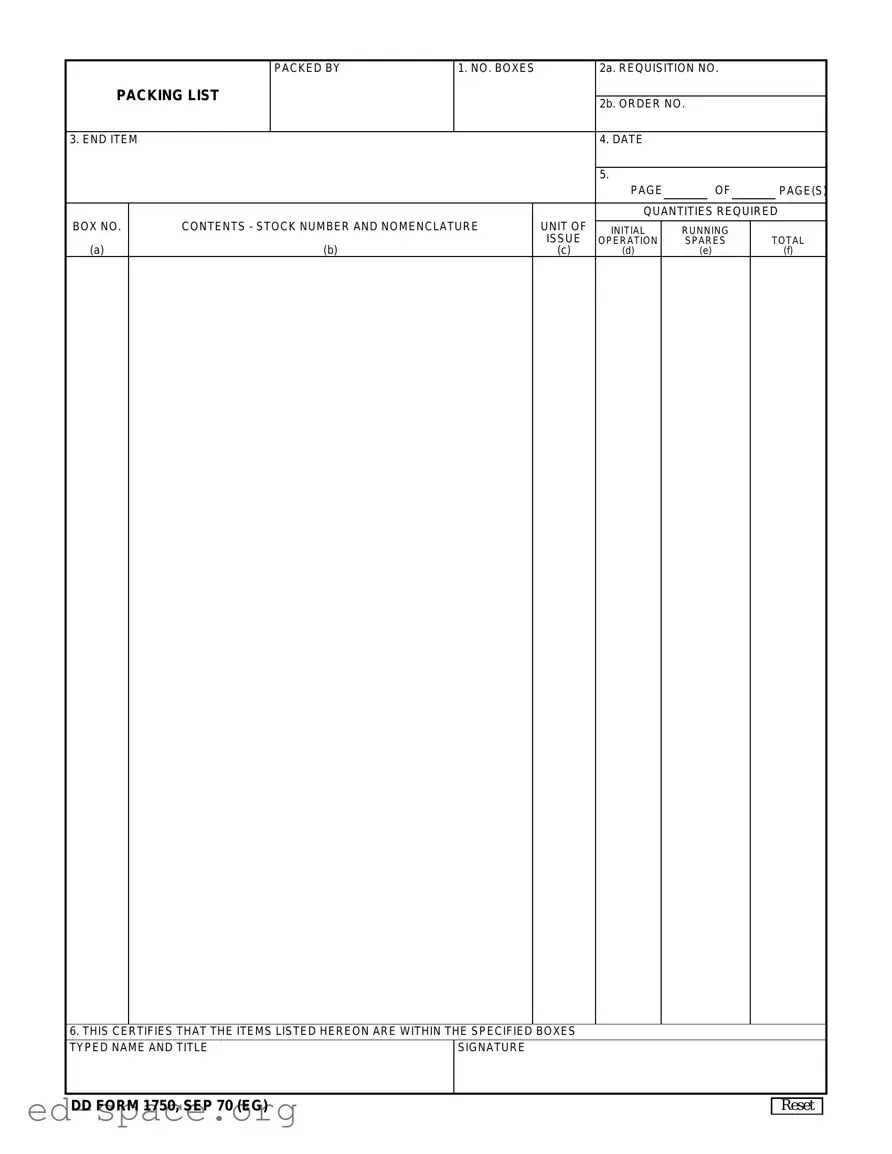
The DD Form 1750 serves a crucial role in the logistics and inventory management processes within the Department of Defense (DoD). This packing list is designed to facilitate the efficient tracking and organization of military supplies and equipment during shipment. Each form includes essential details such as the number of boxes, requisition and order numbers, and specific information about the end items being shipped. The form also captures the date of preparation and outlines the contents of each box, including stock numbers and nomenclature, which helps ensure that all items are accounted for and properly categorized. Furthermore, it distinguishes between items necessary for initial operation and those designated as running spares, allowing for clear communication regarding the operational readiness of equipment. The DD Form 1750 not only serves as a record for the consignee but also aids in maintaining accurate property books and inventory management, making it a vital tool for military logistics. Understanding the various components of this form is essential for anyone involved in the procurement and distribution of military supplies, as it streamlines the process and enhances accountability.

|
|
PACKED BY |
1. NO. BOXES |
|
2a. REQUISITION NO. |
|
|
||
PACKING LIST |
|
|
|
|
|
|
|
|
|
|
|
|
2b. ORDER NO. |
|
|
||||
|
|
|
|
|
|
|
|||
|
|
|
|
|
|
|
|
|
|
3. END ITEM |
|
|
|
|
4. DATE |
|
|
|
|
|
|
|
|
|
|
|
|
|
|
|
|
|
|
|
5. |
|
|
|
|
|
|
|
|
|
PAGE |
|
OF |
|
PAGE(S) |
|
|
|
|
|
|
|
|
|
|
BOX NO. |
CONTENTS - STOCK NUMBER AND NOMENCLATURE |
UNIT OF |
QUANTITIES REQUIRED |
||||||
INITIAL |
RUNNING |
TOTAL |
|||||||
(a) |
|
(b) |
|
ISSUE |
OPERATION |
SPARES |
|||
|
|
(c) |
(d) |
(e) |
|
(f) |
|||
6. THIS CERTIFIES THAT THE ITEMS LISTED HEREON ARE WITHIN THE SPECIFIED BOXES
TYPED NAME AND TITLE |
SIGNATURE |
DD FORM 1750, SEP 70 (EG)
Reset

NOTES TO CONSIGNEE
The listing shown on the reverse side, together with pertinent notations relative to each item included, is furnished for your information and guidance only. In the case of lists covering equipment sets, one copy may be retained for reference and used as a supporting document to property books and the other copy retained with the equipment as a component parts listing. For the purpose of clarification, explanations of the various entries on this Packing List are furnished.
ITEM 1. The number of boxes in a set.
ITEMS 2a. & b. The requisition number appearing on the DD Form
ITEM 3. The stock number, nomenclature, type number (when available), and the directive under which the end item was assembled. Not applicable to shipments consisting only of miscellaneous repair parts and accessories for the assembly, set or unit in which case this entry will contain such a notation in lieu of the information cited above (See 5.3.1.1).
ITEM 4. Date of preparation.
ITEM 5.
Column a. This column will be used when two or more boxes are required for the equipment. It will indicate the number of the container in which the items are packed.
Column b. This space contains a listing of items contained within the box, which are identified by stock number and nomenclature. When an FSN is not
applicable, the manufacturer's code (See 5.2.2.10) and part number shall be used.
NOTE: As required, due to out of stock position within the DOD supply system, a component parts shortage which will not hinder operational functions may be waived by higher authority and will be so indicated to the right of the nomenclature. Waivers noted thereon should be requisitioned through normal supply channels.
Column c.
Column d. "Initial Operation" - Items which are required for operation of the equipment.
Column e. "Running Spares" - Those items shipped concurrently with the equipment as spare parts and accessories.
NOTE: Columns d and e will be used on an optional basis.
"Total" -
ITEM 6.
DD FORM 1750 Reverse, SEP 70
| Fact Name | Description |
|---|---|
| Purpose | The DD Form 1750 is primarily used as a packing list for military shipments, detailing the contents of boxes and their respective stock numbers. |
| Requisition Numbers | Sections 2a and 2b of the form require the requisition number and order number, which are crucial for tracking and correspondence regarding the shipment. |
| Contents Listing | Column b lists the items in each box, identified by stock number and nomenclature, ensuring clarity about what is included in the shipment. |
| Operational Items | Columns d and e specify items necessary for initial operation and running spares, helping to differentiate between immediate needs and additional supplies. |
| Date of Preparation | Item 4 requires the date the form was completed, which is important for record-keeping and tracking shipment timelines. |
| Certification | Item 6 certifies that the items listed are packed within the specified boxes, ensuring accountability and accuracy in shipments. |
| State-Specific Forms | While the DD Form 1750 is a federal form, certain states may have additional requirements governed by their own procurement laws, which should be verified separately. |
Filling out the DD Form 1750 is a straightforward process that requires attention to detail. Each section of the form must be completed accurately to ensure proper documentation of the items being packed. Following the steps outlined below will help in effectively completing the form.
After completing the form, ensure all entries are clear and legible. The next steps involve retaining copies as necessary and distributing the completed form as required for shipping and record-keeping purposes.
What is the purpose of the DD Form 1750?
The DD Form 1750 serves as a packing list for shipments within the Department of Defense (DoD). It provides detailed information about the contents of boxes being shipped, including stock numbers, item descriptions, and quantities. This form is essential for ensuring that all items are accounted for during the shipping process and helps facilitate proper inventory management upon receipt.
What information is required on the DD Form 1750?
Several key pieces of information must be included on the DD Form 1750. First, the number of boxes in the shipment should be indicated. Next, the requisition and order numbers from the relevant forms must be noted. Additionally, details about the end item, such as stock numbers and nomenclature, are necessary. The form also requires the date of preparation and a breakdown of contents for each box, including initial operational items and running spares. This comprehensive data helps ensure clarity and accuracy in the shipping process.
How should the DD Form 1750 be used upon receipt of the shipment?
Upon receiving a shipment accompanied by the DD Form 1750, it’s important to carefully review the form against the actual contents of the boxes. This ensures that all items listed are present and in good condition. If discrepancies are found, they should be documented and reported to the appropriate supply channels immediately. Additionally, one copy of the form can be retained for reference, while another should stay with the equipment as a component parts listing, aiding in future inventory checks and management.
Are there any specific notes or instructions for the consignee regarding the DD Form 1750?
Yes, there are important notes for the consignee. The reverse side of the DD Form 1750 contains additional information and guidance related to each item included in the shipment. It’s crucial to pay attention to any notations regarding equipment sets or component parts. If there are any waivers noted due to component shortages that do not affect operational functionality, these should be requisitioned through normal supply channels. This ensures that all necessary parts are eventually obtained without hindering operations.
Not filling in the requisition number correctly. This number is crucial for tracking the shipment and should match the number on the DD Form 1348-1.
Leaving out the date of preparation. This date helps in understanding when the packing list was created and is important for record-keeping.
Failing to list the correct stock number and nomenclature. Each item needs accurate identification to avoid confusion during shipment and receipt.
Not indicating the number of boxes correctly. Each box in a shipment should be numbered to ensure all items can be accounted for easily.
Overlooking the contents column. This should clearly list what is inside each box, including stock numbers and descriptions.
Misunderstanding the columns for initial operation and running spares. Items required for operation should be clearly marked, and spares should be listed separately.
Not signing the form. A signature is necessary to certify that the information provided is accurate and complete.
Ignoring the notes to consignee. These notes provide important guidance and should be reviewed carefully to ensure compliance with shipping requirements.
The DD Form 1750 is a crucial document used in military logistics, specifically for packing lists. It provides essential details about the contents of boxes being shipped, ensuring that all items are accounted for and properly documented. Alongside this form, there are several other important documents that often accompany it to facilitate the shipping and receiving process. Here are five commonly used forms and documents:
Each of these documents plays a significant role in the logistics and supply chain process, helping to maintain order and accountability. Understanding their purposes can streamline operations and enhance communication between parties involved in the shipment and receipt of goods.
The DD Form 1750 is a packing list used primarily by the Department of Defense to detail the contents of a shipment. Several other documents serve similar purposes in tracking and managing inventory, shipments, and requisitions. Here are four documents that are comparable to the DD Form 1750:
When filling out the DD Form 1750, it is essential to follow specific guidelines to ensure accuracy and compliance. Here are four key points to consider:
By adhering to these guidelines, individuals can facilitate a smoother process when completing the DD Form 1750.
Misconceptions about the DD 1750 form can lead to confusion and mistakes in handling military shipments. Here are four common misunderstandings:
Filling out the DD Form 1750 is a critical step in ensuring proper documentation for military shipments. Here are some key takeaways to keep in mind:
By following these guidelines, you can help ensure a smooth shipping process and maintain compliance with military logistics requirements.