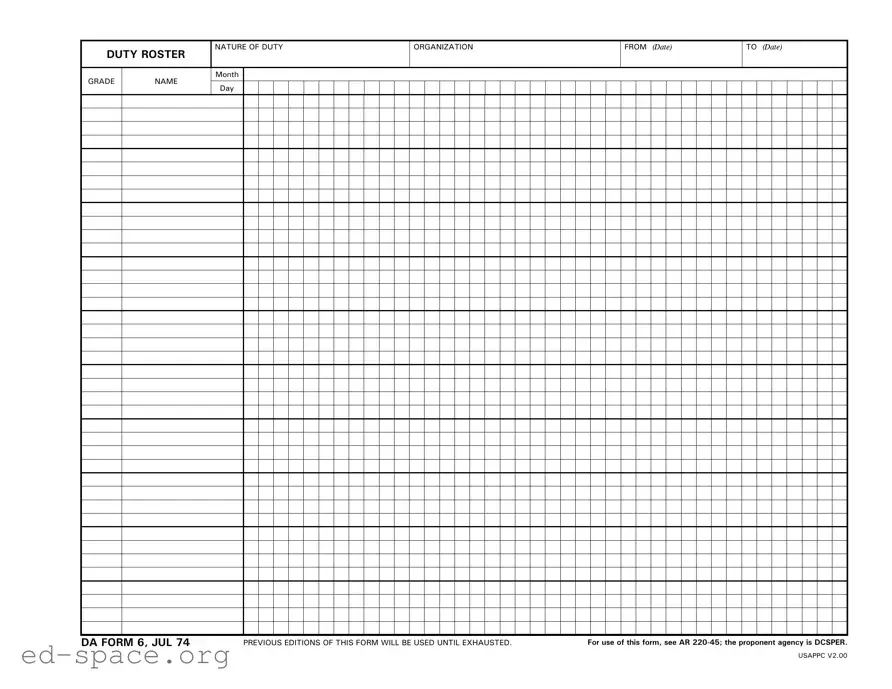
The DA 6 form is a crucial document used by the United States Army to manage and record duty rosters for personnel. It captures essential information, including the nature of duty, the organization, and the specific dates during which the duty is performed. Each entry on the form outlines the month, grade, and name of the individual assigned to a particular duty. This systematic approach ensures that all personnel are accounted for and that their responsibilities are clearly defined. The form also adheres to guidelines set forth in AR 220-45, which governs the management of duty rosters. Notably, the DA 6 form has undergone various revisions, with the current version dating back to July 1974, although previous editions may still be in circulation until they are fully utilized. This document plays a vital role in maintaining organizational efficiency and accountability within the Army's operational framework.
NATURE OF DUTY |
ORGANIZATION |
FROM (DATE) |
TO (DATE) |
DUTY ROSTER
Month
GRADE |
NAME |
Day
DA FORM 6, JUL 74 |
PREVIOUS EDITIONS OF THIS FORM WILL BE USED UNTIL EXHAUSTED. |
For use of this form, see AR |
USAPPC V2.00
| Fact Name | Description |
|---|---|
| Nature of Duty | The form captures the specific duties assigned to a service member during a designated period. |
| Organization | The form requires the name of the organization to which the service member is assigned. |
| Date Range | It specifies the start and end dates for the duty period covered by the form. |
| Duty Roster | The form includes a month-by-month breakdown of the duty roster for the specified period. |
| Governing Laws | This form is governed by AR 220-45, which outlines the requirements for duty rosters. |
| Version Information | The current version is DA Form 6, dated July 1974, with previous editions still valid until exhausted. |
Filling out the DA Form 6 is an important task that ensures proper documentation of duty assignments and roster information. Follow these steps carefully to complete the form accurately.
Once you have completed the DA Form 6, review it for accuracy and completeness before submitting it to the appropriate authority. This ensures that all necessary information is captured and helps maintain effective record-keeping.
What is the DA 6 form used for?
The DA 6 form, also known as the Duty Roster form, is utilized by military personnel to document and manage duty assignments. It helps in organizing the schedule for soldiers, ensuring that everyone is aware of their responsibilities and duties during a specified period. This form is essential for maintaining accountability and operational efficiency within military units.
Who is responsible for filling out the DA 6 form?
The responsibility for completing the DA 6 form typically falls on the unit's leadership, such as the first sergeant or other designated personnel. They gather information from team members about their duties and compile this data into the form. It's crucial for leadership to ensure accuracy and clarity when filling out the form to avoid any confusion regarding assignments.
What information is required on the DA 6 form?
The DA 6 form requires several key pieces of information. This includes the nature of duty, the organization, the dates for the duty period, and the duty roster for each month. Additionally, it asks for the grade and name of the soldiers assigned to specific duties. This comprehensive information helps maintain a clear and organized schedule.
How often should the DA 6 form be updated?
Updating the DA 6 form is essential whenever there are changes in duty assignments, personnel, or operational requirements. Regular updates ensure that all members of the unit have the most current information regarding their responsibilities. Generally, it is advisable to review and revise the form at the beginning of each month or as needed.
Is there a specific format for the DA 6 form?
Yes, the DA 6 form follows a specific format that includes designated sections for entering the required information. The form is designed to be user-friendly, with clear headings and spaces for each category of data. While the form may have a standard layout, it's important to follow any additional guidelines provided by your unit or command to ensure compliance.
Where can I obtain a copy of the DA 6 form?
You can obtain a copy of the DA 6 form from your unit's administrative office or through the official military forms website. The form is also available in various formats, including printed copies and digital versions. It's important to use the most current version of the form, as previous editions may still be in circulation until they are exhausted.
Not providing the correct dates for the period of duty. Ensure that the "FROM" and "TO" dates are accurate to avoid discrepancies.
Failing to include the organization name. This information is crucial for identifying where the duty took place.
Leaving the duty roster section incomplete. Make sure to fill in all relevant details to reflect your actual duty schedule.
Using an outdated version of the form. Always verify that you are using the most current version of the DA Form 6.
Not signing the form. A signature is required to validate the information provided.
Overlooking the grade section. This information helps categorize the duty and its responsibilities.
Providing incorrect or inconsistent information across different sections of the form. Consistency is key to avoid confusion.
Failing to check for clarity and legibility. Ensure that all handwriting is clear and easy to read to prevent misunderstandings.
The DA Form 6 is an essential document used by military personnel to record duty rosters and related information. When completing this form, it may be beneficial to have additional documents on hand. Here are five other forms often used alongside the DA Form 6:
Having these forms readily available can facilitate smoother administrative processes and ensure that all necessary information is accurately documented. Each form serves a specific purpose and collectively supports the effective management of military personnel.
The DA 6 form is a document used by the U.S. Army for duty roster purposes. It has some similarities with other forms and documents that serve related functions. Here are six documents that share similarities with the DA 6 form:
When filling out the DA Form 6, it's essential to approach the task with care and attention to detail. Here are four important guidelines to follow:
By following these guidelines, you can help ensure that your submission is complete and accurate, facilitating a smoother processing experience.
There are several misconceptions about the DA Form 6 that can lead to confusion for those required to use it. Below is a list of common misunderstandings, along with clarifications for each.
Understanding these misconceptions can help ensure that the DA Form 6 is completed accurately and effectively, supporting duty management processes.
When filling out and using the DA Form 6, keep these key takeaways in mind: