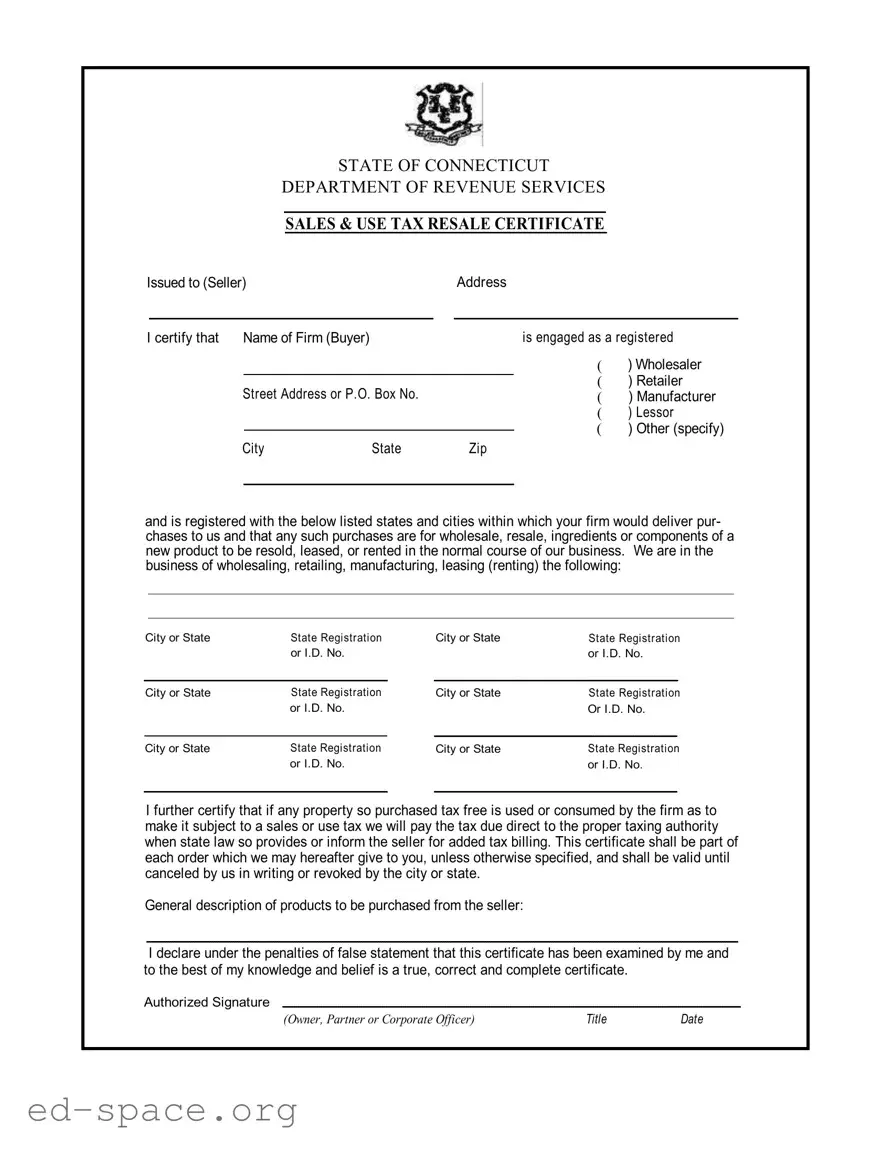
The Connecticut Resale Certificate form serves as a vital tool for businesses engaged in wholesale, retail, manufacturing, or leasing activities. This form allows buyers to purchase goods without paying sales tax, provided that these goods are intended for resale or for use in producing new products. By completing the form, a buyer certifies their status as a registered wholesaler, retailer, manufacturer, or lessor, along with their registration details from various states and cities. This certification not only streamlines the purchasing process but also ensures compliance with state tax laws. In addition to identifying the buyer and their business activities, the form requires a declaration regarding the intended use of the purchased items. Should any tax-exempt items be used in a manner that subjects them to sales or use tax, the buyer commits to paying the tax to the appropriate authorities. The certificate remains valid until it is canceled or revoked, and it must accompany every order placed with the seller unless specified otherwise. By signing this document, the authorized representative of the buyer affirms the accuracy of the information provided, thereby upholding the integrity of the resale process.
STATE OF CONNECTICUT
DEPARTMENT OF REVENUE SERVICES
SALES & USE TAX RESALE CERTIFICATE
Issued to (Seller) |
|
|
Address |
|
||||
|
|
|
|
|
|
|
|
|
I certify that |
Name of Firm (Buyer) |
|
|
|
is engaged as a registered |
|||
|
|
|
|
|
|
|
( |
) Wholesaler |
|
|
Street Address or P.O. Box No. |
( |
) Retailer |
||||
|
|
( |
) Manufacturer |
|||||
|
|
|
|
|
|
( |
) Lessor |
|
|
|
|
|
|
|
|
( |
) Other (specify) |
|
|
|
|
State |
|
|||
|
|
City |
Zip |
|
||||
|
|
|
|
|
|
|
|
|
and is registered with the below listed states and cities within which your firm would deliver pur- chases to us and that any such purchases are for wholesale, resale, ingredients or components of a new product to be resold, leased, or rented in the normal course of our business. We are in the business of wholesaling, retailing, manufacturing, leasing (renting) the following:
City or State |
State Registration |
|
or I.D. No. |
City or State |
State Registration |
|
or I.D. No. |
City or State |
State Registration |
|
or I.D. No. |
City or State |
State Registration |
|
or I.D. No. |
City or State |
State Registration |
|
Or I.D. No. |
City or State |
State Registration |
|
or I.D. No. |
I further certify that if any property so purchased tax free is used or consumed by the firm as to make it subject to a sales or use tax we will pay the tax due direct to the proper taxing authority when state law so provides or inform the seller for added tax billing. This certificate shall be part of each order which we may hereafter give to you, unless otherwise specified, and shall be valid until canceled by us in writing or revoked by the city or state.
General description of products to be purchased from the seller:
I declare under the penalties of false statement that this certificate has been examined by me and to the best of my knowledge and belief is a true, correct and complete certificate.
Authorized Signature
(Owner, Partner or Corporate Officer) |
TITLE |
DATE |
| Fact Name | Details |
|---|---|
| Purpose | The Connecticut Resale Certificate allows buyers to purchase goods without paying sales tax, as long as the items are for resale or use in their business. |
| Who Can Use It | Wholesalers, retailers, manufacturers, lessors, and other specified entities can use this certificate. |
| Registration Requirement | Buyers must be registered with the appropriate state and have a valid registration or ID number. |
| Validity | This certificate remains valid until it is canceled in writing by the buyer or revoked by the state or city. |
| Tax Responsibilities | If property purchased tax-free is used in a way that incurs tax, the buyer must pay the tax directly to the taxing authority. |
| Governing Law | The use of this certificate is governed by the Connecticut General Statutes, specifically related to sales and use tax. |
| Signature Requirement | An authorized signature from the buyer is required to validate the certificate, confirming its accuracy and completeness. |
Completing the Connecticut Resale Certificate form is a straightforward process. This certificate is essential for businesses that wish to make tax-exempt purchases. Follow the steps below to ensure accurate completion.
After completing the form, keep a copy for your records. Submit the original to the seller to facilitate tax-exempt purchases. Ensure that all information is accurate to avoid potential issues with tax compliance.
What is the purpose of the Connecticut Resale Certificate?
The Connecticut Resale Certificate is a document that allows a buyer to purchase goods without paying sales tax. It certifies that the buyer intends to resell the items in the normal course of their business. This certificate is essential for businesses that operate as wholesalers, retailers, manufacturers, or lessors, as it helps them avoid unnecessary taxation on items they plan to sell or lease.
Who can use the Connecticut Resale Certificate?
Any registered business in Connecticut can use the Resale Certificate, provided they are engaged in activities such as wholesaling, retailing, manufacturing, or leasing. The buyer must be registered with the appropriate state and local authorities. This ensures that the buyer is recognized as a legitimate business entity that is eligible to make tax-exempt purchases for resale purposes.
How do I fill out the Connecticut Resale Certificate?
To complete the Resale Certificate, you need to provide specific information, including the name and address of both the seller and buyer. Indicate the type of business the buyer operates (e.g., wholesaler, retailer, etc.) and list any relevant state registration or identification numbers. Additionally, include a general description of the products to be purchased. Ensure that the authorized signature is provided, along with the title and date, to validate the certificate.
What happens if I use the Resale Certificate incorrectly?
If a business uses the Resale Certificate for items that are not intended for resale, it may face penalties. In such cases, the buyer becomes responsible for paying the applicable sales tax directly to the taxing authority. It is crucial to use the certificate correctly to avoid any legal or financial repercussions.
How long is the Connecticut Resale Certificate valid?
The Connecticut Resale Certificate remains valid until it is canceled by the buyer in writing or revoked by the relevant city or state authorities. It should be included with each order made to the seller unless specified otherwise. Businesses should keep track of their certificates to ensure compliance with state regulations.
Incomplete Seller Information: Failing to provide the full name and address of the seller can lead to confusion and invalidation of the certificate.
Incorrect Buyer Classification: Choosing the wrong classification (wholesaler, retailer, etc.) can result in penalties. Ensure the correct status is indicated.
Missing State Registration Numbers: Omitting state registration or identification numbers can render the certificate ineffective. Each applicable state must be listed.
Vague Product Descriptions: Providing a general or unclear description of the products being purchased can lead to disputes. Be specific about the items.
Failure to Sign: Not signing the certificate or having an unauthorized person sign can invalidate the document. Ensure the signature is from an authorized individual.
The Connecticut Resale Certificate is an important document used for tax exemption on purchases intended for resale. When using this form, you may also encounter several other documents that support or complement its use. Below is a list of these forms, each serving a specific purpose in the resale process.
These forms and documents work together to ensure that your transactions are compliant with tax regulations and that your business operations run smoothly. Having the necessary paperwork in order can help avoid issues with tax authorities and streamline your purchasing processes.
The Connecticut Resale Certificate form is an important document used in the sales and use tax process. It allows businesses to purchase goods tax-free if those goods are intended for resale. Several other documents serve similar purposes across different jurisdictions or contexts. Here’s a list of eight documents that share similarities with the Ct Resale Certificate:
Each of these documents plays a crucial role in ensuring compliance with tax regulations while facilitating business transactions. Understanding their similarities can help businesses navigate the complexities of sales tax more effectively.
When filling out the Connecticut Resale Certificate form, it’s important to follow specific guidelines to ensure accuracy and compliance. Here’s a list of what you should and shouldn’t do:
Misconceptions about the Connecticut Resale Certificate form can lead to confusion for both buyers and sellers. Here are seven common misconceptions along with explanations to clarify them.
When filling out and using the Connecticut Resale Certificate form, it is essential to understand the following key points: