Homepage Blank Cswmft Ohio Gov PDF Form
Article Guide

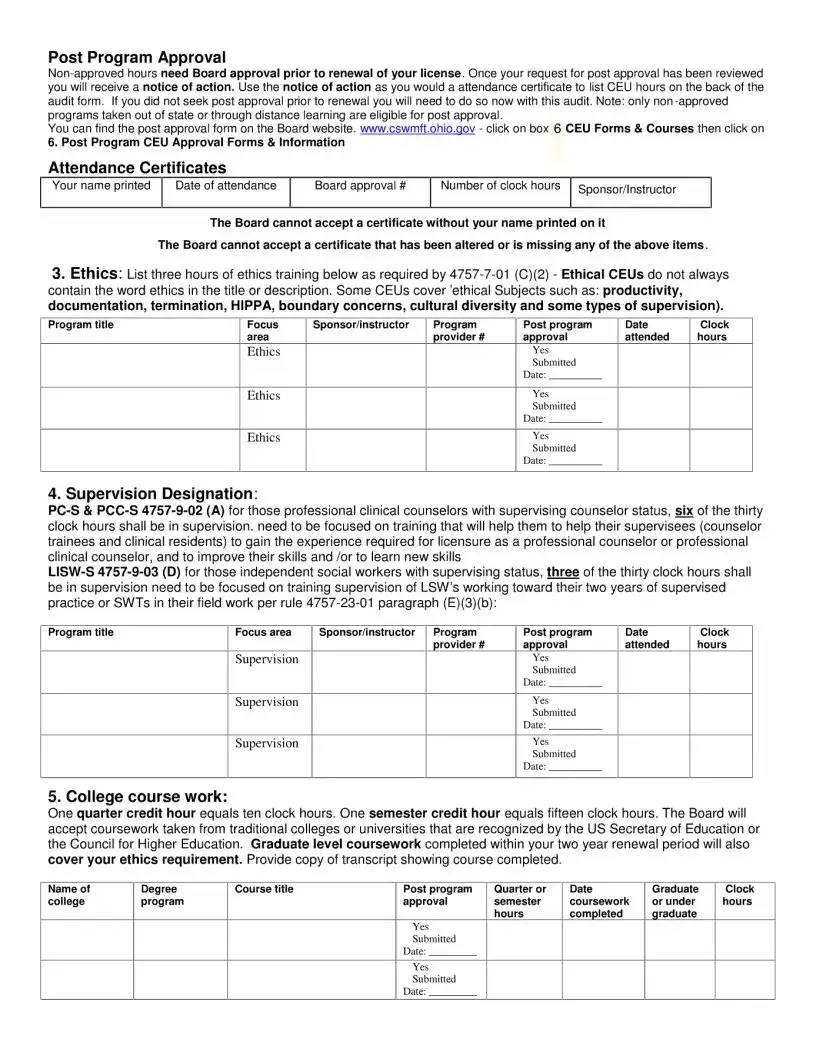
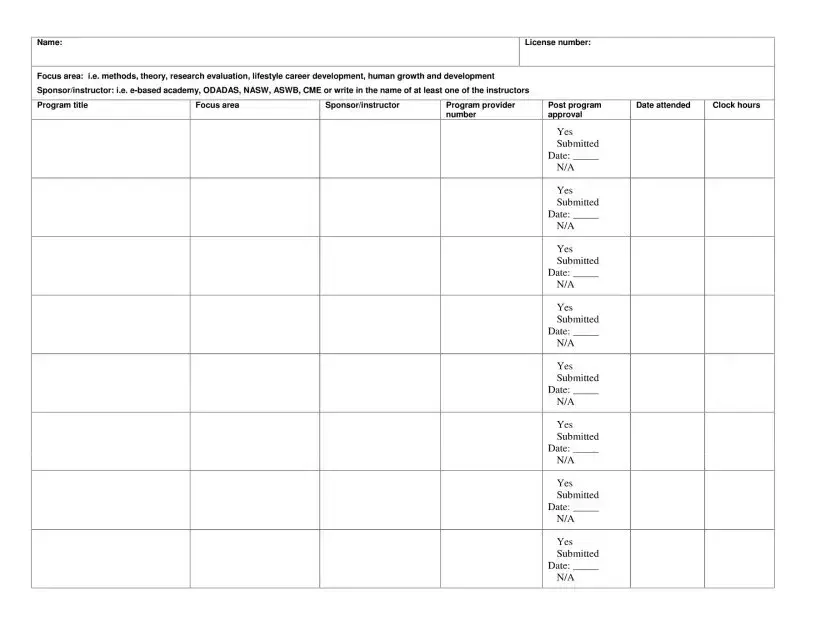
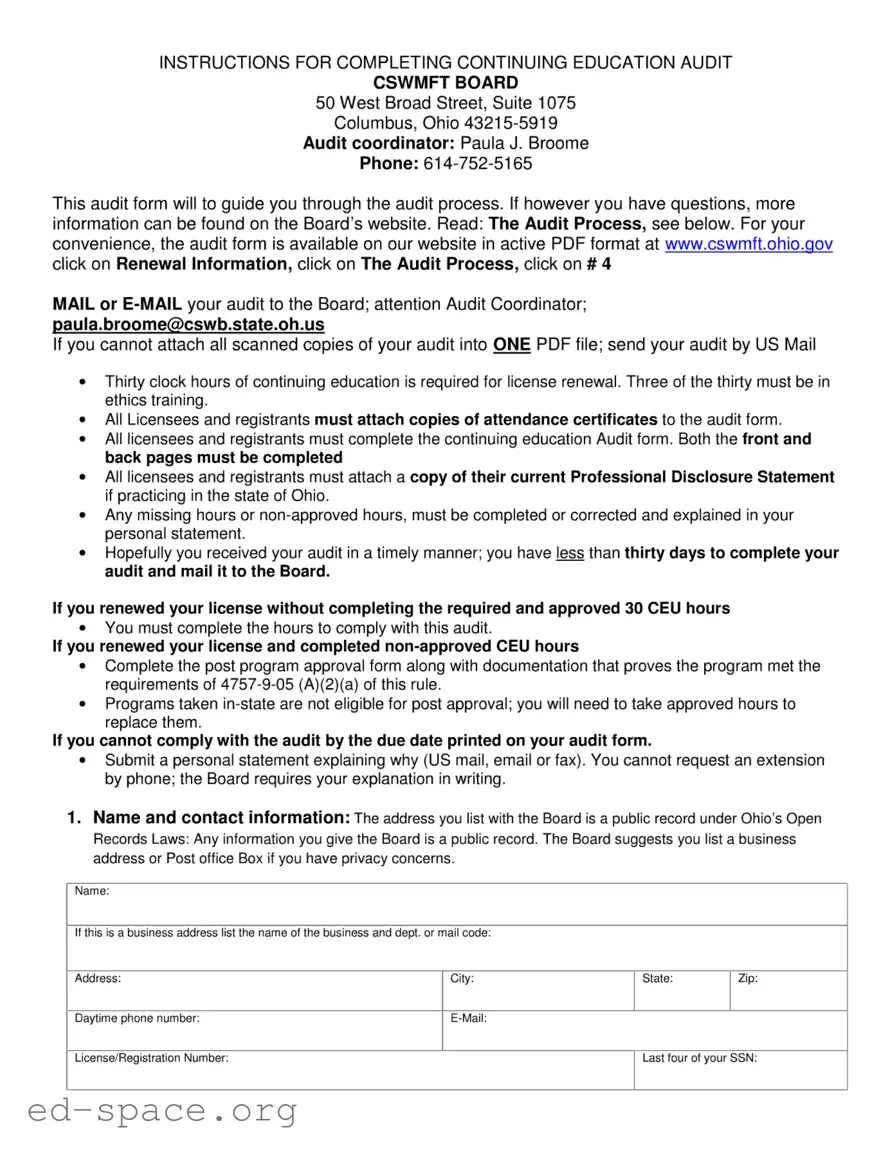
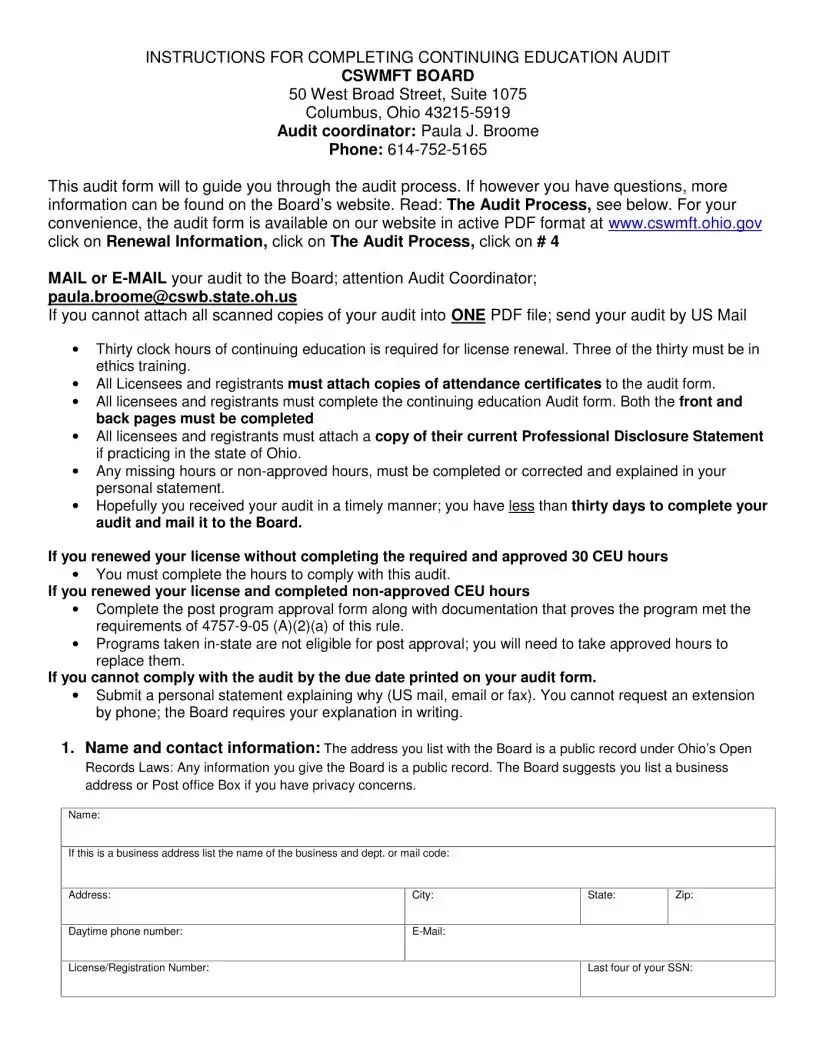
The CSWMFT Ohio Gov form is an essential tool for licensees and registrants in the field of counseling, social work, and marriage and family therapy. This form guides individuals through the continuing education audit process required for license renewal. To maintain an active license, practitioners must complete thirty clock hours of continuing education every two years, including three hours specifically focused on ethics training. The form not only requires the completion of both front and back pages but also mandates the submission of attendance certificates and a current Professional Disclosure Statement if practicing in Ohio. If there are any discrepancies, such as missing or non-approved hours, licensees must provide explanations in a personal statement. The audit process is time-sensitive, with less than thirty days typically allowed for completion. Additionally, the form outlines specific instructions for those who may not be practicing in Ohio or who are in exempt settings, ensuring that all necessary information is submitted correctly. By following the steps outlined in the CSWMFT Ohio Gov form, licensees can navigate the renewal process with confidence and clarity.
Document Preview

Form Specifications

Fact Name Fact Description
Audit Process This form guides licensees through the continuing education audit process for the CSWMFT Board in Ohio.
Continuing Education Requirement License renewal requires thirty clock hours of continuing education, with three hours specifically in ethics training.
Submission of Certificates All licensees and registrants must attach copies of attendance certificates to the audit form.
Professional Disclosure Statement A copy of the current Professional Disclosure Statement must be included if practicing in Ohio.
Missing Hours Explanation Licensees must explain any missing or non-approved hours in a personal statement.
Deadline for Submission Licensees have less than thirty days to complete and submit their audit after receiving it.
Post Program Approval For non-approved CEU hours, a post program approval form is required, along with documentation proving compliance.
Banking Hours Licensees may bank up to 12 extra hours of continuing education for future renewal periods.

Cswmft Ohio Gov: Usage Guidelines

Completing the CSWMFT Ohio Gov form is an important step in ensuring compliance with continuing education requirements for license renewal. Following these steps carefully will help streamline the process and ensure that all necessary information is provided accurately.

  1. Gather Personal Information: Collect your name, contact information, license or registration number, and the last four digits of your Social Security Number. Ensure that you provide a business address or P.O. Box if privacy is a concern.
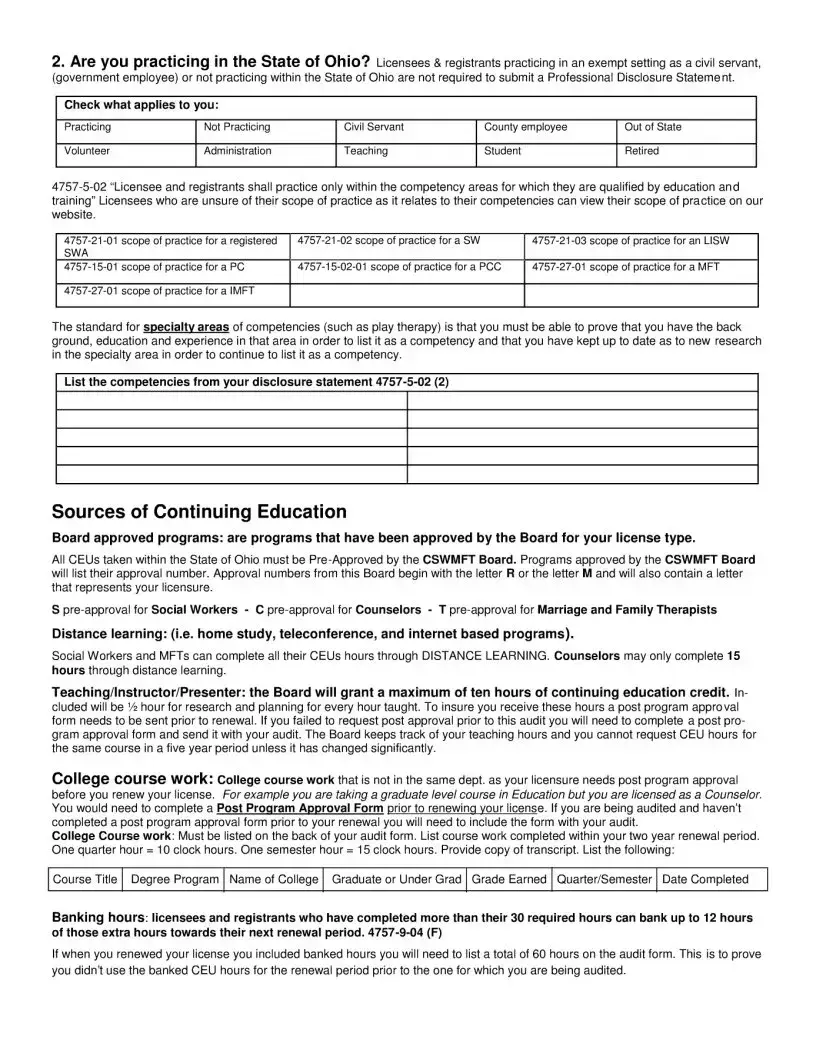
  2. Indicate Your Practice Status: Check the appropriate box to indicate whether you are practicing in Ohio or not. If you are a civil servant or not practicing, you do not need to submit a Professional Disclosure Statement.
  3. List Competencies: From your Professional Disclosure Statement, list the competencies relevant to your practice. Ensure that these align with the areas in which you are qualified by education and training.
  4. Document Continuing Education: List all continuing education units (CEUs) you have completed. Include only those that have been approved by the CSWMFT Board. Make sure to note the approval numbers, which begin with "R," "C," or "T," depending on your license type.
  5. Include Distance Learning Credits: If applicable, indicate any CEUs earned through distance learning. Remember that Social Workers and Marriage and Family Therapists can complete all their CEUs this way, while Counselors are limited to 15 hours.
  6. Teaching Credits: If you have taught courses, list the hours earned. Include a post program approval form if you did not request approval prior to this audit.
  7. College Coursework: If you completed college coursework during your renewal period, list the details on the back of the audit form. Include the course title, degree program, college name, whether it was graduate or undergraduate, grade earned, and the date completed.
  8. Banking Hours: If you have completed more than the required 30 hours, you can bank up to 12 extra hours for your next renewal. Make sure to list a total of 60 hours on the audit form if you used banked hours for your previous renewal.
  9. Attach Required Documents: Include copies of attendance certificates for all CEUs, your current Professional Disclosure Statement, and any additional documentation required for non-approved hours.
  10. Submit Your Audit: Mail or email your completed audit to the Board, addressing it to the Audit Coordinator. Ensure it is sent within the specified timeframe to avoid penalties.

After completing these steps, review your form to ensure accuracy and completeness before submission. This will help facilitate a smooth audit process and maintain your license in good standing.

Your Questions, Answered

1. What is the purpose of the CSWMFT Ohio Gov form?

The CSWMFT Ohio Gov form is designed to guide licensees and registrants through the continuing education audit process required for license renewal in Ohio. It ensures that professionals meet the necessary educational requirements to maintain their licenses and stay current in their fields.

2. How many continuing education hours are required for license renewal?

For license renewal, a total of thirty clock hours of continuing education is required. Out of these thirty hours, three must specifically focus on ethics training. This ensures that professionals not only enhance their skills but also adhere to ethical standards in their practice.

3. What should I include when submitting my audit form?

When submitting your audit form, you must attach copies of your attendance certificates for all continuing education programs. Additionally, you need to complete both the front and back pages of the audit form. If you are practicing in Ohio, include a copy of your current Professional Disclosure Statement as well.

4. What happens if I have missing or non-approved hours?

If you find that you have missing hours or hours that are not approved, you need to complete or correct these and provide an explanation in your personal statement. It’s crucial to address any discrepancies to ensure compliance with the audit requirements.

5. What if I renewed my license without completing the required CEU hours?

If you renewed your license without completing the required thirty CEU hours, you must fulfill these hours to comply with the audit. It’s essential to complete the necessary education before submitting your audit form to avoid any penalties.

6. Can I request an extension for my audit submission?

Extensions cannot be requested by phone. If you cannot meet the due date, you must submit a personal statement explaining your situation. This statement can be sent via US mail, email, or fax. The Board requires all explanations in writing to consider your request.

7. Are there specific guidelines for distance learning programs?

Yes, there are specific guidelines regarding distance learning. Social Workers and Marriage and Family Therapists can complete all their CEU hours through distance learning. However, Counselors are limited to only 15 hours through this method. Make sure the programs are approved by the CSWMFT Board to ensure they count towards your required hours.

8. What if I have completed more than the required CEU hours?

If you have completed more than the required thirty hours, you can bank up to twelve of those extra hours for your next renewal period. When you submit your audit form, if you included banked hours during your last renewal, you must list a total of sixty hours to demonstrate that you did not use those banked hours for the previous renewal period.

Common mistakes

  1. Incomplete Information: Failing to provide all required personal information, such as name, contact details, and license number, can lead to delays or rejection of the audit form.

  2. Missing Certificates: Not attaching copies of attendance certificates for all continuing education hours can result in non-compliance with the audit requirements.

  3. Neglecting the Professional Disclosure Statement: Licensees must attach a current Professional Disclosure Statement if practicing in Ohio. Forgetting this step can lead to complications.

  4. Ignoring Non-Approved Hours: Failing to address any non-approved continuing education hours in a personal statement may result in penalties. It is essential to explain any discrepancies.

  5. Late Submission: The audit must be completed and submitted within thirty days. Delays can jeopardize license renewal. Timeliness is crucial.

  6. Incorrect Scope of Practice: Misunderstanding or misrepresenting the scope of practice can lead to issues. Licensees should ensure they are only practicing within their qualified areas.

  7. Improper Documentation: Not providing proper documentation for college coursework or teaching hours can result in incomplete submissions. This includes failing to submit a post program approval form when necessary.

  8. Banking Hours Mismanagement: If banking hours were used during the renewal period, licensees must accurately report a total of 60 hours on the audit form. Misreporting can lead to compliance issues.

Documents used along the form

When completing the CSWMFT audit form in Ohio, several other documents may be necessary to ensure compliance with licensing requirements. These documents help provide clarity and support during the audit process, ensuring that all required information is submitted accurately and on time.

  • Professional Disclosure Statement: This document outlines the services provided by the licensee and must be submitted if the individual is practicing in Ohio. It serves to inform clients about the professional's qualifications and areas of expertise.
  • Attendance Certificates: Licensees must attach copies of certificates that verify their completion of continuing education courses. These certificates confirm that the required thirty clock hours of education, including three hours in ethics, have been fulfilled.
  • Post Program Approval Form: If a licensee has completed non-approved continuing education hours, this form is necessary to seek retroactive approval for those hours. It must include documentation that demonstrates how the program met the Board's requirements.
  • Personal Statement: If there are any discrepancies or issues with the audit, such as missing hours, a personal statement is required. This document should explain the circumstances surrounding the audit and any challenges faced in meeting the requirements.

Collectively, these documents support the audit process and help ensure that all licensees meet the necessary standards for continuing education in Ohio. Properly preparing and submitting these forms can facilitate a smoother audit experience and maintain compliance with state regulations.

Similar forms

The CSWMFT Ohio Gov form is essential for license renewal and continuing education audits. Here are nine other documents that share similarities with this form:

  • Continuing Education Certificate: This document verifies completion of required educational hours, similar to the attendance certificates needed for the CSWMFT audit.
  • Professional Disclosure Statement: Like the CSWMFT form, this statement outlines a professional's qualifications and areas of practice, ensuring transparency in client interactions.
  • License Renewal Application: Both documents require detailed information about the licensee, including personal and professional details for verification purposes.
  • Post Program Approval Form: This form is necessary for documenting non-approved continuing education hours, paralleling the requirements outlined in the CSWMFT audit process.
  • Personal Statement for Extension Requests: Similar to the CSWMFT audit, this document must be submitted in writing to explain any delays in compliance with continuing education requirements.
  • Distance Learning Approval Form: This form ensures that distance education programs meet specific standards, akin to the approval process for CEUs in the CSWMFT form.
  • Transcripts from College Coursework: Required for verification of educational hours, transcripts serve a similar purpose to the documentation needed for the CSWMFT audit.
  • Competency Statement: This document outlines the areas of expertise for a professional, much like the competency requirements stated in the CSWMFT audit.
  • Audit Response Form: When responding to an audit, this form is used to provide necessary documentation, mirroring the submission process outlined in the CSWMFT form.

Dos and Don'ts

When completing the CSWMFT Ohio Government form, it is important to follow certain guidelines to ensure your submission is accurate and complete. Here are five things you should do and five things you should avoid.

  • Do read all instructions carefully before filling out the form.
  • Do attach copies of your attendance certificates for all continuing education hours.
  • Do ensure that both pages of the audit form are filled out completely.
  • Do submit a personal statement if you are unable to meet the deadline.
  • Do verify that the continuing education programs you attended are approved by the Board.
  • Don't leave any sections of the form blank; incomplete forms may be rejected.
  • Don't forget to include your current Professional Disclosure Statement if you are practicing in Ohio.
  • Don't submit your audit by phone; all communication must be in writing.
  • Don't assume that all hours completed will automatically count; check for approval status.
  • Don't mix up your CEU hours; ensure that you report only the hours that are relevant to your license type.

By following these guidelines, you can navigate the audit process with confidence. Ensuring that your submission is complete and accurate will help you avoid potential issues and delays. If you have any questions, additional resources are available on the Board’s website.

Misconceptions

Here are 10 common misconceptions about the CSWMFT Ohio Gov form:

  1. All continuing education hours are accepted. Only hours from Board-approved programs count toward your requirements. Ensure you check for approval before submitting.
  2. Distance learning is unlimited for all licensees. Social Workers and Marriage and Family Therapists can complete all hours through distance learning, but Counselors are limited to 15 hours.
  3. Submitting the audit form is optional. All licensees and registrants must complete and submit the audit form, including both front and back pages.
  4. Late submissions are easily accepted. If you miss the deadline, you must submit a personal statement explaining your situation in writing. Extensions cannot be requested by phone.
  5. All college coursework automatically counts as continuing education. Coursework outside your licensure department requires post program approval before it can be counted.
  6. Certificates of attendance are not necessary. You must attach copies of attendance certificates to your audit form to verify your completed hours.
  7. Banked hours can be used freely. If you use banked hours for a renewal, you must list a total of 60 hours on the audit form to demonstrate compliance.
  8. Practicing in an exempt setting means no requirements. Civil servants and those not practicing in Ohio do not need to submit a Professional Disclosure Statement, but they must still meet other requirements.
  9. Ethics training is not mandatory. Out of the 30 required continuing education hours, three must specifically be in ethics training.
  10. Information submitted to the Board is private. Your contact information is a public record. Consider using a business address or P.O. Box if privacy is a concern.

Key takeaways

Filling out and using the CSWMFT Ohio Gov form is essential for compliance with continuing education requirements. Here are key takeaways to ensure a smooth process:

  • Complete the Audit Form: Both the front and back pages of the audit form must be filled out. This is mandatory for all licensees and registrants.
  • Attach Required Documents: Include copies of attendance certificates and a current Professional Disclosure Statement if practicing in Ohio.
  • Understand Continuing Education Requirements: A total of thirty clock hours of continuing education is required for license renewal, including three hours specifically in ethics training.
  • Timely Submission is Crucial: You have less than thirty days to complete and submit your audit. If you miss this deadline, you must provide a personal statement explaining the delay.
  • Banking Hours: If you have completed more than thirty hours, you can bank up to twelve hours for your next renewal period. Ensure to list a total of sixty hours on the audit form if you used banked hours in your previous renewal.

By following these guidelines, you can navigate the audit process effectively and maintain your professional standing in Ohio.