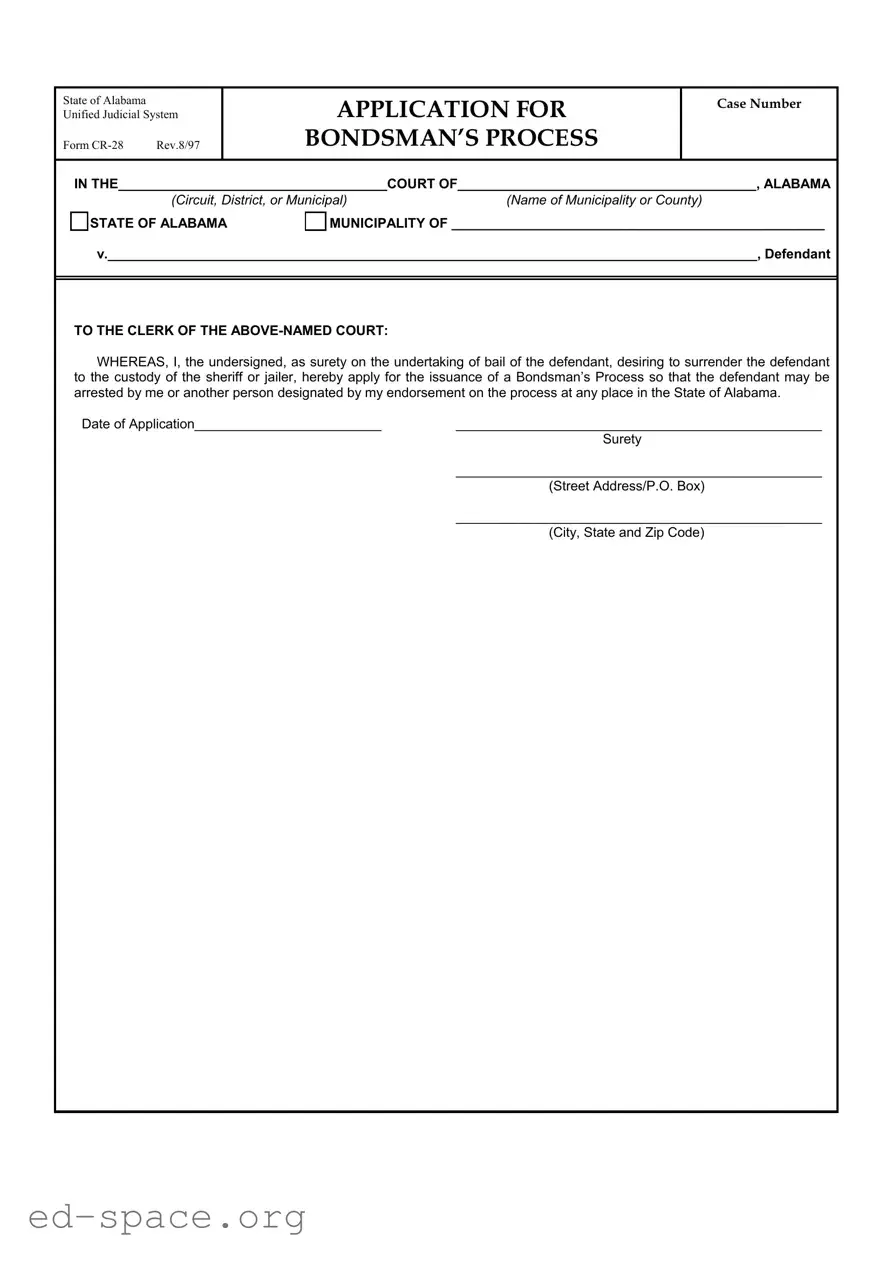
The Cr 28 Alabama form is an essential document within the state's judicial system, specifically designed for bondsmen who wish to surrender a defendant to law enforcement. This application is filed in the appropriate court, whether it be Circuit, District, or Municipal, and it serves a critical function in the bail process. By completing this form, a surety indicates their intent to take action regarding a defendant who has failed to appear in court or has violated the terms of their bail. The form includes necessary information such as the case number, the name of the court, and details about the surety, including their address. It also allows the surety to designate another person to assist in the arrest of the defendant, thereby streamlining the process of returning the individual to custody. The Cr 28 form is a vital tool for ensuring accountability and maintaining the integrity of the bail system in Alabama.

State of Alabama Unified Judicial System
Form |
Rev.8/97 |
APPLICATION FOR
BONDSMAN’S PROCESS
CASE NUMBER
IN THE____________________________________COURT OF________________________________________, ALABAMA
(Circuit, District, or Municipal) |
(Name of Municipality or County) |
|
STATE OF ALABAMA |
MUNICIPALITY OF __________________________________________________ |
|
V._______________________________________________________________________________________, DEFENDANT
TO THE CLERK OF THE
WHEREAS, I, the undersigned, as surety on the undertaking of bail of the defendant, desiring to surrender the defendant to the custody of the sheriff or jailer, hereby apply for the issuance of a Bondsman’s Process so that the defendant may be arrested by me or another person designated by my endorsement on the process at any place in the State of Alabama.
Date of Application_________________________ |
_________________________________________________ |
|
Surety |
|
_________________________________________________ |
|
(Street Address/P.O. Box) |
|
_________________________________________________ |
|
(City, State and Zip Code) |
| Fact Name | Details |
|---|---|
| Purpose | The CR-28 form is used by a surety to apply for a Bondsman’s Process to surrender a defendant to law enforcement. |
| Governing Law | This form is governed by Alabama state law, specifically Title 15 of the Alabama Code, which pertains to criminal procedure. |
| Jurisdiction | The form can be filed in any Circuit, District, or Municipal Court within the State of Alabama. |
| Defendant Information | The form requires the name of the defendant, who is the individual being surrendered. |
| Surety Details | The surety must provide their name and address, ensuring that they can be contacted regarding the process. |
| Date of Application | The applicant must indicate the date on which they are submitting the form, marking the official request for the Bondsman’s Process. |
Filling out the Cr 28 form is a straightforward process. Ensure that you have all necessary information on hand before you begin. This will help you complete the form accurately and efficiently.
What is the CR-28 form used for?
The CR-28 form is an application for a Bondsman’s Process in Alabama. It allows a surety, who is responsible for the bail of a defendant, to surrender that defendant to the custody of law enforcement. By completing this form, the surety can request permission to have the defendant arrested by themselves or another designated person within the state.
Who can fill out the CR-28 form?
The form can be filled out by the surety who has provided bail for the defendant. This individual is essentially acting as a guarantor for the defendant’s appearance in court. It is important that the surety is someone who is legally allowed to act in this capacity, as they are taking responsibility for the defendant’s compliance with court orders.
Where do I submit the CR-28 form?
You should submit the CR-28 form to the clerk of the court where the original case is being heard. This could be a Circuit, District, or Municipal court, depending on the nature of the case. Make sure to check the specific court's requirements for submission to ensure that everything is in order.
What information is required on the CR-28 form?
The form requires several key pieces of information. You will need to provide the case number, the name of the court, and the name of the municipality or county. Additionally, you must include your name as the surety, your address, and the date of the application. All of this information helps to properly identify the case and the parties involved.
What happens after I submit the CR-28 form?
Once you submit the CR-28 form, the court will review your application. If approved, a Bondsman’s Process will be issued. This allows you or a designated person to arrest the defendant and take them into custody. It’s important to follow any further instructions provided by the court to ensure compliance with the legal process.
Failing to provide a complete case number. This number is crucial for identifying the specific legal matter and ensuring the application is processed correctly.
Not specifying the correct court type. Applicants often forget to indicate whether it is a Circuit, District, or Municipal court, which can lead to confusion and delays.
Omitting the municipality or county name. This information is essential for jurisdictional purposes, yet it is frequently overlooked.
Neglecting to sign the application. A signature is required to validate the request, and without it, the form is incomplete.
Using an incorrect or outdated version of the form. Always ensure that you are using the latest version of the CR-28 form to avoid any issues.
Providing an incomplete or incorrect address. The surety’s address must be accurate to ensure that all communications are received promptly.
Failing to include a designated person for arrest. If the surety wishes to authorize someone else to act on their behalf, that person must be named in the application.
Not including the date of application. This detail is important for tracking the timeline of the request and ensuring timely processing.
Overlooking the need for additional documentation. Depending on the situation, extra paperwork may be necessary to support the application.
Submitting the form without reviewing it. A thorough review can catch errors that may lead to delays or denials.
The CR-28 form is an essential document used in the state of Alabama for bondsmen to apply for the process of surrendering a defendant. Alongside this form, several other documents may be necessary to ensure proper legal procedures are followed. Each of these documents serves a specific purpose in the process of managing bail and the responsibilities of the surety. Below is a list of commonly used forms and documents that often accompany the CR-28.
Understanding these documents and their purposes is crucial for anyone involved in the bail process. Each form plays a vital role in ensuring that the legal obligations are met and that the rights of all parties are protected. It is always recommended to consult with legal professionals when dealing with these forms to ensure compliance with all regulations and procedures.
The CR-28 form is an application for a bondsman's process in Alabama. Several other documents serve similar purposes in the legal system. Below is a list of nine documents that share characteristics with the CR-28 form:
When filling out the CR-28 Alabama form, it’s important to follow specific guidelines to ensure accuracy and compliance. Here are four things you should and shouldn't do:
Misconceptions about the CR-28 Alabama form can lead to confusion for those involved in the legal process. Here are seven common misunderstandings:
Understanding these misconceptions can help individuals navigate the legal system more effectively and ensure that they utilize the CR-28 form appropriately.
When filling out and using the Cr 28 Alabama form, there are several important points to keep in mind: