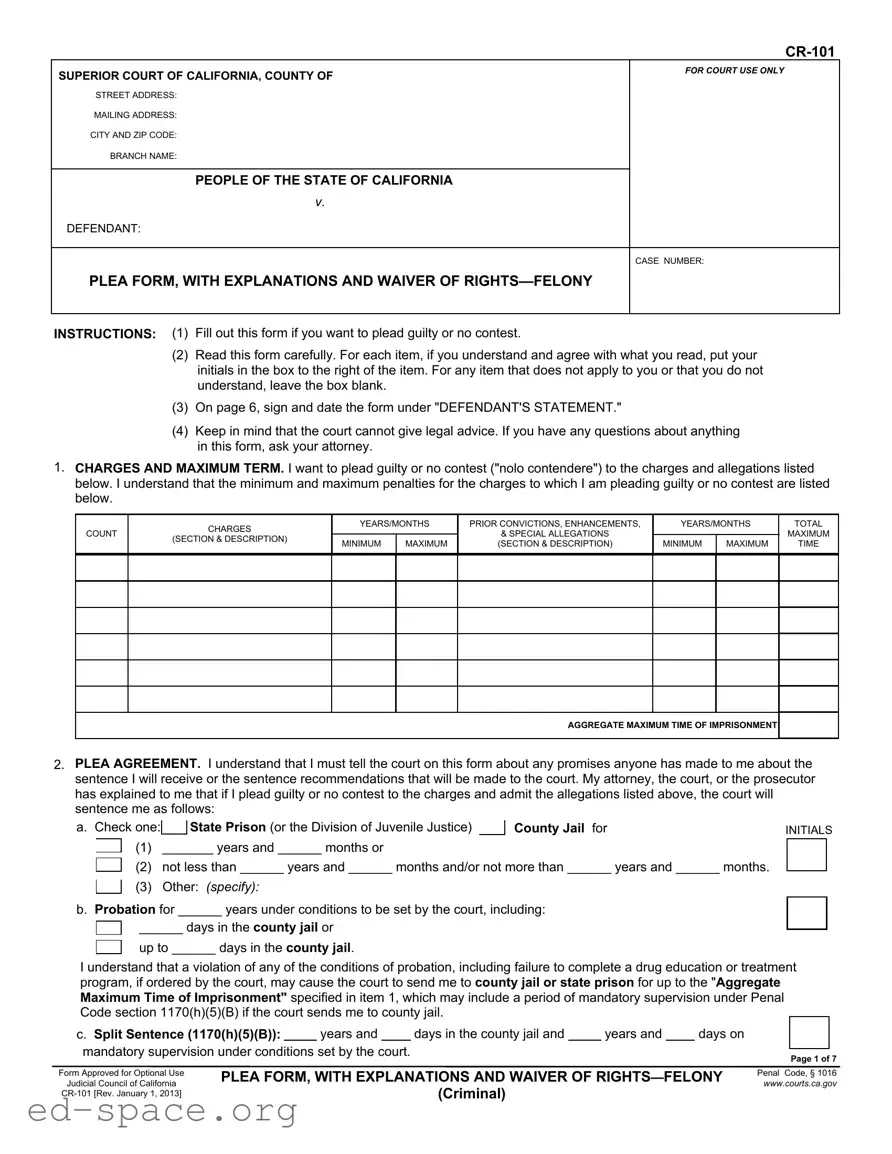
The CR-101 form is an essential document used in California's legal system when a defendant wishes to plead guilty or no contest to felony charges. It serves as a plea form that outlines various critical aspects of the plea process, ensuring that defendants fully understand their rights and the consequences of their decisions. The form requires individuals to acknowledge the charges against them, including the potential penalties and any prior convictions that may affect their sentencing. Additionally, it details the plea agreement, including possible jail time, probation conditions, and any financial obligations such as restitution or fines. The CR-101 also addresses the implications of a no contest plea, the rights defendants waive by entering such a plea, and the importance of legal representation. By signing the form, defendants confirm their understanding of these factors and the overall legal process, making it a vital component in navigating the complexities of criminal proceedings in California.
SUPERIOR COURT OF CALIFORNIA, COUNTY OF |
FOR COURT USE ONLY |
|
|
STREET ADDRESS: |
|
MAILING ADDRESS: |
|
CITY AND ZIP CODE: |
|
BRANCH NAME: |
|
PEOPLE OF THE STATE OF CALIFORNIA
v.
DEFENDANT:
CASE NUMBER:
PLEA FORM, WITH EXPLANATIONS AND WAIVER OF
INSTRUCTIONS: (1) Fill out this form if you want to plead guilty or no contest.
(2)Read this form carefully. For each item, if you understand and agree with what you read, put your initials in the box to the right of the item. For any item that does not apply to you or that you do not understand, leave the box blank.
(3)On page 6, sign and date the form under "DEFENDANT'S STATEMENT."
(4)Keep in mind that the court cannot give legal advice. If you have any questions about anything
in this form, ask your attorney.
1.CHARGES AND MAXIMUM TERM. I want to plead guilty or no contest ("nolo contendere") to the charges and allegations listed below. I understand that the minimum and maximum penalties for the charges to which I am pleading guilty or no contest are listed below.
|
CHARGES |
YEARS/MONTHS |
PRIOR CONVICTIONS, ENHANCEMENTS, |
YEARS/MONTHS |
TOTAL |
||
COUNT |
|
|
& SPECIAL ALLEGATIONS |
|
|
MAXIMUM |
|
|
(SECTION & DESCRIPTION) |
MINIMUM |
MAXIMUM |
(SECTION & DESCRIPTION) |
MINIMUM |
MAXIMUM |
TIME |
|
|
||||||
|
|
|
|
|
|
|
|
|
|
|
|
|
|
|
|
|
|
|
|
|
|
|
|
|
|
|
|
|
|
|
|
|
|
|
|
|
|
|
|
|
|
|
|
|
|
|
|
|
|
|
|
|
|
|
|
AGGREGATE MAXIMUM TIME OF IMPRISONMENT
2.PLEA AGREEMENT. I understand that I must tell the court on this form about any promises anyone has made to me about the sentence I will receive or the sentence recommendations that will be made to the court. My attorney, the court, or the prosecutor has explained to me that if I plead guilty or no contest to the charges and admit the allegations listed above, the court will sentence me as follows:
a. Check one: |
|
State Prison (or the Division of Juvenile Justice) |
|
County Jail for |
INITIALS |
|||||
|
|
|
|
|
|
|
|
|
|
|
|
|
(1) |
_______ years and ______ months or |
|
|
|
||||
|
|
|
|
|
||||||
|
|
|
|
|
|
|
|
|
|
|
|
|
|
(2) |
not less than ______ years and ______ months and/or not more than ______ years and ______ months. |
|
|
||||
|
|
|
|
|
||||||
|
|
|
|
|
|
|
|
|
|
|
|
|
|
(3) |
Other: (specify): |
|
|
|
|||
b. Probation for ______ years under conditions to be set by the court, including: |
|
|
||||||||
|
|
|||||||||
|
|
|
|
______ days in the county jail or |
|
|
|
|||
|
|
|
|
|
|
|
||||
|
|
|
|
|
|
|
||||
|
|
|
|
up to ______ days in the county jail. |
|
|
|
|||
|
|
|
|
|
|
|
||||
I understand that a violation of any of the conditions of probation, including failure to complete a drug education or treatment program, if ordered by the court, may cause the court to send me to county jail or state prison for up to the "Aggregate Maximum Time of Imprisonment" specified in item 1, which may include a period of mandatory supervision under Penal Code section 1170(h)(5)(B) if the court sends me to county jail.
c. Split Sentence (1170(h)(5)(B)): |
|
years and |
|
|
days in the county jail and |
|
years and |
|
days on |
|
|
|
||
mandatory supervision under conditions set by the court. |
|
|
|
|
|
|
|
|
||||||
|
|
|
|
|
|
Page 1 of 7 |
||||||||
|
|
|
|
|
|
|
|
|
|
|
|
|||
Form Approved for Optional Use |
PLEA FORM, WITH EXPLANATIONS AND WAIVER OF |
Penal Code, § 1016 |
||||||||||||
Judicial Council of California |
www.courts.ca.gov |
|||||||||||||
|
|
|
|
|
(Criminal) |
|
|
|
|
|||||
|
|
|
|
|
|
|
|
|
|
|
|
|||
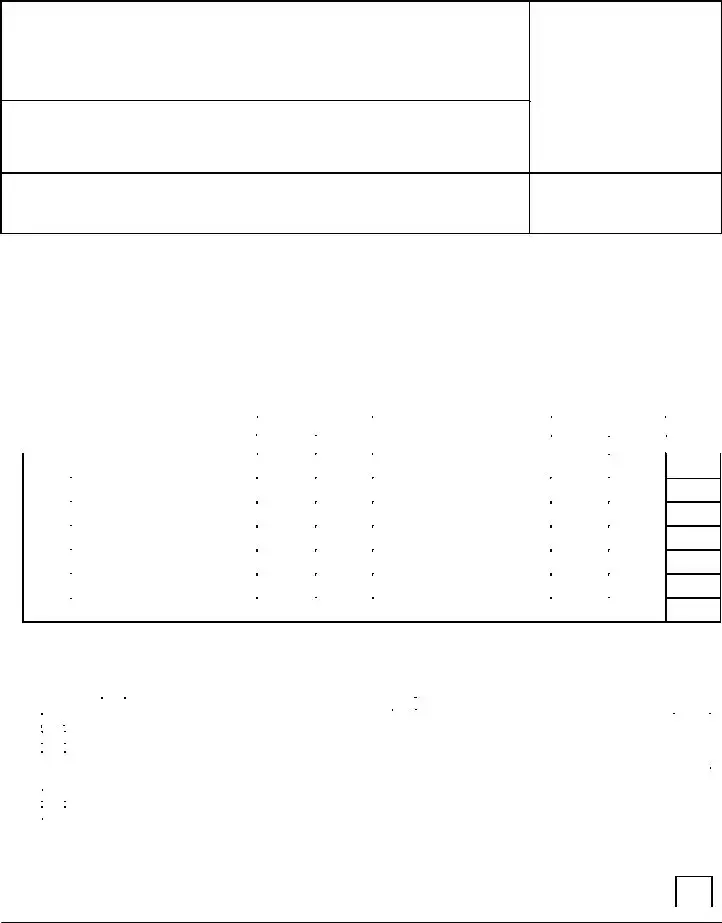
PEOPLE OF THE STATE OF CALIFORNIA v.
DEFENDANT:
CASE NUMBER:
INITIALS
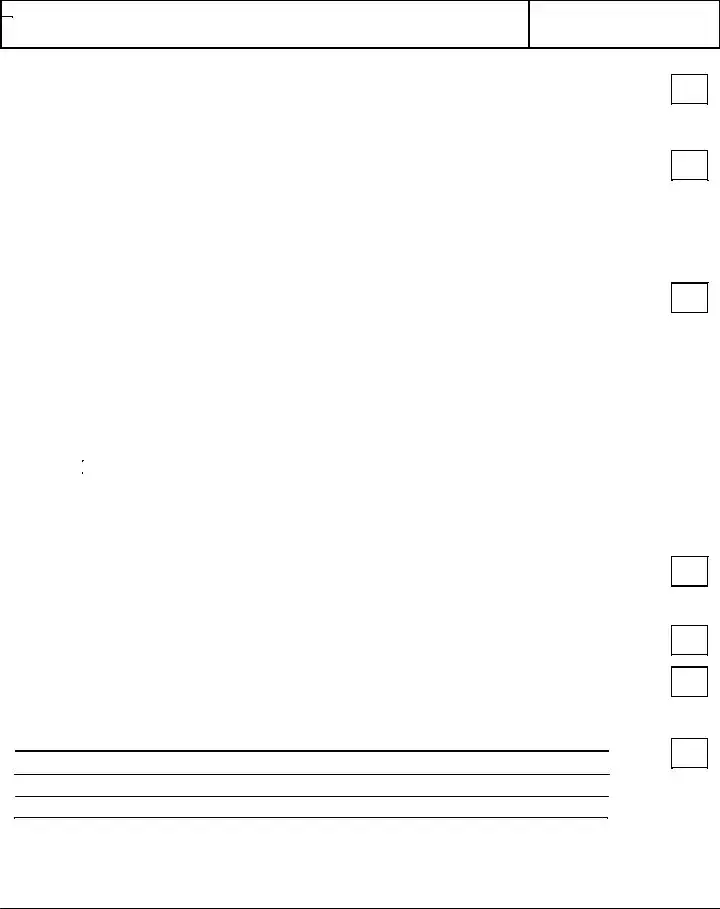
2.d. Narcotics Addiction Confinement
I understand that if the court finds that I am addicted to narcotics or in immediate danger of becoming a narcotics addict, the court may send me to a narcotics detention, treatment, and rehabilitation facility for up to the amount of time I would otherwise have served in prison.
e.Open Plea
1.
2.
3.
I understand the maximum and minimum sentences for the charges and allegations stated on page 1. No one has made any other promises to me about what sentence the court may order.
I understand that I am not eligible for probation.
I understand that I will not be granted probation unless the court finds at the time of sentencing that this is an unusual case where the interests of justice would be best served by granting probation.
f.Restitution, Statutory Fees, and Assessments
I understand that the court will order me to pay the following amounts (if an amount is not yet known, "TBD" for "to be determined" is entered next to the $); I must prepare financial disclosure statements to assist the court in determining my ability to pay; and refusal or failure to prepare the required financial disclosure statements may be used against me at sentencing:
1.
2.
3.
4.
5.
6.
7.
8.
9.
$__________ to the Victim Restitution Fund
$__________ restitution to actual victims
$__________ restitution to the State of California, Victims of Crime Fund
$__________ court operations assessment
$__________ court facilities assessment
$__________ base fine plus any applicable penalties, assessments, and surcharges
$__________ other (specify): __________________________________________________________
$__________ other (specify): __________________________________________________________
An (additional) amount to be determined by the court at sentencing or such other hearing as the court may set.
g.Parole Revocation or Probation Revocation Fine
I understand that if I am sentenced to state prison, the court will impose a parole revocation fine, which will be collected only if my parole is later revoked. I also understand that if I am granted probation, the court will impose a probation revocation fine, which will be collected only if my probation is later revoked.
h.Dismissal of Other Counts
I understand that as part of the plea agreement bargain, the following counts will be dismissed after sentencing:
__________________________________________________________________________________________
I understand and agree that the sentencing judge may consider facts underlying dismissed counts to determine restitution and to sentence me on the counts to which I am entering a plea.
i.Other Terms (specify):
PLEA FORM, WITH EXPLANATIONS AND WAIVER OF
(Criminal)
Page 2 of 7
PEOPLE OF THE STATE OF CALIFORNIA v.
DEFENDANT:
CASE NUMBER:
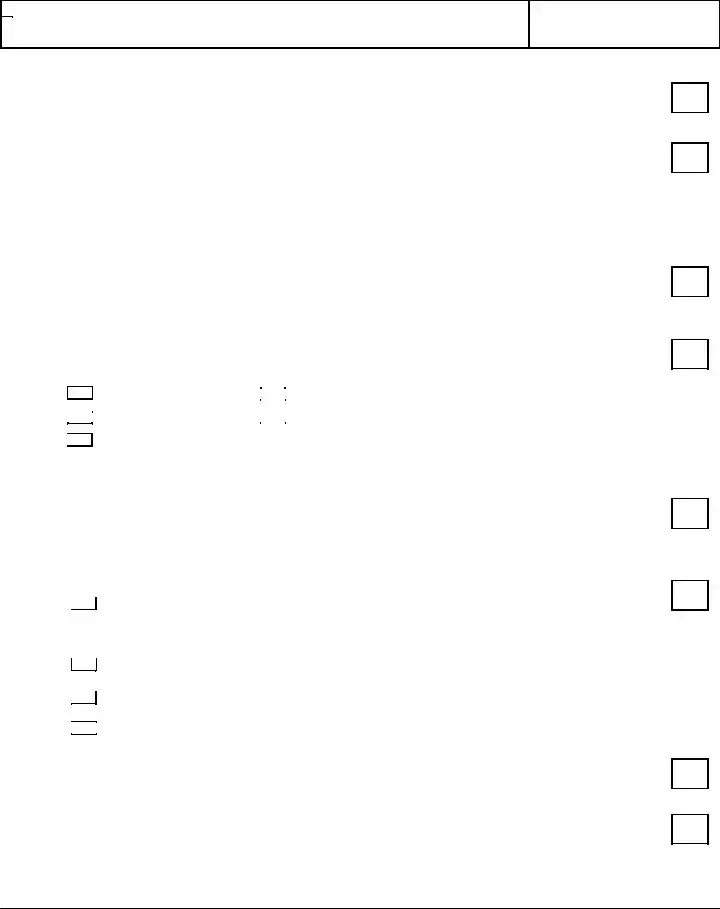
3. CONSEQUENCES OF MY PLEA |
INITIALS |
a.No Contest ("Nolo Contendere") Plea
I understand that a no contest plea is the same as pleading guilty and that if I plead no contest I will be convicted and my no contest plea could be used against me in a civil case.
b.Parole and Postrelease Community Supervision
I understand that if I am sentenced to state prison or a narcotics treatment facility
(1)I will be placed on parole or postrelease community supervision for up to __________ years after my release.
(2)If I abscond or the court tolls my supervision, the total time of parole or postrelease community supervision can be extended.
(3)If I violate any of the terms or conditions of my parole, I can be sentenced to county jail for up to 180 days for each violation, or returned to state prison for up to one year, up to a maximum of ___ years. If I violate any of the terms or conditions of postrelease community supervision, I can be sentenced to county jail for up to 180 days for each violation, for up to a maximum of 3 years.
c.Effect of Conviction on Other Cases
I understand that a conviction in this case may constitute a violation of any other current grant of parole, mandatory supervision, postrelease community supervision, or probation in any other case and that I may receive additional punishment as a result of that violation.
d.Registration
I understand that I will be required to register with the local police agency or sheriff's department in the city or county in which I reside as
(1)
(2)
(3)
an arson offender |
(4) |
|
a sex offender (this registration is a lifelong requirement) |
a gang member |
(5) |
|
other (specify): |
|
|||
a narcotics offender |
|
|
|
and that if I fail to register or to keep my registration current for any reason, new felony criminal charges may be filed against me.
e.Prints and DNA Samples
I understand that I must provide biological samples and prints for identification
f.Serious or Violent Felony
(1)
(2)
(3)
(4)
I understand that by pleading guilty or no contest to a serious or violent felony ("strike"), the penalty for any future felony conviction will be increased as a result of my conviction in this case, depending on the number of strikes I have, up to a mandatory prison sentence of double the term otherwise provided or a term of at least 25 years to life.
I understand that if I am convicted of a violent felony, jail or prison
I understand that if I am admitting a prior strike conviction, prison
I understand that if I am convicted of murder or a third felony conviction of certain offenses, I am ineligible to receive
g.Prior Prison Term or County Jail Sentence Under Penal Code Section 1170(h)(5)
I understand that if I am sentenced to prison or county jail under Penal Code section 1170(h), the penalty for any future felony conviction may be increased as a result of my incarceration in this case.
h.Driver's License and Vehicle Forfeiture
I understand that my privilege to drive a motor vehicle may be revoked or suspended by the court or the California Department of Motor Vehicles and my vehicle may be ordered forfeited if it was involved in the offense.
PLEA FORM, WITH EXPLANATIONS AND WAIVER OF
(Criminal)
Page 3 of 7
PEOPLE OF THE STATE OF CALIFORNIA v.
DEFENDANT:
CASE NUMBER:
3. i. |
Immigration Consequences |
INITIALS |
|
|
|
||
I understand that if I am not a citizen of the United States, my plea of guilty or no contest may or, with certain offenses, will result in my deportation, exclusion from reentry to the United States, and denial of naturalization and amnesty and that the appropriate consulate may be informed of my conviction. The offenses that will result in such immigration action include, but are not limited to, an aggravated felony, conspiracy, a controlled substance offense, a firearm offense, and, under certain circumstances, a moral turpitude offense.
j.Firearms
I understand that federal and state laws prohibit a convicted felon from possessing firearms or ammunition for life.
k.Other Consequences (specify):
4.RIGHT TO AN ATTORNEY
I understand that I have the right to an attorney of my choice to represent me throughout the proceedings. If I cannot afford to hire an attorney, the court will appoint one to represent me.
I hereby give up my right to be represented by an attorney.
5.OTHER CONSTITUTIONAL RIGHTS
I understand that I am entitled to each of the following rights as to the charges listed in item 1 (on page 1):
a.Right to a Jury Trial
I understand that I have a right to a speedy and public jury trial. At the trial, I would be presumed to be innocent, and I could not be convicted unless, after hearing all of the evidence, 12 impartial jurors chosen from the community were convinced beyond a reasonable doubt that I am guilty.
b.Right to a Court Trial
I understand that, as an alternative to a jury trial, if the prosecutor agrees, I may give up a jury trial and have a court trial in which the judge alone, without a jury, hears the evidence. I still could not be convicted unless, after hearing all of the evidence, the judge was convinced beyond a reasonable doubt that I am guilty.
c.Right to Confront and
I understand that I have the right to confront and
d.Right to Remain Silent and Not to Incriminate Myself
I understand that I have the right to remain silent, and my silence cannot be considered as evidence against me. I understand that I also have the right not to incriminate myself, and I cannot be forced to testify.
e.Right to Produce Evidence and to Present a Defense
I understand that I have a right to present evidence and to have the court issue subpoenas to bring to court all witnesses and evidence favorable to me, at no cost to me. I also have the right to testify on my own behalf.
6.BEFORE THE PLEA
a. Discussion With My Attorney
Before entering this plea, I have had a full opportunity to discuss the following with my attorney:
(1)The facts of my case;
(2)The elements of the charged offenses, prior convictions, enhancements, and special allegations;
(3)Any defenses that I may have;
(4)My constitutional and statutory rights and waiver of those rights;
(5)The consequences of this plea, including the immigration consequences; and
(6)Anything else I think is important to my case.
PLEA FORM, WITH EXPLANATIONS AND WAIVER OF
(Criminal)
Page 4 of 7
PEOPLE OF THE STATE OF CALIFORNIA v.
DEFENDANT:
CASE NUMBER:
INITIALS
6.b. Questions
I have no further questions of the court or of my attorney with regard to my plea and admissions in this case, any of the rights, or anything else on this form.
c.Stipulation to Commissioner
I understand that I have the right to have a judge take my plea and sentence me. I give up this right and agree to have a commissioner, sitting as a temporary judge, take my plea and sentence me.
d.Medications or Controlled Substances
I am not taking any medication that affects my ability to understand this form and the consequences of my plea, have not recently consumed any alcohol or drugs, and am not suffering from any medical condition, except for the following:
e.Discovery of New Facts
I understand that the plea agreement in item 2 (on pages 1 and 2) is based on the facts before the court, and if the court discovers new facts, such as an additional prior felony conviction not listed on this form, the court may refuse to accept the plea agreement. If the court discovers new facts and refuses to accept this plea agreement, I understand that I will be allowed to withdraw my plea.
7.STATUTORY RIGHT TO A PRELIMINARY HEARING
I understand that before I have a trial, the law gives me the right to a speedy preliminary hearing at which the prosecution would produce evidence and the court must find reasonable cause to believe I committed the crimes with which I have been charged. I understand that I have all of the above constitutional rights at the preliminary hearing, except for the right to a jury trial.
I give up my right to a preliminary hearing and the constitutional rights listed in item 5 (on page 4).
8.WAIVER OF CONSTITUTIONAL RIGHTS
I give up, for each of the charges and allegations listed in item 1 (on page 1) my right to a jury trial, my right to a court trial, my right to confront and
9.THE PLEA
I freely and voluntarily plead |
|
GUILTY |
|
NO CONTEST to the charges listed in item 1 (on page 1) |
|
||||
|
|
|
|
|
and admit the allegations listed in item 1 (on page 1), understanding that this plea and admission will lead to the penalties listed in item 2 (on pages 1 and 2).
a.I offer my plea of guilty or no contest freely and voluntarily and with full understanding of everything in this form. No one has made any threats; used any force against me, my family, or my loved ones; or made any promises to me, except as listed in this form, in order to convince me to plead guilty or no contest.
b.I understand that the court is required to find a factual basis for my plea to make sure that I am entering a plea to the proper offenses under the facts of the case.
I offer to the court the following as the basis for my plea of guilty or no contest and any admissions:
(1)I understand that the court may consider the following as proof of the factual basis for my plea:
(a) Preliminary hearing transcript
(b) Police report
(c) Probation report
(d) Welfare investigator's declaration
(e) Court documents regarding any alleged prior offenses
(f) Other (specify):
(g) (Specify facts):
PLEA FORM, WITH EXPLANATIONS AND WAIVER OF
(Criminal)
Page 5 of 7
PEOPLE OF THE STATE OF CALIFORNIA v.
DEFENDANT:
CASE NUMBER:
INITIALS
9.b. (2) I am pleading guilty or no contest to take advantage of a plea agreement (my attorney will stipulate to a factual basis for the plea). (People v. West (1970) 3 Cal.3d 595.)
10.AFTER THE PLEA
a.Surrender
I understand that the court is allowing me to surrender at a later date to begin serving time in custody.
I agree that if I fail to appear on the date set for surrender or sentencing without a legal excuse, my plea will become an "open plea" to the court, I will not be allowed to withdraw my plea, and I may be sentenced up to the maximum allowed by law.
b.Sentencing Court
I understand that I have the right to be sentenced by the same judge or commissioner who takes my plea. I give up that right and agree that any judge or commissioner may sentence me.
c.Sentencing Date
I understand that I have the right to be sentenced within 20 court days. I give up that right and agree to be sentenced at a later date.
11.MANDATORY WARNING
I understand that if I am charged with violating Vehicle Code section 23103, as specified in Vehicle Code section 23103.5, or Vehicle Code sections 23152 or 23153, the following warning applies:
You are hereby advised that being under the influence of alcohol or drugs, or both, impairs your ability to safely operate a motor vehicle. Therefore, it is extremely dangerous to human life to drive while under the influence of alcohol or drugs, or both. If you continue to drive while under the influence of alcohol or drugs, or both, and as a result of that driving someone is killed, you can be charged with murder.
DEFENDANT'S STATEMENT
I have read or have had read to me this form and have initialed each of the items that applies to my case. If I have an attorney, I have discussed each item with my attorney. By putting my initials next to the items in this form, I am indicating that I understand and agree with what is stated in each item that I have initialed. The nature of the charges, possible defenses, and effects of any prior convictions, enhancements, and special allegations have been explained to me. I understand each of the rights outlined above, and I give up each of them to enter my plea.
DEFENDANT'S SIGNATURE |
|
DATE |
|
|
ATTORNEY'S STATEMENT |
|
|
|
|
|
|
I am the attorney of record for the defendant. I have reviewed this form with my client. I have explained each of the items in the form, including the defendant's constitutional and statutory rights, to the defendant and have answered all of his or her questions with regard to those rights, the other items in this form, and the plea agreement. I have also discussed the facts of the case with the defendant and have explained the nature and elements of each charge; any possible defenses to the charges; the effect of any prior convictions, enhancements, and special allegations; and the consequences of the plea.
I concur in the plea and admissions and join in the waiver of the defendant's constitutional and statutory rights, and I hereby |
|
|||||||||
stipulate that there is a factual basis for the plea and refer the court to the |
|
police report |
|
preliminary hearing transcript |
||||||
|
|
|||||||||
|
|
|
|
|
|
|
|
|
|
|
|
probation report |
|
other (specify): |
|
|
|
(People v. West (1970) 3 Cal.3d |
595.) |
||
ATTORNEY'S SIGNATURE
DATE
PLEA FORM, WITH EXPLANATIONS AND WAIVER OF
(Criminal)
Page 6 of 7
PEOPLE OF THE STATE OF CALIFORNIA v.
DEFENDANT:
CASE NUMBER:
INTERPRETER'S STATEMENT
I, having been duly sworn or having a written oath on file, certify that I truly translated this form to the defendant in the language noted below. The defendant stated that he or she understood the contents on the form and then initialed and signed the form.
|
|
Language: |
|
Spanish |
|
Other (specify): |
|
|
|
|
|
|
|
|
|
|
|
|
|
|
|||||
|
|
|
|
|
|
|
|
|
|
|
|
|
|
|
|
|
|
|
|
|
|
|
|
|
|
|
|
|
INTERPRETER'S SIGNATURE |
DATE |
|
|
||||||
|
|
|
|
|
|
|
|
|
|
|||
|
|
INTERPRETER'S NAME |
(TYPE OR PRINT) |
|
|
|
||||||
|
|
|
|
|
|
|
|
|
|
|||
|
|
|
|
|
|
DISTRICT ATTORNEY'S STATEMENT |
|
|
|
|||
|
|
|
|
|
|
|
|
|
|
|
|
|
I have read this form and understand the terms of the plea agreement.
I agree do not agree with the terms of the plea agreement and the indicated sentence.
ATTORNEY'S SIGNATURE |
DATE |
COURT'S FINDINGS AND ORDER
The court, having reviewed this form (and any addenda), and having orally examined the defendant, finds as follows:
1.The defendant has read or has had read to him or her and understands each of the initialed items in this form.
2.The defendant understands the nature of the crimes and allegations listed in item 1 (on page 1) and the consequences of the plea and any admissions.
3.The defendant expressly, knowingly, understandingly, and intelligently waives his or her constitutional and statutory rights.
4.The defendant's plea, admissions, and waiver of rights are made freely and voluntarily.
5.A factual basis exists for the plea and admissions, or the defendant is pleading pursuant to a plea bargain under People v. West.
The court accepts the defendant's plea, admissions, and waiver of rights, and the defendant is hereby convicted based thereon.
It is ordered that this document be filed with the court's records of this case and that the defendant's plea, admissions, and waiver of rights be accepted and entered in the minutes of this court.
JUDGE'S SIGNATURE |
DATE |
PLEA FORM, WITH EXPLANATIONS AND WAIVER OF
(Criminal)
Page 7 of 7
| Fact Name | Fact Description |
|---|---|
| Form Title | CR-101: Plea Form, with Explanations and Waiver of Rights—Felony |
| Governing Law | Penal Code, § 1016 |
| Purpose | This form is used by defendants to plead guilty or no contest in felony cases. |
| Initials Requirement | Defendants must initial each item they understand and agree with on the form. |
| Consequences of Plea | A no contest plea is treated as a guilty plea and can affect civil cases. |
| Right to Attorney | Defendants have the right to an attorney and may request one if they cannot afford it. |
| Registration Requirement | Convicted individuals may be required to register with local law enforcement. |
| Immigration Consequences | Non-citizens may face deportation or other immigration actions as a result of their plea. |
Completing the CR-101 form is an essential step in the legal process when you are considering a plea of guilty or no contest. This form requires careful attention to detail and a clear understanding of the implications of your plea. Once filled out, the form will be submitted to the court as part of your case documentation, and it is crucial to ensure that all information is accurate and complete.
What is the purpose of the CR-101 form in California?
The CR-101 form is used in California courts when a defendant wants to plead guilty or no contest to felony charges. This form outlines the charges, potential penalties, and the rights being waived by the defendant. It ensures that the defendant understands the implications of their plea and the consequences that may follow.
Who should fill out the CR-101 form?
The defendant in a felony case should fill out the CR-101 form. This form is specifically designed for individuals who have decided to plead guilty or no contest. It is essential that the defendant carefully reads and understands each section before signing.
What are the key sections included in the CR-101 form?
The CR-101 form includes several important sections. These sections cover the charges and maximum penalties, plea agreements, consequences of the plea, rights to an attorney, and the waiver of constitutional rights. Each section requires the defendant to initial or sign, confirming their understanding and agreement.
Can I change my plea after submitting the CR-101 form?
Once the CR-101 form is submitted and the plea is accepted by the court, changing the plea can be challenging. However, if the court discovers new facts or if the plea agreement is not accepted, the defendant may be allowed to withdraw their plea. It's important to discuss any concerns with an attorney before submitting the form.
What happens if I do not understand something on the CR-101 form?
If a defendant does not understand any part of the CR-101 form, it is crucial to seek clarification. The court cannot provide legal advice, so it is recommended to ask an attorney for assistance. Leaving sections blank without understanding them can lead to unintended consequences.
What are the potential consequences of pleading no contest?
Pleading no contest, or "nolo contendere," has similar legal effects as a guilty plea. The defendant will be convicted, and this plea can be used against them in future civil cases. It is essential to understand that a no contest plea carries the same penalties as a guilty plea.
Is legal representation necessary when filling out the CR-101 form?
Incomplete Initials: Many individuals forget to initial each section of the form. Initialing indicates understanding and agreement. Leaving boxes blank can lead to confusion or delays in processing.
Misunderstanding the Charges: Some people do not fully comprehend the charges they are pleading to. It’s crucial to read and understand each charge and its consequences before signing the form.
Ignoring Legal Advice: Individuals often overlook the importance of consulting their attorney. Questions about the form or plea should be discussed with legal counsel to ensure informed decisions.
Failing to Disclose Promises: Many forget to mention any plea deals or promises made by the prosecutor. This information is essential for the court to understand the context of the plea.
The CR-101 form is an essential document in the California court system, specifically designed for individuals entering a guilty or no contest plea in felony cases. Alongside this form, several other documents are frequently utilized to ensure a comprehensive understanding of the legal process and the implications of the plea. Below is a list of related forms and documents that may accompany the CR-101.
These documents collectively support the legal proceedings surrounding a plea agreement, ensuring that defendants are fully informed of their rights and the consequences of their decisions. Understanding these forms can significantly impact the outcomes of legal situations, emphasizing the importance of thorough preparation and awareness throughout the process.
The CR-101 form in California, which is used for entering a plea in felony cases, shares similarities with several other legal documents. Here are five documents that are comparable and how they relate to the CR-101:
When filling out the CR-101 California form, it’s crucial to follow specific guidelines to ensure accuracy and compliance. Here are ten essential do's and don'ts:
Many individuals believe that filling out the CR-101 form will automatically lead to leniency or a lighter sentence. In reality, the form is merely a procedural step in the legal process, and outcomes depend on various factors including the nature of the charges and the defendant's history.
Some may think that by signing the CR-101, they are admitting to the charges outright. However, a plea of "no contest" is an option that allows individuals to avoid a formal admission of guilt while still accepting the consequences.
There is a common belief that once the CR-101 is submitted, the plea cannot be changed. In fact, defendants may have the opportunity to withdraw their plea if new evidence arises or if they feel misled about the implications of their plea.
Many assume that the court will offer guidance on how to fill out the CR-101 or interpret its contents. However, the court is prohibited from giving legal advice, emphasizing the importance of consulting with an attorney beforehand.
Some individuals believe that the CR-101 covers every possible consequence of their plea. While it details many outcomes, there may be additional repercussions, such as immigration consequences, that are not fully addressed in the form.
There is a misconception that completing the CR-101 is optional. In reality, it is a required document for those wishing to plead guilty or no contest in California, ensuring that defendants acknowledge their rights and the implications of their plea.
Understand the Purpose: The CR 101 form is used when a defendant wants to plead guilty or no contest to charges in a felony case.
Read Carefully: It is crucial to read the entire form thoroughly. Initial each item that you understand and agree with.
Seek Legal Advice: If there are any questions or uncertainties, it’s important to consult with your attorney before proceeding.
Sign the Form: Ensure that you sign and date the form on page 6 under "DEFENDANT'S STATEMENT." This confirms your understanding and agreement.
Know the Consequences: Be aware of the potential penalties, including prison time, probation, and financial obligations like restitution and fines.
Immigration Implications: If you are not a U.S. citizen, understand that a guilty or no contest plea may lead to deportation or other immigration issues.
Waive Rights: By signing the form, you waive important rights, such as the right to a jury trial and the right to confront witnesses.
Finality of the Plea: Once the plea is entered and accepted by the court, it may be difficult to withdraw it later, especially if new facts arise.