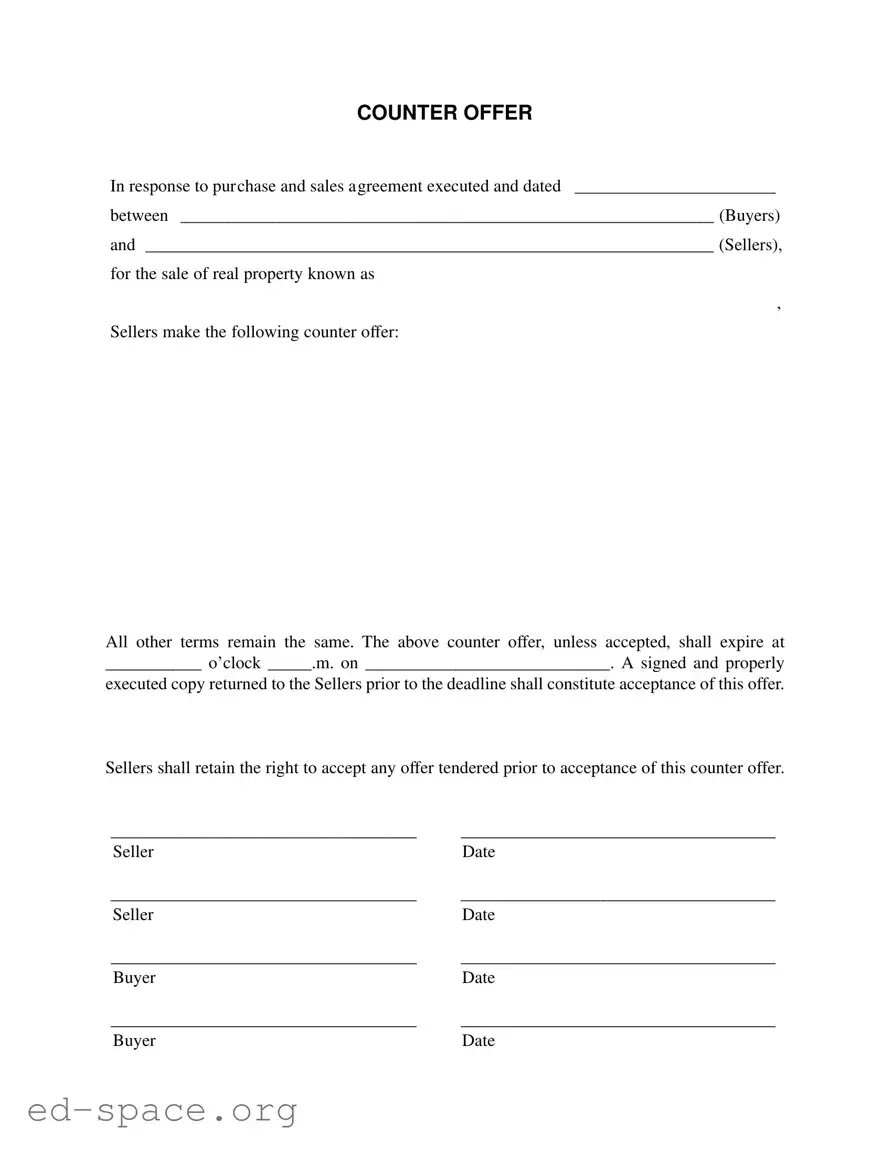
The Counter Offer form serves as a crucial tool in real estate transactions, allowing sellers to respond to a buyer's initial offer with their own terms. This form is initiated after a purchase and sales agreement has been executed, clearly identifying both the buyers and sellers involved in the transaction. It outlines the specific counter offer made by the sellers, while also stating that all other terms of the original agreement remain unchanged. A key aspect of this form is its time-sensitive nature; the counter offer will expire at a specified date and time unless accepted by the buyers. Acceptance requires a signed and properly executed copy of the counter offer to be returned to the sellers before the deadline. Additionally, sellers retain the right to accept other offers that may come in before the counter offer is accepted. This ensures that sellers can maximize their opportunities while navigating the complexities of real estate negotiations.
COUNTER OFFER
In response to purchase and sales agreement executed and dated _______________________
between _____________________________________________________________ (Buyers)
and _________________________________________________________________ (Sellers),
for the sale of real property known as
,
Sellers make the following counter offer:
All other terms remain the same. The above counter offer, unless accepted, shall expire at
___________ o’clock _____.m. on ____________________________. A signed and properly
executed copy returned to the Sellers prior to the deadline shall constitute acceptance of this offer.
Sellers shall retain the right to accept any offer tendered prior to acceptance of this counter offer.
___________________________________ |
____________________________________ |
Seller |
Date |
___________________________________ |
____________________________________ |
Seller |
Date |
___________________________________ |
____________________________________ |
Buyer |
Date |
___________________________________ |
____________________________________ |
Buyer |
Date |
| Fact Name | Description |
|---|---|
| Purpose | The Counter Offer form is used by sellers to propose modifications to the original purchase and sales agreement. |
| Expiration | The counter offer includes a specific expiration time and date, after which it is no longer valid unless accepted. |
| Acceptance | A signed copy of the counter offer must be returned to the sellers before the expiration time to constitute acceptance. |
| Governing Law | In states such as California, the governing law for the Counter Offer form is outlined in the California Civil Code. |
Once the Counter Offer form is completed, it will need to be submitted to the Sellers for consideration. The Sellers will review the terms and either accept or reject the counter offer before the specified deadline.
What is a Counter Offer form?
A Counter Offer form is a document used in real estate transactions. It allows sellers to respond to an initial purchase and sales agreement by proposing new terms. This form outlines the changes the sellers wish to make while keeping other terms of the original agreement intact.
When should a Counter Offer form be used?
A Counter Offer form should be used when sellers do not agree with the terms of the initial purchase and sales agreement. Instead of rejecting the offer outright, sellers can propose adjustments that better meet their needs.
What information is required on the Counter Offer form?
The form requires the date of the original agreement, the names of the buyers and sellers, the property address, and the proposed changes. Additionally, the form includes a deadline for acceptance and spaces for signatures from both parties.
What happens if the Counter Offer is accepted?
If the buyers accept the Counter Offer, they must sign and return the document to the sellers before the specified deadline. Once this occurs, the terms outlined in the Counter Offer become part of the binding agreement.
Can sellers accept other offers while the Counter Offer is pending?
Yes, sellers retain the right to accept any other offers that may come in before the buyers accept the Counter Offer. This means that the sellers can continue to negotiate with other potential buyers until an agreement is finalized.
What is the significance of the expiration time on the Counter Offer?
The expiration time indicates how long the Counter Offer remains valid. If the buyers do not accept the Counter Offer by the specified time, the offer becomes void, and the sellers are free to pursue other options.
Is a verbal acceptance of the Counter Offer sufficient?
No, a verbal acceptance is not sufficient. The Counter Offer must be signed and returned in writing to constitute acceptance. This ensures that both parties have a clear and documented understanding of the agreement.
What if the buyers want to make further changes after receiving the Counter Offer?
If the buyers wish to propose additional changes, they can do so by creating a new Counter Offer in response to the sellers’ Counter Offer. This back-and-forth negotiation can continue until both parties reach a mutually agreeable set of terms.
Can a Counter Offer be rescinded?
Yes, sellers can rescind their Counter Offer before it is accepted. However, once the buyers have signed and returned the Counter Offer, it becomes binding, and the sellers can no longer withdraw it without facing potential legal consequences.
What should buyers do if they disagree with the Counter Offer?
If buyers disagree with the Counter Offer, they can either accept it as is, propose a new Counter Offer, or reject it outright. Clear communication is essential to ensure that both parties understand each other’s positions and can work towards a satisfactory agreement.
Leaving the date blank: Failing to fill in the date of the original purchase and sales agreement can lead to confusion about the timeline of the agreement.
Not specifying the property: Omitting the address or details of the property can make it difficult to identify which property the counter offer pertains to.
Ignoring the expiration time: Forgetting to fill in the expiration time can leave both parties uncertain about how long the counter offer remains valid.
Failing to sign: Not providing signatures from all sellers can invalidate the counter offer, making it unenforceable.
Leaving buyer signatures blank: If the buyers do not sign the counter offer, it cannot be considered accepted, regardless of their intentions.
Not clarifying changes: If the counter offer includes changes to the original terms, failing to clearly outline these changes can lead to misunderstandings.
Using vague language: Being unclear or ambiguous in the counter offer can create confusion and potential disputes later on.
Forgetting to retain copies: Not keeping a copy of the counter offer for personal records can result in lost documentation and confusion about what was agreed upon.
Neglecting to communicate: Failing to discuss the counter offer with all parties involved can lead to miscommunication and potential conflicts.
Not consulting a professional: Attempting to navigate the counter offer process without legal advice can result in mistakes that may have been easily avoided.
When engaging in real estate transactions, several forms and documents complement the Counter Offer form. Each document serves a specific purpose in facilitating the negotiation and sale process. Below is a list of commonly used forms that may accompany a Counter Offer.
Understanding these forms can enhance your real estate experience. Each document plays a vital role in ensuring a smooth transaction, protecting the interests of both buyers and sellers.
The Counter Offer form is a crucial document in real estate transactions, particularly in negotiations between buyers and sellers. Several other documents share similarities with the Counter Offer form, each serving distinct purposes while maintaining a common theme of negotiation and agreement. Below is a list of ten documents that are similar to the Counter Offer form:
When filling out a Counter Offer form, attention to detail is crucial. Here are some important dos and don’ts to keep in mind:
By following these tips, you can navigate the counter offer process with confidence. Remember, clarity and communication are key to a successful negotiation.
Misconceptions about the Counter Offer form can lead to confusion during real estate transactions. Below are seven common misconceptions, along with clarifications for each.
When filling out and using the Counter Offer form, keep these key takeaways in mind: