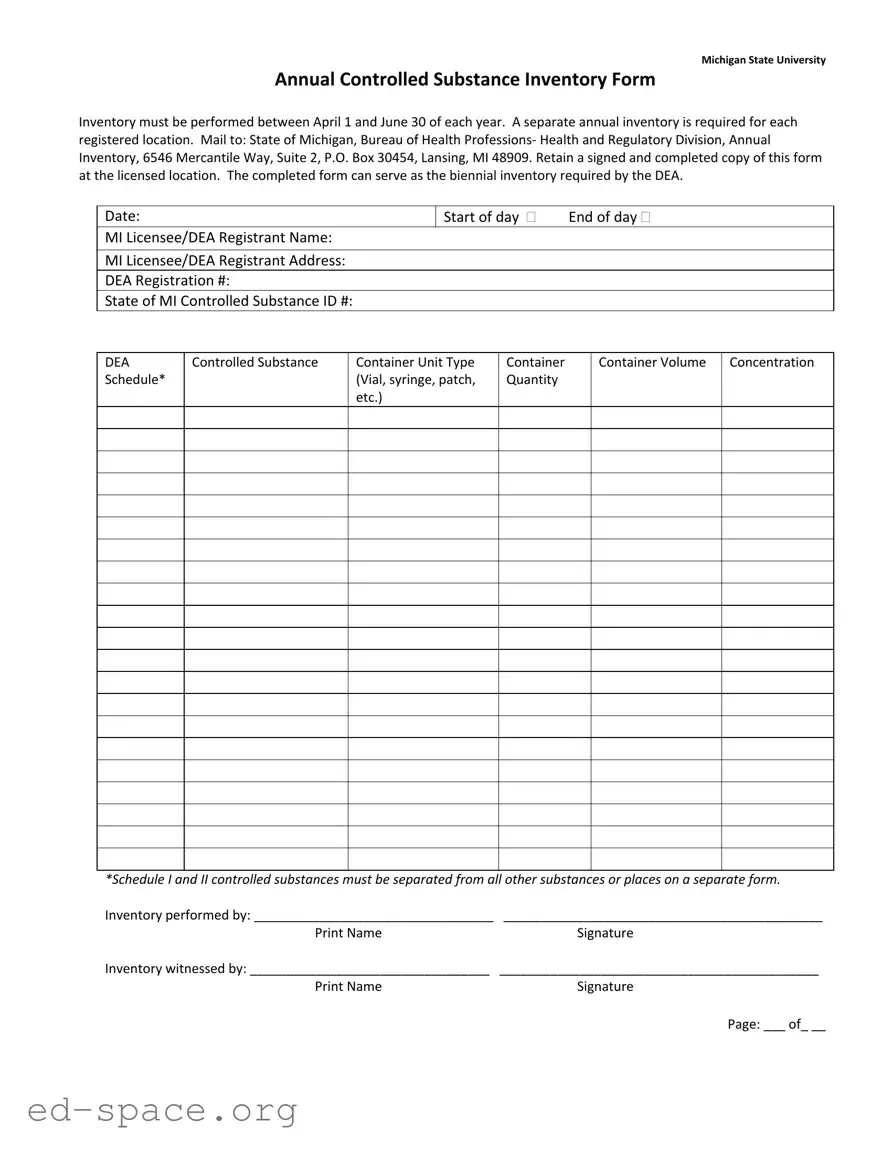
The Control Substance Inventory Michigan form is an essential document for any facility that handles controlled substances. This form must be completed annually between April 1 and June 30, ensuring compliance with state regulations. Each registered location needs its own inventory, highlighting the importance of maintaining accurate records. Once filled out, the form should be mailed to the Bureau of Health Professions in Lansing, MI, and a signed copy must be kept on-site for reference. Notably, this form can also fulfill the biennial inventory requirement set by the DEA, making it a crucial tool for legal compliance. The inventory details include the date of the count, the name and address of the DEA registrant, and specific information about each controlled substance, such as its container type and quantity. For Schedule I and II substances, special care is required, as they must be documented separately. It is vital that the inventory is conducted by a qualified individual and witnessed by another, ensuring accountability and accuracy in the reporting process.

Michigan State University
Annual Controlled Substance Inventory Form
Inventory must be performed between April 1 and June 30 of each year. A separate annual inventory is required for each registered location. Mail to: State of Michigan, Bureau of Health Professions‐ Health and Regulatory Division, Annual Inventory, 6546 Mercantile Way, Suite 2, P.O. Box 30454, Lansing, MI 48909. Retain a signed and completed copy of this form at the licensed location. The completed form can serve as the biennial inventory required by the DEA.
Date:
Start of day |
End of day |
MI Licensee/DEA Registrant Name:
MI Licensee/DEA Registrant Address:
DEA Registration #:
State of MI Controlled Substance ID #:
DEA Schedule*
Controlled Substance
Container Unit Type (Vial, syringe, patch, etc.)
Container Quantity
Container Volume
Concentration
*Schedule I and II controlled substances must be separated from all other substances or places on a separate form.
Inventory performed by: _________________________________ |
____________________________________________ |
Print Name |
Signature |
Inventory witnessed by: _________________________________ |
____________________________________________ |
Print Name |
Signature |
|
Page: ___ of_ __ |
| Fact Name | Description |
|---|---|
| Inventory Period | The inventory must be conducted annually between April 1 and June 30. |
| Location Requirement | A separate inventory form is necessary for each registered location. |
| Submission Address | Mail the completed form to the Bureau of Health Professions at the specified Lansing address. |
| DEA Compliance | This form can fulfill the biennial inventory requirement set by the DEA. |
Completing the Control Substance Inventory Michigan form is an essential task for maintaining compliance with state regulations. This process ensures that all controlled substances are accurately accounted for and properly documented. Following the steps below will guide you through filling out the form correctly.
Once you have completed the form, mail it to the specified address in Lansing, MI. Retain a signed copy at your licensed location, as it may also serve as the biennial inventory required by the DEA. Ensure you complete this process between April 1 and June 30 each year for compliance.
What is the purpose of the Controlled Substance Inventory Michigan form?
The Controlled Substance Inventory Michigan form is used to document the inventory of controlled substances at registered locations. It helps ensure compliance with state regulations and can also fulfill the biennial inventory requirement set by the DEA.
When should the inventory be performed?
The inventory must be conducted annually between April 1 and June 30. This time frame is set to maintain consistency and compliance with state regulations.
Do I need to submit a separate form for each location?
Yes, a separate annual inventory form is required for each registered location. This ensures that each facility's controlled substances are accurately accounted for and reported.
Where do I send the completed form?
Mail the completed form to the State of Michigan, Bureau of Health Professions‐ Health and Regulatory Division, Annual Inventory, 6546 Mercantile Way, Suite 2, P.O. Box 30454, Lansing, MI 48909.
What should I do with a signed copy of the form?
It is important to retain a signed and completed copy of the form at the licensed location. This copy serves as proof of compliance and can be referenced in future audits or inspections.
What information is required on the form?
The form requires details such as the date of the inventory, the name and address of the licensee or DEA registrant, DEA registration number, state-controlled substance ID number, and specifics about the controlled substances being inventoried, including type, quantity, and concentration.
How should Schedule I and II substances be handled on the form?
Schedule I and II controlled substances must be separated from all other substances. They should either be documented on a separate form or clearly identified to ensure compliance with regulations.
Who should perform and witness the inventory?
The inventory should be performed by a qualified individual, whose name and signature must be recorded on the form. Additionally, a witness is required to sign and print their name, confirming that the inventory was conducted accurately.
Not Performing Inventory Within the Required Dates: The inventory must be conducted between April 1 and June 30 of each year. Failing to adhere to this timeline can result in compliance issues.
Submitting a Single Inventory for Multiple Locations: Each registered location requires a separate annual inventory. Combining inventories can lead to inaccuracies and potential legal repercussions.
Incorrectly Filling Out the DEA Registration Number: Ensure the DEA Registration Number is accurate. An error here can invalidate the entire form.
Forgetting to Retain a Signed Copy: It is essential to keep a signed and completed copy of the form at the licensed location. This serves as proof of compliance.
Not Separating Schedule I and II Substances: Schedule I and II controlled substances must be separated from all other substances or documented on a separate form. Mixing them can lead to regulatory issues.
Neglecting to Include All Required Information: Ensure all fields, such as the MI Licensee/DEA Registrant Name and Address, are filled out completely. Missing information can delay processing.
Failing to Document the Inventory Witness: The form requires a witness to the inventory. Not including this information can raise questions about the inventory's validity.
Using Incorrect Container Types: Be precise when identifying the container unit type (e.g., vial, syringe, patch). Incorrect entries can lead to discrepancies in the inventory.
Overlooking Container Quantity and Volume: Accurately report the container quantity and volume concentration. Mistakes here can result in significant compliance issues.
The Controlled Substance Inventory Michigan form is essential for maintaining compliance with state regulations. However, several other documents are often used in conjunction with this form to ensure comprehensive record-keeping and regulatory adherence. Below is a list of related documents that may be required.
Maintaining accurate records and completing the necessary forms is vital for compliance with both state and federal regulations. Failure to do so can result in penalties or loss of licensure. It is important to stay informed about all required documentation and ensure that all forms are completed accurately and timely.
The Control Substance Inventory Michigan form shares similarities with several other documents related to controlled substances. Below is a list of these documents and their corresponding similarities:
When filling out the Control Substance Inventory Michigan form, it is essential to adhere to specific guidelines to ensure accuracy and compliance. Here are seven things you should and shouldn't do:
Misconceptions about the Control Substance Inventory Michigan form can lead to confusion. Understanding the facts can help ensure compliance and accuracy. Here are four common misconceptions:
When filling out the Control Substance Inventory Michigan form, consider these key takeaways: