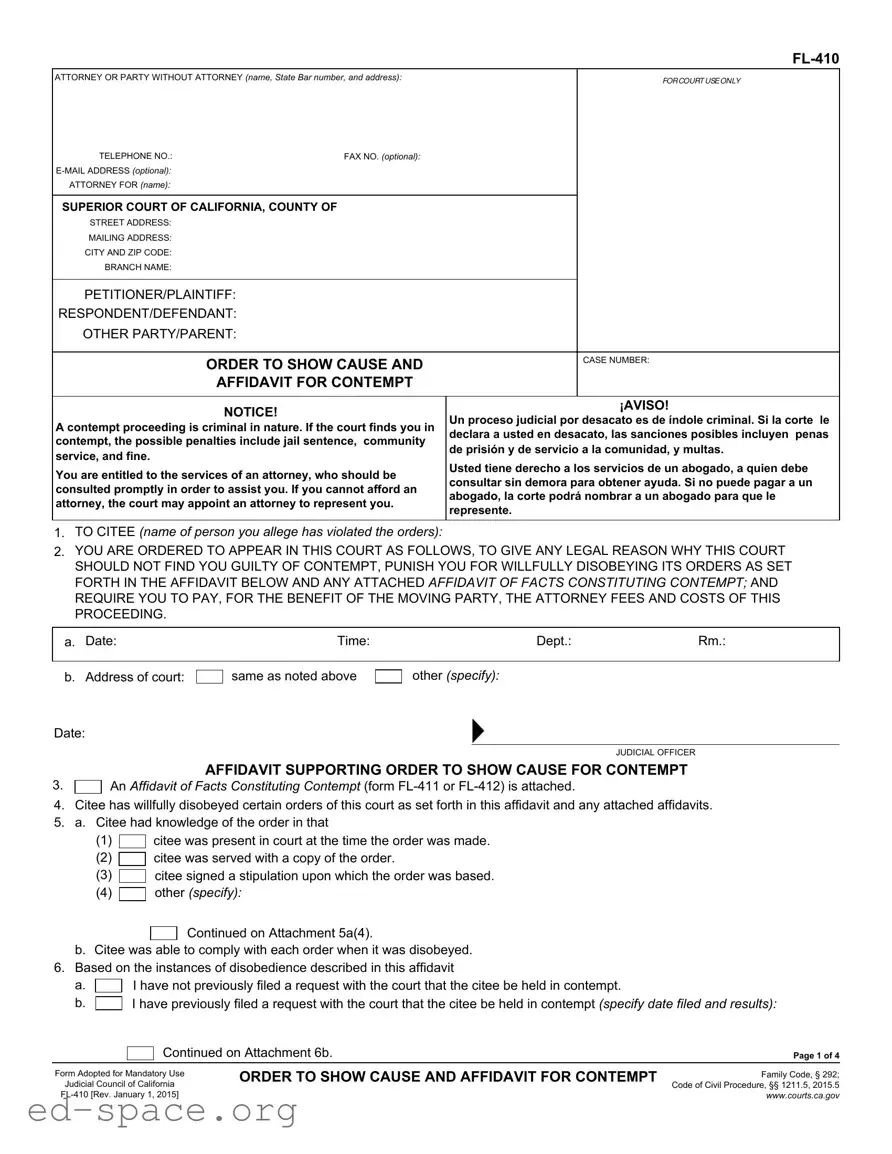
The Contempt FL-410 form is an essential document used in California courts to address situations where an individual is accused of disobeying court orders. This form initiates a contempt proceeding, which is a serious legal action that can have criminal implications. It requires the party alleging contempt, known as the petitioner or plaintiff, to provide specific details about the alleged violations. Key components of the form include the identification of the citee—the person accused of contempt—and a request for them to appear in court to explain why they should not be found guilty. The form also emphasizes the necessity of legal representation, advising individuals to consult an attorney promptly. If the court finds the citee in contempt, penalties may include fines, community service, or even jail time. Additionally, the form allows for the inclusion of an affidavit that details the facts supporting the contempt claim, ensuring that all relevant information is presented for the court's consideration. Completing the FL-410 form accurately is crucial, as it sets the stage for potential legal consequences and the enforcement of the original court orders.

ATTORNEY OR PARTY WITHOUT ATTORNEY (name, State Bar number, and address): |
|
FOR COURT USE ONLY |
||
|
|
|
||
TELEPHONE NO.: |
FAX NO. (optional): |
|
|
|
|
|
|
||
ATTORNEY FOR (name): |
|
|
|
|
|
|
|
|
|
SUPERIOR COURT OF CALIFORNIA, COUNTY OF |
|
|
|
|
STREET ADDRESS: |
|
|
|
|
MAILING ADDRESS: |
|
|
|
|
CITY AND ZIP CODE: |
|
|
|
|
BRANCH NAME: |
|
|
|
|
|
|
|
|
|
PETITIONER/PLAINTIFF: |
|
|
|
|
RESPONDENT/DEFENDANT: |
|
|
|
|
OTHER PARTY/PARENT: |
|
|
|
|
|
|
|
|
|
ORDER TO SHOW CAUSE AND |
|
CASE NUMBER: |
||
|
|
|||
AFFIDAVIT FOR CONTEMPT |
|
|
||
|
|
|
|
|
NOTICE! |
|
|
¡AVISO! |
|
|
Un proceso judicial por desacato es de índole criminal. Si la corte le |
|||
A contempt proceeding is criminal in nature. If the court finds you in |
||||
declara a usted en desacato, las sanciones posibles incluyen penas |
||||
contempt, the possible penalties include jail sentence, community |
de prisión y de servicio a la comunidad, y multas. |
|||
service, and fine. |
|
|||
|
|
|
||
You are entitled to the services of an attorney, who should be |
Usted tiene derecho a los servicios de un abogado, a quien debe |
|||
consultar sin demora para obtener ayuda. Si no puede pagar a un |
||||
consulted promptly in order to assist you. If you cannot afford an |
||||
abogado, la corte podrá nombrar a un abogado para que le |
||||
attorney, the court may appoint an attorney to represent you. |
||||
represente. |
||||
|
|
|||
|
|
|
|
|
1.TO CITEE (name of person you allege has violated the orders):
2.YOU ARE ORDERED TO APPEAR IN THIS COURT AS FOLLOWS, TO GIVE ANY LEGAL REASON WHY THIS COURT SHOULD NOT FIND YOU GUILTY OF CONTEMPT, PUNISH YOU FOR WILLFULLY DISOBEYING ITS ORDERS AS SET FORTH IN THE AFFIDAVIT BELOW AND ANY ATTACHED AFFIDAVIT OF FACTS CONSTITUTING CONTEMPT; AND REQUIRE YOU TO PAY, FOR THE BENEFIT OF THE MOVING PARTY, THE ATTORNEY FEES AND COSTS OF THIS PROCEEDING.
a. Date: |
Time: |
Dept.: |
Rm.: |
b.Address of court:
Date:
same as noted above
other (specify):
JUDICIAL OFFICER
AFFIDAVIT SUPPORTING ORDER TO SHOW CAUSE FOR CONTEMPT
3. An Affidavit of Facts Constituting Contempt (form
4.Citee has willfully disobeyed certain orders of this court as set forth in this affidavit and any attached affidavits.
5.a. Citee had knowledge of the order in that
(1) |
|
citee was present in court at the time the order was made. |
(2) |
|
citee was served with a copy of the order. |
|
||
(3) |
|
citee signed a stipulation upon which the order was based. |
|
||
(4) |
|
other (specify): |
|
Continued on Attachment 5a(4).
b. Citee was able to comply with each order when it was disobeyed.
6.Based on the instances of disobedience described in this affidavit
a. |
|
|
I have not previously filed a request with the court that the citee be held in contempt. |
|
||
b. |
|
|
I have previously filed a request with the court that the citee be held in contempt (specify date filed and results): |
|||
|
||||||
|
|
|
|
Continued on Attachment 6b. |
Page 1 of 4 |
|
|
|
|
|
|||
|
|
|
|
|
|
|
Form Adopted for Mandatory Use |
ORDER TO SHOW CAUSE AND AFFIDAVIT FOR CONTEMPT |
Family Code, § 292; |
||||
Judicial Council of California |
Code of Civil Procedure, §§ 1211.5, 2015.5 |
|||||
|
www.courts.ca.gov |
|||||

PETITIONER/PLAINTIFF:
RESPONDENT/DEFENDANT:
OTHER PARTY/PARENT:
CASE NUMBER:
7. Citee has previously been found in contempt of a court order (specify case, court, date):
8.
Continued on Attachment 7.
Each order disobeyed and each instance of disobedience is described as follows:
a. Orders for child support, spousal support, family support, attorney fees, and court or other litigation costs (see attached Affidavit of Facts Constituting Contempt (form
b. Domestic violence restraining orders and child custody and visitation orders (see attached Affidavit of Facts Constituting Contempt (form
c. Injunctive or other order (specify which order was violated, how the order was violated, and when the order was violated):
d.
Continued on Attachment 8c.
Other material facts, including facts indicating that the violation of the orders was without justification or excuse (specify):
e.
Continued on Attachment 8d.
I am requesting that attorney fees and costs be awarded to me for the costs of pursuing this contempt action. (A copy of my Income and Expense Declaration (form
WARNING: IF YOU PURSUE THIS CONTEMPT ACTION, IT MAY AFFECT THE ABILITY OF THE DISTRICT ATTORNEY TO PROSECUTE THE CITEE CRIMINALLY FOR THE SAME VIOLATIONS.
I declare under penalty of perjury under the laws of the State of California that the foregoing is true and correct.
Date:
(TYPE OR PRINT NAME) |
(SIGNATURE) |
ORDER TO SHOW CAUSE AND AFFIDAVIT FOR CONTEMPT
Page 2 of 4

INFORMATION SHEET FOR ORDER TO SHOW CAUSE
AND AFFIDAVIT FOR CONTEMPT
(Do NOT deliver this Information Sheet to the court clerk.)
Please follow these instructions to complete the Order to Show Cause and Affidavit for Contempt (form
Contempt actions are very difficult to prove. An attorney may be appointed for the citee.
INSTRUCTIONS FOR COMPLETING THE ORDER TO SHOW CAUSE AND AFFIDAVIT FOR CONTEMPT (TYPE OR PRINT FORM IN INK):
If the top section of the form has already been filled out, skip down to number 1 below. If the top section of the form is blank, you must provide this information.
Front page, first box, top of form, left side: Print your name, address, telephone number, and fax number, if any, in this box. If you have a restraining order and wish to keep your address confidential, you may use any address where you can receive mail. You can be legally served court papers at this address.
Front page, second box, left side: Print the name of the county where the court is located and insert the address and any branch name of the court building where you are seeking to obtain a contempt order. You may get this information from the court clerk. This should be the same court in which the original order was issued.
Front page, third box, left side: Print the names of the Petitioner, Respondent, and Other Party/Parent (if any) in this box. Use the same names as appear on the most recent court order disobeyed.
Front page, first box, top of form, right side: Leave this box blank for the court's use.
Front page, second box, right side: Print the court case number in this box. This number is also shown on the most recent court order disobeyed.
Item 1: Insert the name of the party who disobeyed the order ("the citee").
Item 2: The court clerk will provide the hearing date and location.
Item 3: Either check the box in item 3 and attach an Affidavit of Facts Constituting Contempt (form
Item 5: Check the box that describes how the citee knew about the order that has been disobeyed.
Item 6: a. Check this box if you have not previously applied for a contempt order.
b.Check this box if you have previously applied for a contempt order and briefly explain when you requested the order and results of your request. If you need more space, check the box that says "continued on Attachment 6b" and attach a separate sheet to this order to show cause.
Item 7: Check this box if the citee has previously been found in contempt by a court of law. Briefly explain when the citee was found in contempt and for what. If there is not enough space to write all the facts, check the box that says "continued on Attachment 7" and attach a separate sheet to this order to show cause.
Item 8: a. Check this box if the citee has disobeyed orders for child support, custody, visitation, spousal support, family support, attorney fees, and court or litigation costs. Refer to item 1a on Affidavit of Facts Constituting Contempt (form
b.Check this box if the citee has disobeyed domestic violence orders or child custody and visitation orders. Refer to Affidavit of Facts Constituting Contempt (form
ORDER TO SHOW CAUSE AND AFFIDAVIT FOR CONTEMPT
Page 3 of 4

Information Sheet (continued)
Item 8: c. If you are completing this item, use facts personally known to you or known to the best of your knowledge. State the facts in detail. If there is not enough space to write all the facts, check the box that says "continued on Attachment 8c" and attach a separate sheet to this order to show cause, including facts indicating that the violation of the orders was without justification or excuse.
d.Use this item to write other facts that are important to this order. If you are completing this item, insert facts personally known to you, or known to the best of your knowledge. State facts in detail. If there is not enough space to write all the facts, check the box that says "Continued on Attachment 8d" and attach a separate sheet to the order to show cause.
e.If you request attorney fees and/or costs for pursuing this contempt action, check this box. Attach a copy of your Income and Expense Declaration (form
Type or print and sign your name at the bottom of page 2.
If you checked the boxes in item 3 and item 8a or 8b, complete the appropriate Affidavit of Facts Constituting Contempt (form
Make at least three copies of the Order to Show Cause and Affidavit for Contempt (form
Take the completed form(s) to the court clerk's office. The clerk will provide hearing date and location in item 2, obtain the judicial officer's signature, file the originals, and return the copies to you.
Have someone who is at least 18 years of age, who is not a party, serve the order and any attached papers on the disobedient party. For example, a process server or someone you know may serve the papers. You may not serve the papers yourself. Service must be personal; service by mail is insufficient. The papers must be served at least 16 court days before the hearing. The person serving papers must complete a Proof of Personal Service (form
If you need assistance with these forms, contact an attorney or the Family Law Facilitator in your county.
ORDER TO SHOW CAUSE AND AFFIDAVIT FOR CONTEMPT |
|
|
Page 4 of 4
For your protection and privacy, please press the Clear
This Form button after you have printed the form.
| Fact Name | Details |
|---|---|
| Form Purpose | The FL-410 form is used to initiate contempt proceedings in California family law cases. |
| Governing Laws | Family Code, § 292; Judicial Council of California Code of Civil Procedure, §§ 1211.5, 2015.5. |
| Criminal Nature | Contempt proceedings are considered criminal in nature, which can lead to serious penalties. |
| Possible Penalties | Penalties for contempt may include jail time, community service, and fines. |
| Legal Representation | Individuals facing contempt charges have the right to legal representation, which can be appointed if they cannot afford an attorney. |
| Knowledge of Orders | The citee must have had knowledge of the court orders that were allegedly violated. |
| Affidavit Requirement | An Affidavit of Facts Constituting Contempt (FL-411 or FL-412) must accompany the FL-410 form. |
| Service of Papers | Service of the contempt papers must be personal and completed at least 16 court days before the hearing. |
After completing the Contempt FL-410 form, the next steps involve filing the form with the court and ensuring that the other party is properly notified of the proceedings. This process is crucial for moving forward with the contempt action.
What is the FL-410 form used for?
The FL-410 form, known as the Order to Show Cause and Affidavit for Contempt, is utilized in California family law cases. It serves to initiate a legal process when one party believes that another has willfully disobeyed a court order. This could involve issues such as child support, spousal support, custody arrangements, or other court mandates. Essentially, it requests the court to hold the non-compliant party accountable for their actions.
Who can file the FL-410 form?
Any party involved in a family law case can file the FL-410 form. This includes petitioners, respondents, or any other parties with a vested interest in the court order that has allegedly been violated. It is important to note that while individuals can represent themselves, seeking legal counsel is advisable due to the complexities involved in contempt proceedings.
What happens after I file the FL-410 form?
Once the FL-410 form is filed, the court will schedule a hearing. The date, time, and location of this hearing will be provided on the form. The party accused of contempt, known as the "citee," will be ordered to appear in court and explain why they should not be found guilty of contempt. This is an opportunity for both parties to present their arguments and any evidence related to the case.
What are the potential consequences of being found in contempt?
If the court finds the citee guilty of contempt, the consequences can be serious. Possible penalties include jail time, community service, fines, or other punitive measures. Additionally, the court may order the citee to pay attorney fees and costs incurred by the party who filed the contempt action. Understanding these potential outcomes is crucial for anyone involved in such proceedings.
Do I need an attorney to file the FL-410 form?
While it is not mandatory to have an attorney to file the FL-410 form, it is highly recommended. Contempt actions can be complex and challenging to navigate. An attorney can provide valuable guidance, help prepare the necessary documents, and represent your interests in court. If you cannot afford an attorney, the court may appoint one for you.
What information do I need to include on the FL-410 form?
The FL-410 form requires several key pieces of information. You must include your name and contact details, the name of the citee, and details about the specific court order that has been violated. Additionally, you will need to describe how the citee disobeyed the order and any prior instances of contempt, if applicable. Be thorough and precise, as this information is crucial for the court's consideration.
What is the role of the Affidavit of Facts Constituting Contempt?
The Affidavit of Facts Constituting Contempt, which is attached to the FL-410 form, provides the detailed evidence supporting your claim of contempt. This affidavit outlines the specific instances of disobedience and any relevant facts that demonstrate the citee's willful disregard for the court's orders. This document is essential for substantiating your case and will be reviewed by the court during the hearing.
Can I pursue contempt charges if there are ongoing criminal proceedings?
Pursuing a contempt action can complicate ongoing criminal proceedings related to the same violations. It is crucial to be aware that filing for contempt may affect the district attorney's ability to prosecute the citee criminally. Consulting with an attorney is advisable to navigate these potential conflicts and determine the best course of action.
What should I do if I need help with the FL-410 form?
If you find yourself needing assistance with the FL-410 form, several resources are available. You can contact an attorney for personalized legal advice. Additionally, many counties have Family Law Facilitators who can provide guidance on completing the form and understanding the contempt process. Utilizing these resources can help ensure that you are adequately prepared for your case.
Incomplete Information: Failing to fill out all required sections can lead to delays or rejections. Each part of the form must be completed, including names, addresses, and case numbers.
Incorrect Case Number: Entering the wrong case number can cause confusion. Always double-check that the number matches the most recent court order.
Missing Attachments: Not including the necessary affidavits can weaken the case. Attach the Affidavit of Facts Constituting Contempt (FL-411 or FL-412) as required.
Failure to Specify Orders: Vague descriptions of the orders that were disobeyed can lead to misunderstandings. Clearly state each order and how it was violated.
Not Following Court Instructions: Ignoring specific instructions for completing the form can lead to errors. Review the instructions carefully before submission.
Improper Service of Papers: Serving the order incorrectly can invalidate the process. Ensure that the papers are served personally and by someone over 18 who is not involved in the case.
Missing Signatures: Forgetting to sign the form can result in it being rejected. Always sign and date the form before submitting it to the court.
The Contempt FL-410 form is often used in conjunction with several other documents to support a contempt action in court. Each of these forms serves a specific purpose in the legal process. Below is a list of related forms and documents commonly utilized alongside the FL-410.
These documents collectively help to establish the context and basis for the contempt action, ensuring that all necessary information is presented to the court. Properly completing and filing these forms is crucial for the success of the contempt proceedings.
The Contempt FL-410 form is used in legal proceedings to address situations where an individual has allegedly disobeyed a court order. Several other legal documents serve similar purposes in various contexts. Here are ten documents that share similarities with the FL-410 form:
When filling out the Contempt FL-410 form, it is important to follow specific guidelines to ensure accuracy and compliance. Below is a list of dos and don'ts to consider.
Understanding the Contempt FL-410 form is essential for anyone involved in a contempt proceeding. However, several misconceptions often cloud the clarity of this legal document. Here are nine common misunderstandings:
Clarifying these misconceptions can help individuals navigate the complexities of the contempt process more effectively.
Here are some key takeaways for filling out and using the Contempt FL-410 form:
Following these guidelines will help ensure that your contempt action is properly filed and addressed by the court.