When engaging in various activities, whether they are medical procedures, research studies, or participation in events, individuals often encounter consent forms. These documents serve a crucial purpose, ensuring that participants are fully informed about what they are agreeing to. A well-structured consent form outlines the nature of the activity, potential risks involved, and the rights of the participant. It also includes information on confidentiality and how personal data will be handled. By signing the form, individuals acknowledge that they understand the information presented and voluntarily agree to participate. This process not only protects the rights of participants but also fosters trust between them and the organizations involved. Understanding the key components of a consent form is essential for anyone considering participation in activities that require such documentation.
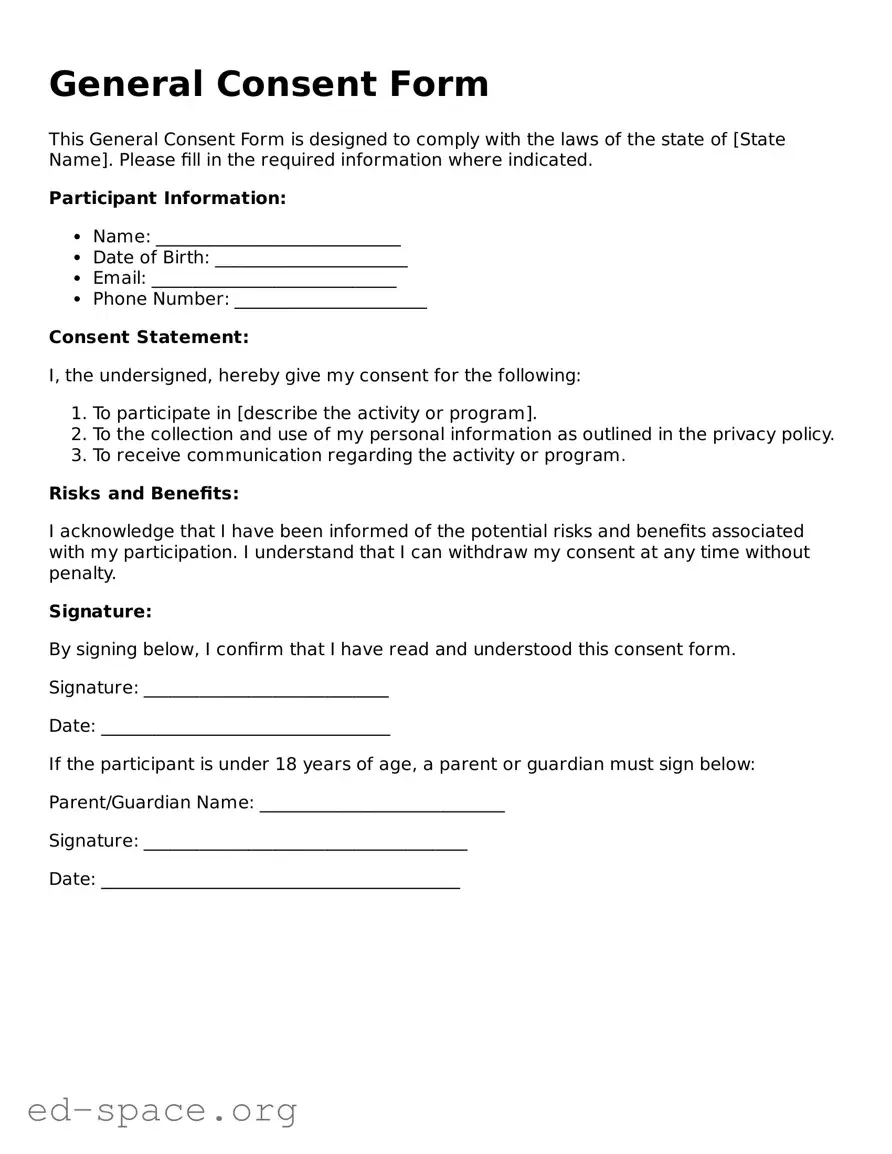
General Consent Form
This General Consent Form is designed to comply with the laws of the state of [State Name]. Please fill in the required information where indicated.
Participant Information:
Consent Statement:
I, the undersigned, hereby give my consent for the following:
Risks and Benefits:
I acknowledge that I have been informed of the potential risks and benefits associated with my participation. I understand that I can withdraw my consent at any time without penalty.
Signature:
By signing below, I confirm that I have read and understood this consent form.
Signature: ____________________________
Date: _________________________________
If the participant is under 18 years of age, a parent or guardian must sign below:
Parent/Guardian Name: ____________________________
Signature: _____________________________________
Date: _________________________________________
| Fact Name | Description |
|---|---|
| Definition | A consent form is a document that individuals sign to indicate their agreement to participate in a specific activity or to allow certain actions to be taken regarding their personal information or rights. |
| Purpose | Consent forms are used to ensure that individuals are fully informed about what they are agreeing to, protecting both the individual and the organization from potential legal issues. |
| Informed Consent | For consent to be valid, individuals must be provided with all relevant information, including risks, benefits, and alternatives, allowing them to make an informed decision. |
| State-Specific Forms | Many states have specific requirements for consent forms, which may include particular language or disclosures mandated by state law. |
| Governing Laws | In the United States, laws governing consent forms can vary by state, with regulations often found in health care, privacy, and contract law. |
| Revocation of Consent | Individuals have the right to revoke their consent at any time, and the process for doing so should be clearly outlined in the consent form. |
After obtaining the Consent form, you will proceed to fill it out accurately. This ensures that all necessary information is captured for the next steps in the process.
What is a consent form and why is it important?
A consent form is a document that outlines the agreement between a participant and an organization or researcher regarding participation in a study, program, or activity. It is crucial because it ensures that participants are fully informed about what they are agreeing to, including any potential risks and benefits. By signing the form, participants acknowledge their understanding and voluntarily agree to participate, which protects both their rights and the integrity of the research or program.
What information should be included in a consent form?
A well-structured consent form should include several key elements. First, it must clearly state the purpose of the study or activity. Second, it should describe the procedures involved, including any potential risks or discomforts. Third, the form should explain the benefits of participation, if any, and outline the confidentiality measures in place to protect participants’ information. Lastly, it should provide contact information for individuals who can answer questions or address concerns, ensuring participants feel supported throughout the process.
Can a participant withdraw their consent at any time?
Yes, participants have the right to withdraw their consent at any time without facing any penalties or loss of benefits. This principle is fundamental to ethical research practices and respects the autonomy of individuals. If a participant decides to withdraw, they should communicate their decision to the researcher or organization. It is important for participants to know that their well-being is a priority, and they can choose to exit the study or program whenever they feel it is necessary.
What happens if a participant does not sign the consent form?
If a participant chooses not to sign the consent form, they will not be able to participate in the study or activity. This is because the consent form serves as a legal and ethical safeguard for both the participant and the organization. Without consent, the organization cannot assume that the participant is informed or willing to take part in the research. It is essential for participants to understand that signing the consent form is a prerequisite for involvement, ensuring that their rights and choices are respected.
Not reading the entire form: Many individuals skim through the consent form, missing important details. It’s crucial to read every section to fully understand what you are agreeing to.
Failing to ask questions: If something is unclear, it’s essential to seek clarification. Ignoring confusion can lead to misunderstandings about the consent being given.
Not providing accurate information: Some people may inadvertently supply incorrect personal information. Ensure that all details, such as name, address, and contact information, are accurate.
Overlooking signature requirements: A common mistake is forgetting to sign or date the form. Without a signature, the consent may not be valid.
Ignoring withdrawal options: Many forms include information on how to withdraw consent. Failing to note this can lead to confusion later on.
Not keeping a copy: After signing, it’s advisable to keep a copy of the consent form for personal records. This can be helpful in case of future disputes or questions.
Assuming consent is permanent: Some people mistakenly believe that once they give consent, it cannot be revoked. Understanding the terms of consent is vital.
When navigating various legal processes, it is essential to have a complete set of documents to ensure clarity and compliance. Alongside a Consent form, several other forms and documents are commonly utilized. Each serves a unique purpose, contributing to a well-structured legal framework.
Having these documents in place alongside a Consent form not only enhances legal protection but also fosters transparency and trust among all parties involved. Proper documentation can significantly reduce misunderstandings and potential disputes, paving the way for smoother interactions and experiences.
When filling out a consent form, it's crucial to ensure that the process is clear and accurate. Here are some essential dos and don'ts to keep in mind:
Understanding consent forms is essential for ensuring that individuals are fully informed about their rights and responsibilities. However, several misconceptions can lead to confusion. Below are five common misunderstandings about consent forms:
Consent forms are only for medical procedures. Many people believe that consent forms are exclusively related to healthcare. In reality, they are used in various contexts, including research studies, legal agreements, and even digital services. Consent is a fundamental aspect of any situation where personal information or participation is involved.
Signing a consent form means you cannot change your mind. Some individuals think that once they sign a consent form, they are bound by its terms forever. However, consent can often be withdrawn at any time, depending on the circumstances. It is important to understand your rights and the specific conditions of the consent you are providing.
All consent forms are the same. There is a belief that all consent forms have a standard format and content. This is not true. Consent forms can vary significantly based on the context, purpose, and legal requirements. Always read the specific form you are presented with to understand its implications.
Consent forms are just a formality. Many people view consent forms as mere paperwork that does not hold real significance. In fact, these forms are vital for protecting both parties involved. They clarify expectations and responsibilities, ensuring that everyone is on the same page.
You don’t need to read a consent form thoroughly. Some individuals assume that they can simply sign a consent form without reading it. This can lead to misunderstandings and unintended consequences. Taking the time to read and comprehend the form is crucial for making informed decisions.
When it comes to filling out and using a consent form, understanding its purpose and the information it requires is crucial. Here are some key takeaways to keep in mind:
By keeping these points in mind, you can navigate the process of filling out and using consent forms with confidence and clarity.