In Connecticut, managing the estate of a loved one who has passed away can often feel overwhelming, especially during a time of grief. However, for smaller estates, the process can be simplified through the use of the Small Estate Affidavit form. This legal tool allows individuals to bypass the lengthy probate process when the total value of the deceased's assets falls below a certain threshold, currently set at $40,000. The form enables heirs to collect the deceased's assets without the need for formal court proceedings, provided they meet specific eligibility criteria. To utilize this affidavit, a person must declare their relationship to the deceased and confirm that no debts remain that would affect the distribution of the estate. Additionally, the affidavit must be signed in front of a notary public to ensure its validity. By understanding the requirements and implications of the Small Estate Affidavit, individuals can navigate the complexities of estate management more effectively, allowing them to focus on honoring their loved one's memory rather than getting bogged down in legal intricacies.
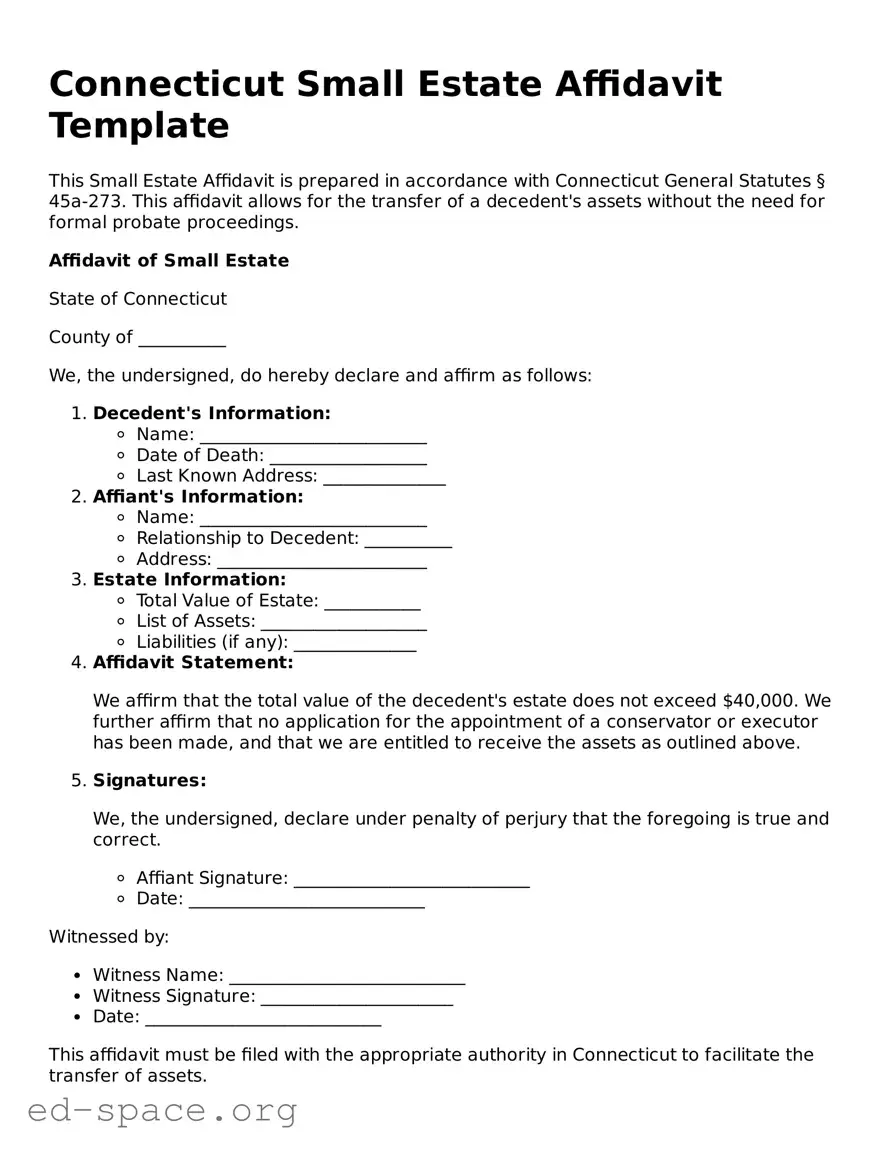
Connecticut Small Estate Affidavit Template
This Small Estate Affidavit is prepared in accordance with Connecticut General Statutes § 45a-273. This affidavit allows for the transfer of a decedent's assets without the need for formal probate proceedings.
Affidavit of Small Estate
State of Connecticut
County of __________
We, the undersigned, do hereby declare and affirm as follows:
We affirm that the total value of the decedent's estate does not exceed $40,000. We further affirm that no application for the appointment of a conservator or executor has been made, and that we are entitled to receive the assets as outlined above.
We, the undersigned, declare under penalty of perjury that the foregoing is true and correct.
Witnessed by:
This affidavit must be filed with the appropriate authority in Connecticut to facilitate the transfer of assets.
| Fact Name | Description |
|---|---|
| Purpose | The Connecticut Small Estate Affidavit allows individuals to claim assets of a deceased person without going through formal probate if the estate's value is below a certain threshold. |
| Value Limit | As of October 2023, the total value of the estate must not exceed $40,000 for a single individual or $60,000 for a married couple. |
| Governing Law | The Small Estate Affidavit is governed by Connecticut General Statutes § 45a-273. |
| Eligibility | Only individuals who are heirs or beneficiaries of the deceased can use this form to claim assets. |
| Required Information | The affidavit must include details such as the deceased's name, date of death, and a list of assets being claimed. |
| Filing Process | After completing the affidavit, it must be filed with the local probate court, along with a copy of the death certificate. |
After gathering the necessary information and documents, you are ready to fill out the Connecticut Small Estate Affidavit form. This form will help facilitate the transfer of assets from a deceased person's estate without the need for a full probate process. Follow these steps carefully to ensure accuracy and compliance.
What is the Connecticut Small Estate Affidavit form?
The Connecticut Small Estate Affidavit form is a legal document that allows individuals to claim assets of a deceased person without going through the full probate process. This form is typically used when the total value of the deceased person's estate is below a certain threshold, which is currently set at $40,000 for individuals who die on or after January 1, 2020. By using this affidavit, heirs can expedite the transfer of assets, such as bank accounts or personal property, to themselves or other beneficiaries.
Who is eligible to use the Small Estate Affidavit?
Eligibility to use the Small Estate Affidavit is generally limited to individuals who are either the surviving spouse or the next of kin of the deceased. In cases where the deceased has no surviving spouse, the affidavit can be utilized by children, parents, siblings, or other relatives, as long as they are entitled to inherit under Connecticut law. Additionally, the total value of the estate must not exceed the established limit, and the affidavit must be filed in the probate court in the district where the deceased resided.
How do I complete and file the Small Estate Affidavit?
To complete the Small Estate Affidavit, individuals must gather necessary information, including the deceased's name, date of death, and a list of assets. The form requires signatures from all heirs, affirming their agreement to the distribution of the estate. After completing the form, it must be filed with the probate court. It is advisable to check with the local probate court for any specific requirements or additional documentation that may be needed during the filing process.
What happens after I file the Small Estate Affidavit?
Once the Small Estate Affidavit is filed with the probate court, the court will review the document to ensure it meets all legal requirements. If approved, the court will issue an order allowing the transfer of assets as outlined in the affidavit. Heirs can then present this order to financial institutions or other entities holding the deceased's assets to claim ownership. It is crucial to keep a copy of the filed affidavit and the court order for future reference, as they serve as proof of entitlement to the assets.
Not verifying the eligibility criteria: Many people jump straight into filling out the form without checking if the estate qualifies as a small estate. In Connecticut, the total value of the estate must not exceed $40,000. If it does, the Small Estate Affidavit cannot be used.
Incomplete information: Failing to provide all required details can lead to delays or rejection. Ensure that every section of the form is filled out completely, including names, addresses, and the relationship to the deceased.
Missing signatures: Some individuals forget to sign the affidavit. This is a crucial step. The affidavit must be signed by the person filing it, as well as any other required parties, to be valid.
Incorrect asset valuation: Underestimating or overestimating the value of the estate's assets can cause issues. It's important to provide accurate valuations to avoid complications with the probate court.
Neglecting to include debts: Some filers overlook the estate's debts. Listing outstanding debts is essential, as it affects the overall value of the estate and how assets are distributed.
Not providing supporting documents: Failing to attach necessary documents, such as a death certificate or a will, can hinder the process. These documents help verify the claims made in the affidavit.
When dealing with small estates in Connecticut, several forms and documents may accompany the Small Estate Affidavit. These documents help streamline the process of settling an estate and ensure that all legal requirements are met. Below is a list of commonly used forms that you might encounter.
Understanding these documents can simplify the process of managing a small estate in Connecticut. Each form serves a specific purpose and helps ensure that the estate is handled according to the law and the wishes of the deceased.
When filling out the Connecticut Small Estate Affidavit form, it is essential to follow specific guidelines to ensure accuracy and compliance. Here are ten things you should and shouldn't do:
The Connecticut Small Estate Affidavit form is a useful tool for settling the estates of individuals who have passed away, particularly when their assets fall below a certain threshold. However, several misconceptions surround this form that can lead to confusion. Here are five common misunderstandings:
Understanding these misconceptions can help individuals navigate the estate settlement process more effectively. It’s important to seek clarity on the requirements and procedures involved to ensure a smooth transition during a challenging time.
Filling out and using the Connecticut Small Estate Affidavit form can simplify the process of settling a deceased person's estate when it meets certain criteria. Here are some key takeaways to consider:
Understanding these points can help streamline the process and ensure that the estate is settled in accordance with Connecticut law.