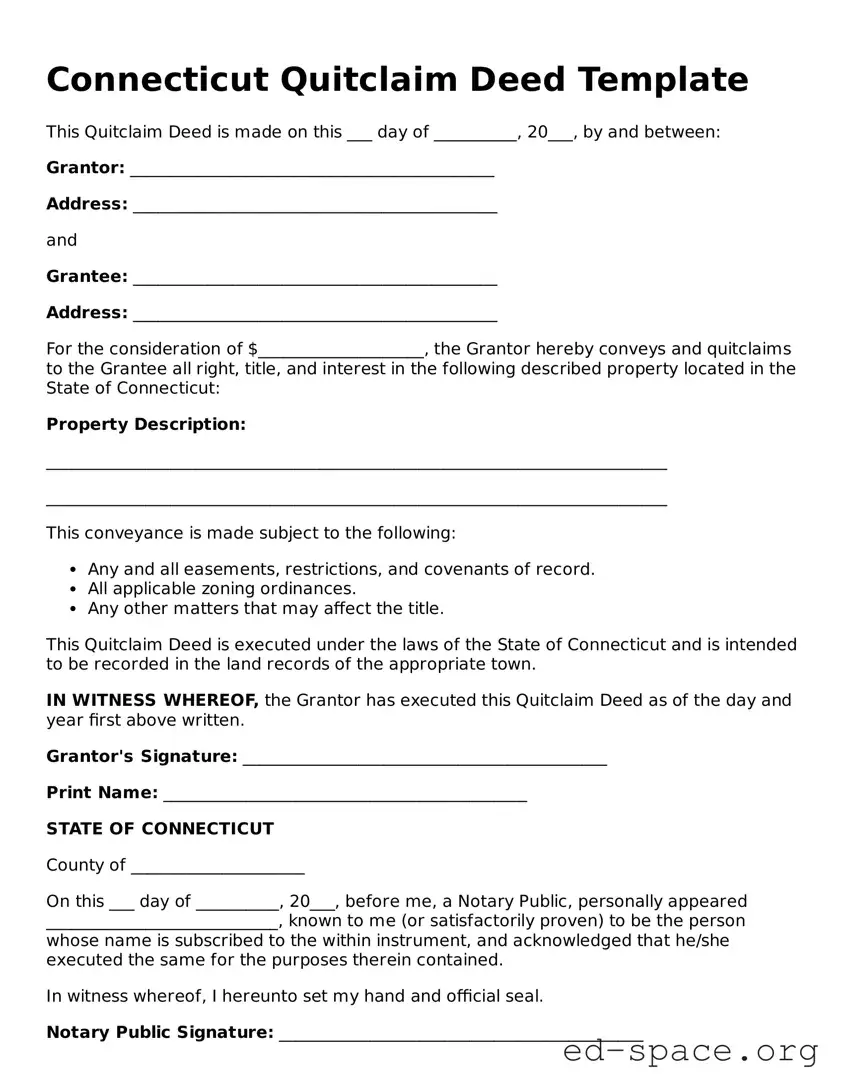
When it comes to transferring property ownership in Connecticut, the Quitclaim Deed form serves as a crucial tool for individuals looking to convey their interests in real estate. This form is particularly popular due to its straightforward nature, allowing for a simple transfer without the need for a title search or warranties. The Quitclaim Deed effectively releases any claim the grantor has on the property, making it an ideal choice for family transfers, divorces, or situations where the parties involved trust each other. While it does not guarantee that the property title is clear or free of encumbrances, it provides a quick and efficient means to transfer property rights. Understanding the nuances of this form is essential for both buyers and sellers, as it outlines the responsibilities and rights of each party involved in the transaction. By familiarizing oneself with the Quitclaim Deed, individuals can navigate property transfers with greater confidence and clarity.
Connecticut Quitclaim Deed Template
This Quitclaim Deed is made on this ___ day of __________, 20___, by and between:
Grantor: ____________________________________________
Address: ____________________________________________
and
Grantee: ____________________________________________
Address: ____________________________________________
For the consideration of $____________________, the Grantor hereby conveys and quitclaims to the Grantee all right, title, and interest in the following described property located in the State of Connecticut:
Property Description:
___________________________________________________________________________
___________________________________________________________________________
This conveyance is made subject to the following:
This Quitclaim Deed is executed under the laws of the State of Connecticut and is intended to be recorded in the land records of the appropriate town.
IN WITNESS WHEREOF, the Grantor has executed this Quitclaim Deed as of the day and year first above written.
Grantor's Signature: ____________________________________________
Print Name: ____________________________________________
STATE OF CONNECTICUT
County of _____________________
On this ___ day of __________, 20___, before me, a Notary Public, personally appeared ____________________________, known to me (or satisfactorily proven) to be the person whose name is subscribed to the within instrument, and acknowledged that he/she executed the same for the purposes therein contained.
In witness whereof, I hereunto set my hand and official seal.
Notary Public Signature: ____________________________________________
My Commission Expires: ____________________________________________
| Fact Name | Description |
|---|---|
| Definition | A quitclaim deed is a legal document used to transfer ownership of real estate without any warranties or guarantees about the title. |
| Governing Law | The Connecticut Quitclaim Deed is governed by Connecticut General Statutes, specifically Section 47-36h. |
| Use Cases | This type of deed is often used in situations such as transferring property between family members or clearing up title issues. |
| Limitations | It does not protect the buyer from any claims against the property; thus, it is crucial to conduct a title search before using it. |
Once you have the Connecticut Quitclaim Deed form in hand, you’re ready to proceed with filling it out. This form is essential for transferring property ownership, and completing it accurately is crucial for a smooth transaction. After filling out the form, you will need to have it signed and notarized before recording it with the appropriate local authority.
What is a Quitclaim Deed in Connecticut?
A Quitclaim Deed is a legal document used to transfer ownership of real estate from one party to another without making any guarantees about the property’s title. In Connecticut, this type of deed is commonly used between family members or in situations where the grantor does not wish to provide warranties regarding the property's title. It is important to note that a Quitclaim Deed does not ensure that the grantor has a clear title to the property; it merely transfers whatever interest the grantor may have at the time of the transfer.
How do I complete a Quitclaim Deed in Connecticut?
To complete a Quitclaim Deed in Connecticut, you will need to gather specific information. This includes the names and addresses of both the grantor (the person transferring the property) and the grantee (the person receiving the property). You will also need to provide a legal description of the property being transferred, which can typically be found in previous deeds or property tax records. Once the form is filled out, both parties must sign it in the presence of a notary public. After notarization, the deed must be filed with the town clerk in the municipality where the property is located to be effective.
Are there any tax implications when using a Quitclaim Deed in Connecticut?
Yes, there can be tax implications when using a Quitclaim Deed in Connecticut. Generally, the transfer of property may trigger a conveyance tax, which is based on the sale price or the fair market value of the property. However, certain exemptions may apply, especially in transfers between family members or in cases of divorce. It is advisable to consult with a tax professional or legal consultant to understand any potential tax liabilities associated with the transfer.
Can I revoke a Quitclaim Deed in Connecticut?
Once a Quitclaim Deed has been executed and recorded, it cannot be revoked unilaterally. The grantor cannot simply take back the property unless there is a mutual agreement with the grantee or if the deed was executed under circumstances that allow for legal challenges, such as fraud or undue influence. If you wish to regain ownership of the property, you may need to pursue a new deed or other legal remedies. It is best to seek legal advice to explore your options in such situations.
Incorrect Grantee Information: One common mistake is providing inaccurate or incomplete information about the grantee. The grantee is the person receiving the property. Ensure that the full legal name is used, along with any necessary identifying information, such as a middle initial or suffix.
Failure to Notarize: Many individuals forget to have the Quitclaim Deed notarized. A notarized signature is essential for the deed to be considered valid. Without this step, the document may not be accepted by the local land records office.
Omitting the Property Description: Another frequent error is leaving out a detailed description of the property. This description should include the property’s address and, if applicable, a legal description. Failing to provide this information can lead to confusion or disputes about the property being transferred.
Not Checking Local Requirements: Each town or county may have specific requirements regarding the Quitclaim Deed. Some areas require additional forms or information. It’s crucial to check local regulations to ensure compliance, as neglecting this can delay the recording process.
When transferring property ownership in Connecticut, the Quitclaim Deed is a commonly used document. However, there are several other forms and documents that often accompany it to ensure a smooth and legally sound transaction. Below is a list of these essential documents, each serving a specific purpose in the property transfer process.
Each of these documents plays a vital role in ensuring that the property transfer is conducted legally and efficiently. Understanding their purpose can help both buyers and sellers navigate the complexities of real estate transactions in Connecticut.
A Quitclaim Deed is a specific type of legal document used to transfer ownership of property. It’s important to understand that there are other documents that serve similar purposes. Here are eight documents that are comparable to a Quitclaim Deed:
Understanding these documents can help you navigate property transactions more effectively. Each serves a specific purpose and offers different levels of protection and clarity regarding ownership rights.
When filling out the Connecticut Quitclaim Deed form, it’s important to follow certain guidelines to ensure accuracy and compliance. Here are five things to do and five things to avoid:
Things You Should Do:
Things You Shouldn't Do:
Understanding the Connecticut Quitclaim Deed form is essential for anyone involved in real estate transactions. However, several misconceptions often arise regarding its use and implications. Here are seven common misconceptions:
Many people believe that a quitclaim deed guarantees clear title to the property. In reality, this type of deed transfers whatever interest the grantor has, if any, without any warranties or assurances about the title.
While quitclaim deeds are frequently used among family members, they are not limited to such transactions. They can be utilized in various situations, including sales and transfers between unrelated parties.
This is a misconception. Although a quitclaim deed may simplify the transfer process, it does not exempt the parties from potential tax obligations, such as capital gains tax or transfer taxes.
Some individuals believe that a quitclaim deed is irrevocable once executed. However, the grantor can revoke the deed if they still hold an interest in the property and follow the appropriate legal procedures.
This is incorrect. Quitclaim deeds are recognized in many states across the U.S., though the specific requirements and implications may vary by jurisdiction.
While notarization is a common practice that adds an extra layer of authenticity, it is not always a legal requirement for the validity of a quitclaim deed in Connecticut. However, recording the deed is essential for public notice.
This misconception arises from a lack of understanding of the differences. Unlike warranty deeds, which provide guarantees about the title, quitclaim deeds do not offer any such assurances. The two serve different purposes in property transfers.
Clarifying these misconceptions can help individuals navigate property transactions more effectively and make informed decisions regarding their real estate interests.
When dealing with the Connecticut Quitclaim Deed form, it's important to understand the key aspects to ensure a smooth transfer of property. Here are some essential takeaways:
Understanding these key points can help ensure that the Quitclaim Deed process goes smoothly and that all necessary steps are followed correctly.