The Connecticut Promissory Note form serves as a crucial document in financial transactions, outlining the terms under which one party borrows money from another. This legally binding agreement specifies the amount borrowed, the interest rate, and the repayment schedule, ensuring clarity for both the lender and borrower. It may also include provisions for late fees, prepayment options, and default consequences, which protect the interests of the lender while providing the borrower with a clear understanding of their obligations. By detailing these terms, the form helps prevent misunderstandings and disputes that could arise during the repayment process. Additionally, the Connecticut Promissory Note can be customized to fit the specific needs of the parties involved, making it a versatile tool in personal and business financing. Understanding the elements of this form is essential for anyone entering into a lending agreement in Connecticut, as it lays the foundation for a trustworthy financial relationship.
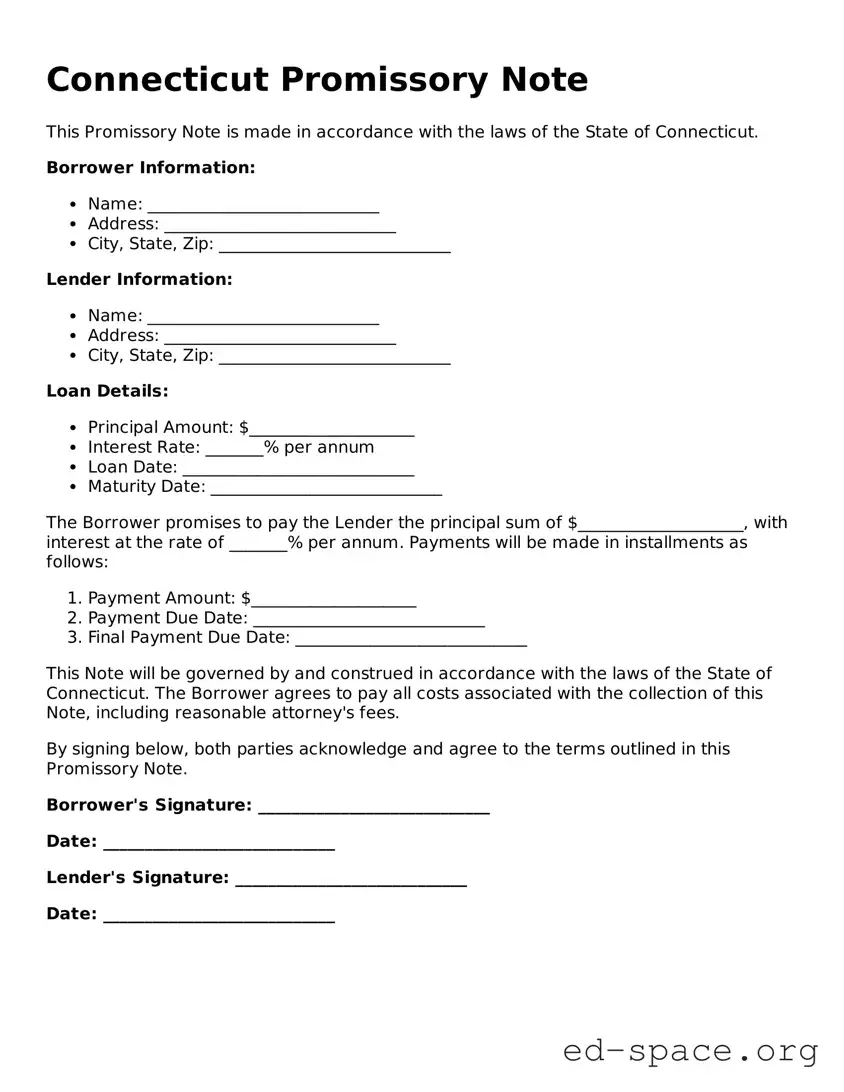
Connecticut Promissory Note
This Promissory Note is made in accordance with the laws of the State of Connecticut.
Borrower Information:
Lender Information:
Loan Details:
The Borrower promises to pay the Lender the principal sum of $____________________, with interest at the rate of _______% per annum. Payments will be made in installments as follows:
This Note will be governed by and construed in accordance with the laws of the State of Connecticut. The Borrower agrees to pay all costs associated with the collection of this Note, including reasonable attorney's fees.
By signing below, both parties acknowledge and agree to the terms outlined in this Promissory Note.
Borrower's Signature: ____________________________
Date: ____________________________
Lender's Signature: ____________________________
Date: ____________________________
| Fact Name | Details |
|---|---|
| Definition | A promissory note is a written promise to pay a specified amount of money to a designated person at a specified time. |
| Governing Law | Connecticut General Statutes, Title 42a - Uniform Commercial Code. |
| Key Components | The note must include the principal amount, interest rate, payment schedule, and signatures of the parties involved. |
| Enforceability | For a promissory note to be enforceable, it must be clear, unambiguous, and signed by the borrower. |
| Interest Rates | Connecticut allows parties to agree on interest rates, but they must comply with state usury laws. |
| Default Consequences | If the borrower fails to make payments, the lender has the right to take legal action to recover the owed amount. |
Once you have the Connecticut Promissory Note form in hand, you will need to fill it out carefully. Make sure to have all necessary information ready before you begin. This ensures a smooth process and helps avoid any mistakes.
What is a Connecticut Promissory Note?
A Connecticut Promissory Note is a legal document that outlines a borrower's promise to repay a specific amount of money to a lender under agreed-upon terms. It serves as a record of the loan and details the repayment schedule, interest rate, and any consequences for non-payment.
Who can use a Promissory Note in Connecticut?
Any individual or business can use a Promissory Note in Connecticut. It is commonly used in personal loans, business loans, and real estate transactions. Both the lender and borrower must be of legal age and have the capacity to enter into a contract.
What information is required in a Connecticut Promissory Note?
A valid Promissory Note should include the names and addresses of both parties, the principal amount being borrowed, the interest rate, the repayment schedule, and any terms regarding late payments or default. Additional details, such as collateral, can also be included if applicable.
Is a Promissory Note legally binding?
Yes, a Promissory Note is legally binding as long as it meets certain requirements. Both parties must agree to the terms, and the document must be signed. In the event of a dispute, the note can be enforced in court.
Do I need a lawyer to create a Promissory Note?
No, you do not need a lawyer to create a Promissory Note in Connecticut. However, it is advisable to consult with one if you have specific legal concerns or if the loan amount is significant. A lawyer can help ensure that the document meets all legal requirements.
Can a Promissory Note be modified after it is signed?
Yes, a Promissory Note can be modified after it is signed, but both parties must agree to the changes. It is best to document any modifications in writing and have both parties sign the revised agreement to avoid future disputes.
What happens if the borrower defaults on the Promissory Note?
If the borrower defaults, the lender may take legal action to recover the owed amount. This could include filing a lawsuit or seeking to collect the debt through other means. The specific consequences should be outlined in the Promissory Note.
Is a Promissory Note the same as a loan agreement?
While both documents serve similar purposes, they are not the same. A Promissory Note focuses on the borrower's promise to repay the loan, while a loan agreement typically includes more detailed terms and conditions, including obligations of both parties beyond repayment.
Can a Promissory Note be used for business loans?
Yes, a Promissory Note can be used for business loans. Many small businesses use Promissory Notes to formalize loans from investors, banks, or other financial institutions. It helps protect both parties by clearly stating the terms of the loan.
What should I do if I lose my Promissory Note?
If you lose your Promissory Note, it is important to notify the other party immediately. You may need to create a replacement note, which both parties should sign. Keeping a copy of the original note in a safe place can help prevent issues in the future.
Incorrect Borrower Information: One common mistake is failing to provide accurate details about the borrower. This includes the full name, address, and contact information. Missing or incorrect information can lead to confusion later on.
Missing Lender Information: Just like with the borrower, it’s crucial to include the lender’s full name and address. Omitting this information can create issues in enforcing the note.
Failure to Specify the Loan Amount: Clearly stating the amount being borrowed is essential. Some individuals forget to include this detail, which can lead to disputes over how much is owed.
Not Including Interest Rate: If there is an interest rate associated with the loan, it must be explicitly stated. Leaving this out can result in misunderstandings about repayment terms.
Omitting Payment Schedule: A payment schedule outlines when payments are due. Not providing this can lead to confusion about when payments should be made.
Neglecting Signatures: All parties involved must sign the document for it to be valid. Forgetting to sign can render the note unenforceable.
Not Dating the Document: A date is essential for establishing when the agreement was made. Without it, there can be ambiguity about the timeline of the loan.
Ignoring State-Specific Requirements: Each state may have specific requirements for promissory notes. Failing to adhere to Connecticut's regulations can invalidate the document.
When dealing with a Connecticut Promissory Note, several other forms and documents may be necessary to ensure clarity and legal protection for all parties involved. Each of these documents serves a specific purpose and can help facilitate a smoother transaction.
Having these documents prepared and understood can streamline the lending process and protect the rights of all parties involved. It's always wise to consult with a legal professional when drafting or signing these forms to ensure compliance with local laws and regulations.
When filling out the Connecticut Promissory Note form, it is important to follow certain guidelines to ensure accuracy and compliance. Here are some key dos and don'ts:
By following these guidelines, you can help ensure that your Promissory Note is completed correctly and is legally binding.
Understanding the Connecticut Promissory Note form is essential for anyone involved in lending or borrowing money. However, several misconceptions often arise. Here are four common misunderstandings:
This is not true. While notarization can add an extra layer of authenticity, a promissory note is valid as long as it meets the basic legal requirements, such as being in writing and signed by the borrower.
In reality, promissory notes can vary significantly. Each note can include different terms, such as interest rates, payment schedules, and consequences for default. Therefore, it is crucial to understand the specific terms of any note you are involved with.
This is misleading. A well-drafted promissory note should include a clear repayment schedule. This helps both parties understand when payments are due and prevents confusion or disputes later on.
This is incorrect. Promissory notes can be used for loans of any size. Whether it’s a small personal loan between friends or a larger loan for a business venture, a promissory note can serve as a formal agreement.
When filling out and using the Connecticut Promissory Note form, it's important to keep several key points in mind. Here are some essential takeaways:
By following these guidelines, you can effectively use the Connecticut Promissory Note form to create a clear and enforceable agreement.