When couples decide to tie the knot, they often focus on the joy and excitement of their upcoming union. However, as they plan their future together, it's also wise to consider the practicalities of their financial lives. This is where the Connecticut Prenuptial Agreement form comes into play. This legal document serves as a tool for couples to outline their financial rights and responsibilities before marriage. It can address various aspects, such as the division of assets and debts, spousal support, and even the handling of property acquired during the marriage. By discussing these topics upfront, couples can foster open communication and reduce potential conflicts down the line. Additionally, a well-crafted prenuptial agreement can provide peace of mind, ensuring that both partners feel secure in their financial arrangements. Understanding the nuances of this form is essential for anyone considering marriage in Connecticut, as it not only protects individual interests but also strengthens the foundation of the relationship.
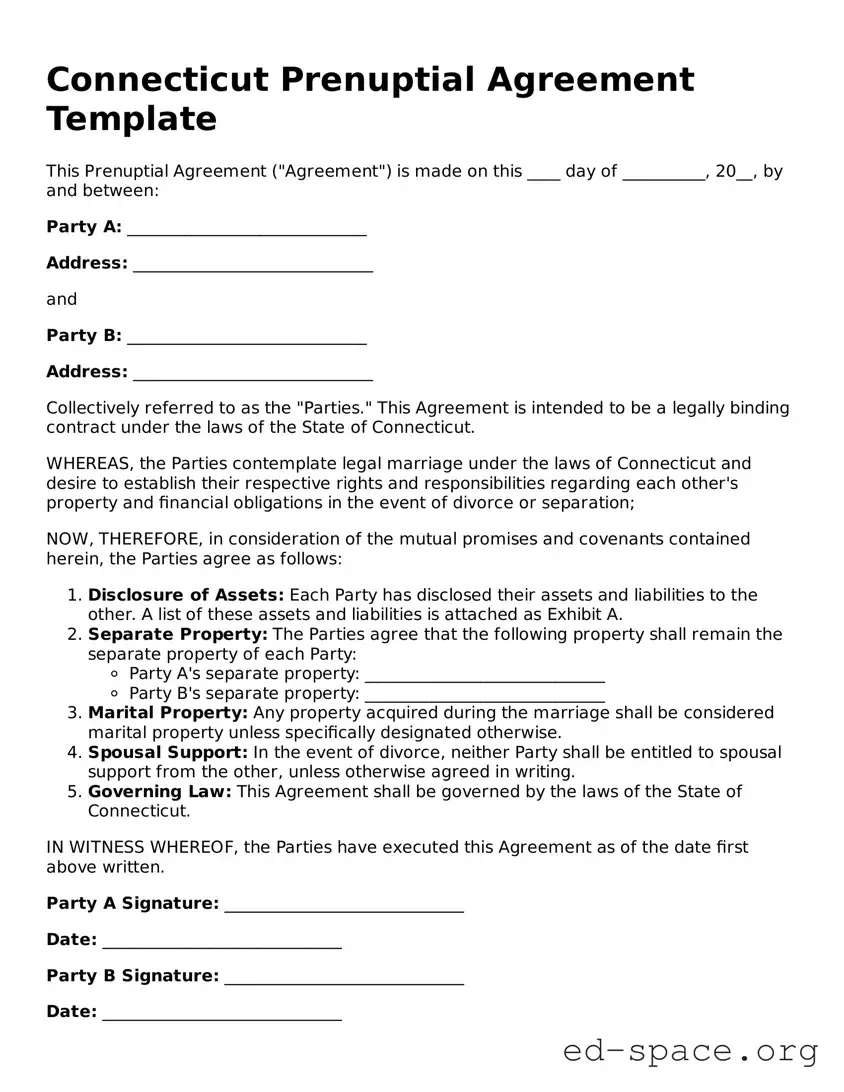
Connecticut Prenuptial Agreement Template
This Prenuptial Agreement ("Agreement") is made on this ____ day of __________, 20__, by and between:
Party A: _____________________________
Address: _____________________________
and
Party B: _____________________________
Address: _____________________________
Collectively referred to as the "Parties." This Agreement is intended to be a legally binding contract under the laws of the State of Connecticut.
WHEREAS, the Parties contemplate legal marriage under the laws of Connecticut and desire to establish their respective rights and responsibilities regarding each other's property and financial obligations in the event of divorce or separation;
NOW, THEREFORE, in consideration of the mutual promises and covenants contained herein, the Parties agree as follows:
IN WITNESS WHEREOF, the Parties have executed this Agreement as of the date first above written.
Party A Signature: _____________________________
Date: _____________________________
Party B Signature: _____________________________
Date: _____________________________
Witness Signature: _____________________________
Date: _____________________________
| Fact Name | Description |
|---|---|
| Governing Law | The Connecticut Prenuptial Agreement is governed by Connecticut General Statutes, specifically Section 46b-36a. |
| Purpose | This agreement outlines the distribution of assets and responsibilities in the event of divorce or death. |
| Enforceability | For a prenuptial agreement to be enforceable, it must be in writing and signed by both parties. |
| Full Disclosure | Both parties are required to provide a full and fair disclosure of their financial situations. |
| Independent Legal Counsel | It is recommended that each party consults with independent legal counsel to ensure understanding and fairness. |
| Modification and Revocation | A prenuptial agreement can be modified or revoked at any time, provided both parties agree in writing. |
Filling out the Connecticut Prenuptial Agreement form is an important step for couples looking to clarify their financial arrangements before marriage. Once you have the form ready, you'll need to provide specific information about your assets, debts, and any other relevant details. Here’s how to get started:
Once the form is completed and signed, it’s advisable to consult with a legal professional to ensure everything is in order and meets Connecticut’s legal requirements. This step can help provide peace of mind as you move forward with your plans.
What is a prenuptial agreement in Connecticut?
A prenuptial agreement, often called a "prenup," is a legal document created by two individuals before they get married. This agreement outlines how assets and debts will be divided in the event of a divorce or separation. In Connecticut, prenups can also address issues like spousal support. It is important for both parties to fully disclose their financial situations when creating this agreement to ensure fairness and legality.
How do I create a prenuptial agreement in Connecticut?
To create a prenuptial agreement in Connecticut, both parties should first discuss their financial situations and what they would like to include in the agreement. It is advisable to consult with a lawyer who specializes in family law to ensure that the document meets legal requirements. After drafting the agreement, both parties should sign it in the presence of a notary. This helps to validate the document and makes it easier to enforce in court if necessary.
Is a prenuptial agreement enforceable in Connecticut?
Yes, a prenuptial agreement can be enforceable in Connecticut, provided it meets certain conditions. The agreement must be in writing and signed by both parties. Additionally, it should be fair and not the result of coercion or fraud. Courts will look at whether both parties had adequate legal representation and whether they fully understood the terms at the time of signing. If these conditions are met, the agreement is likely to be upheld.
Can a prenuptial agreement be changed after marriage?
Yes, a prenuptial agreement can be changed after marriage, but both parties must agree to the changes. This typically involves drafting a new document, often called a postnuptial agreement. Like a prenup, the postnuptial agreement should be in writing and signed by both parties. It is also wise to consult with a lawyer to ensure that any changes made are legally binding and fair to both parties.
Failing to provide complete financial disclosures. Both parties should list all assets, debts, and income accurately.
Not having the agreement reviewed by an attorney. Legal advice can ensure that the document meets all requirements and protects both parties.
Using vague language. Clear and specific terms help prevent misunderstandings in the future.
Neglecting to consider future changes. Couples should address how potential changes in circumstances will affect the agreement.
Forgetting to sign the document in front of witnesses. Signatures should be properly executed to ensure validity.
Not discussing the agreement openly. Communication between both parties about the terms is essential for mutual understanding.
When preparing for marriage, many couples consider a prenuptial agreement to outline financial responsibilities and protect individual assets. However, this important document often goes hand in hand with other forms and documents that can help clarify legal rights and responsibilities. Here’s a list of some commonly used documents alongside a Connecticut Prenuptial Agreement.
Understanding these documents can empower couples to make informed decisions about their future together. Each serves a unique purpose, and when combined with a prenuptial agreement, they can provide a solid foundation for a successful marriage.
A Prenuptial Agreement is a legal document that outlines the financial and personal arrangements between two individuals before they marry. Several other documents serve similar purposes in different contexts. Below are seven documents that share similarities with a Prenuptial Agreement:
Each of these documents serves to clarify intentions and protect individuals' interests, whether before, during, or after a relationship.
When filling out the Connecticut Prenuptial Agreement form, it is essential to approach the process with care. Here are some important dos and don'ts to consider:
By following these guidelines, you can create a fair and effective prenuptial agreement that protects both parties’ interests.
Prenuptial agreements often carry a cloud of misunderstanding. Many people have misconceptions about what these legal documents entail, especially in Connecticut. Here’s a look at six common misconceptions about the Connecticut Prenuptial Agreement form, along with clarifications to help you understand better.
Understanding these misconceptions can help couples approach the idea of a prenuptial agreement with clarity and confidence. It's always wise to consult with a legal professional to ensure that your agreement meets your needs and complies with state laws.
When considering a prenuptial agreement in Connecticut, it's essential to understand a few key aspects. Here are some important takeaways to keep in mind:
By keeping these points in mind, you can create a solid foundation for your future together.