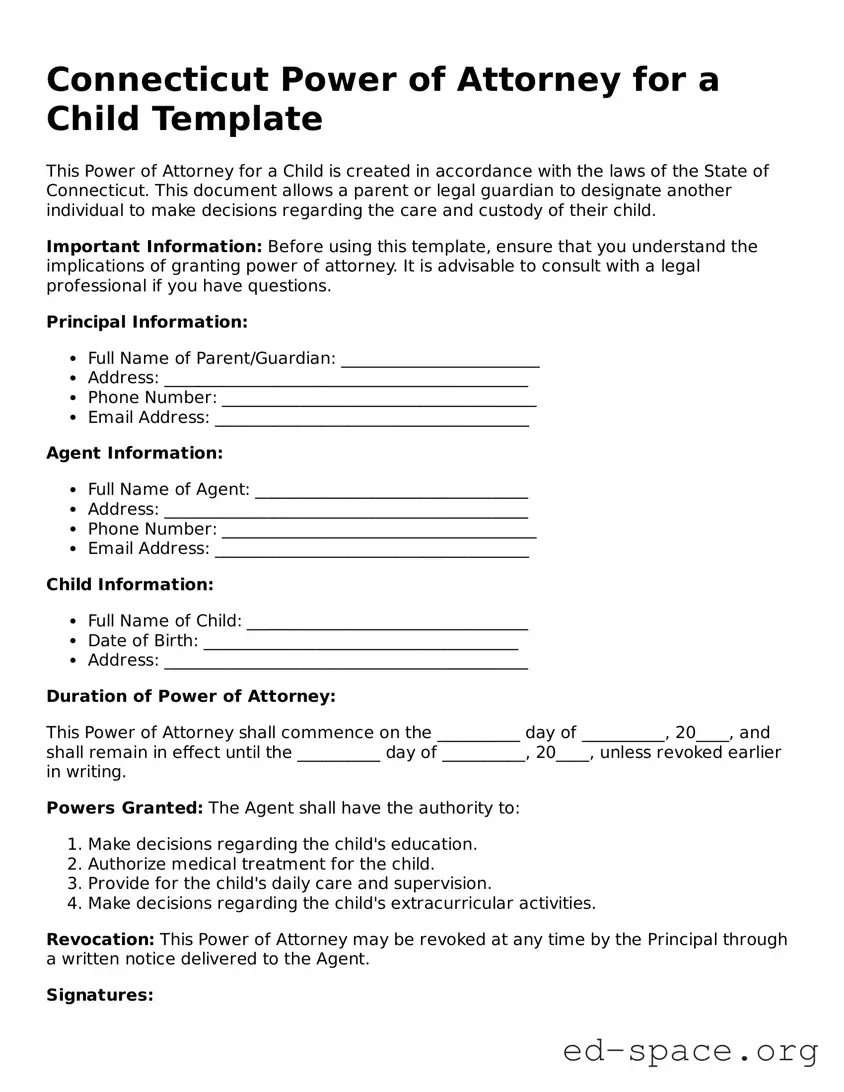
In Connecticut, the Power of Attorney for a Child form serves as a vital tool for parents and guardians who need to delegate authority for their child's care and decision-making to another trusted adult. This form is particularly useful in situations such as temporary relocations, medical emergencies, or when a parent must be away for an extended period. By completing this document, parents can grant specific powers, which may include making medical decisions, enrolling the child in school, or handling everyday activities. The form typically requires the signatures of the parent or legal guardian, as well as the person being designated as the attorney-in-fact. It’s important to note that the authority granted can be limited to certain tasks or can be broad, depending on the needs of the family. Understanding how this form works and the implications of granting such powers can provide peace of mind and ensure that a child's needs are met when parents are unable to be present.
Connecticut Power of Attorney for a Child Template
This Power of Attorney for a Child is created in accordance with the laws of the State of Connecticut. This document allows a parent or legal guardian to designate another individual to make decisions regarding the care and custody of their child.
Important Information: Before using this template, ensure that you understand the implications of granting power of attorney. It is advisable to consult with a legal professional if you have questions.
Principal Information:
Agent Information:
Child Information:
Duration of Power of Attorney:
This Power of Attorney shall commence on the __________ day of __________, 20____, and shall remain in effect until the __________ day of __________, 20____, unless revoked earlier in writing.
Powers Granted: The Agent shall have the authority to:
Revocation: This Power of Attorney may be revoked at any time by the Principal through a written notice delivered to the Agent.
Signatures:
By signing below, the Principal affirms that they are the parent or legal guardian of the child named above and that they understand the terms of this Power of Attorney.
______________________________
Signature of Parent/Guardian
______________________________
Date
______________________________
Signature of Agent
______________________________
Date
Witness Information:
Witness Name: ________________________________________
Witness Signature: ____________________________________
Date: _______________________________________________
This document must be notarized to be valid in the State of Connecticut.
| Fact Name | Description |
|---|---|
| Purpose | The Connecticut Power of Attorney for a Child form allows a parent or guardian to designate another adult to make decisions for their child. |
| Governing Law | This form is governed by Connecticut General Statutes Section 1-56r. |
| Duration | The authority granted can be limited to a specific time frame or remain in effect until revoked. |
| Eligibility | Any parent or legal guardian of a child can complete this form. |
| Notarization | The form must be signed in the presence of a notary public for it to be valid. |
| Revocation | A parent can revoke the power of attorney at any time by providing written notice. |
| Scope of Authority | The designated adult can make decisions regarding education, healthcare, and general welfare of the child. |
| Limitations | The form does not allow the designated adult to make decisions that would require parental consent in legal matters. |
Filling out the Connecticut Power of Attorney for a Child form is a straightforward process. This document allows a parent or legal guardian to grant temporary authority to another adult to make decisions on behalf of their child. Once completed, the form should be signed and dated, ensuring that all necessary parties are aware of the arrangement.
After completing the form, keep a copy for your records and provide a copy to the person you designated. This ensures that they have the necessary documentation to act on your behalf when needed.
What is a Power of Attorney for a Child in Connecticut?
A Power of Attorney for a Child in Connecticut is a legal document that allows a parent or guardian to grant another adult the authority to make decisions on behalf of their child. This can include decisions about healthcare, education, and general welfare. It is often used when a parent is unable to care for their child temporarily due to travel, illness, or other circumstances.
Who can serve as an agent under this Power of Attorney?
Any responsible adult can be designated as an agent in a Power of Attorney for a Child. This could be a relative, friend, or trusted neighbor. It is important to choose someone who is capable of making decisions in the best interest of the child and who understands the responsibilities involved.
How long does a Power of Attorney for a Child last?
The Power of Attorney for a Child remains effective until it is revoked by the parent or guardian, or until the child reaches the age of majority, which is 18 years old in Connecticut. However, it is advisable to specify an end date in the document if the arrangement is temporary, to avoid any confusion.
Do I need to have the Power of Attorney for a Child notarized?
Yes, the Power of Attorney for a Child must be signed in the presence of a notary public. This step helps to ensure the document's validity and can provide additional legal protection for both the parent and the agent. It is also a good idea to keep a copy of the notarized document for your records.
Can I revoke the Power of Attorney for a Child once it is established?
Yes, a parent or guardian can revoke the Power of Attorney for a Child at any time. To do so, it is best to provide written notice to the agent and any relevant parties, such as schools or healthcare providers. This helps to prevent any misunderstandings about who has authority over the child's decisions.
Not specifying the duration: One common mistake is failing to indicate how long the power of attorney will be in effect. It’s essential to clearly state the start and end dates to avoid confusion.
Omitting necessary signatures: All required parties must sign the form. This includes the parent or legal guardian and the designated agent. Missing a signature can invalidate the document.
Choosing an unqualified agent: Selecting someone who lacks the ability or willingness to act responsibly can lead to issues. It's important to choose a trusted individual who understands the responsibilities involved.
Not detailing specific powers: The form should specify what decisions the agent can make. Vague language can lead to misunderstandings about the authority granted.
Failing to include contact information: Providing up-to-date contact details for both the parent and the agent is crucial. This ensures that anyone involved can reach the right people when needed.
Ignoring witness requirements: Some situations may require witnesses to sign the document. Not adhering to these requirements can render the power of attorney ineffective.
Not reviewing state laws: Each state has its own rules regarding power of attorney forms. Not being aware of Connecticut’s specific requirements can lead to errors.
Neglecting to update the form: Life changes, such as a move or a change in relationships, may necessitate updates to the power of attorney. Failing to revise the document can create complications.
Assuming the form is permanent: Many people think that once the form is signed, it cannot be changed. In reality, the power of attorney can be revoked or amended as needed.
The Connecticut Power of Attorney for a Child form is a crucial document for parents or guardians who need to grant authority to another adult for the care and management of their child. Alongside this form, several other documents may be necessary to ensure comprehensive legal authority and protection for the child. Below is a list of related forms and documents commonly used in conjunction with the Power of Attorney for a Child.
Each of these documents plays a significant role in ensuring that a child’s needs are met and that the designated caregiver has the necessary authority to act on behalf of the child. It is advisable to consult with a legal professional to ensure that all forms are completed accurately and comply with state laws.
When filling out the Connecticut Power of Attorney for a Child form, it is crucial to approach the process with care and attention to detail. This document allows a parent or legal guardian to designate another adult to make decisions on behalf of their child. Here are some important dos and don'ts to consider:
Understanding the Connecticut Power of Attorney for a Child form can be confusing. Here are four common misconceptions that many people have about this important legal document.
Many believe that a Power of Attorney for a Child is only needed when parents are going on vacation or traveling out of state. In reality, this form can be useful in various situations, such as when a parent is temporarily unable to care for their child due to illness, work commitments, or other personal matters. It allows another trusted adult to make decisions on behalf of the child during that time.
Some think that signing a Power of Attorney for a Child means they are giving up custody of their child. This is not the case. The document grants specific authority to the designated adult for a limited time and purpose, but it does not transfer full custody rights. Parents retain their parental rights unless a court order states otherwise.
Another misconception is that the Power of Attorney for a Child is a permanent document. However, this form is designed to be temporary. Parents can set a specific duration for the authority granted, and they can revoke it at any time. This flexibility ensures that parents remain in control of their child's care.
Many people believe that a lawyer must draft the Power of Attorney for a Child. While legal advice can be beneficial, it is not a requirement. Parents can fill out the form themselves, provided they understand the responsibilities and limitations involved. However, consulting with a lawyer can help clarify any questions and ensure that the document meets all legal requirements.
Being informed about these misconceptions can help parents make better decisions regarding their child's care and ensure that they have the right legal protections in place.
When filling out and using the Connecticut Power of Attorney for a Child form, consider these key takeaways:
By following these steps, you can ensure that the Power of Attorney for a Child form serves its intended purpose effectively.