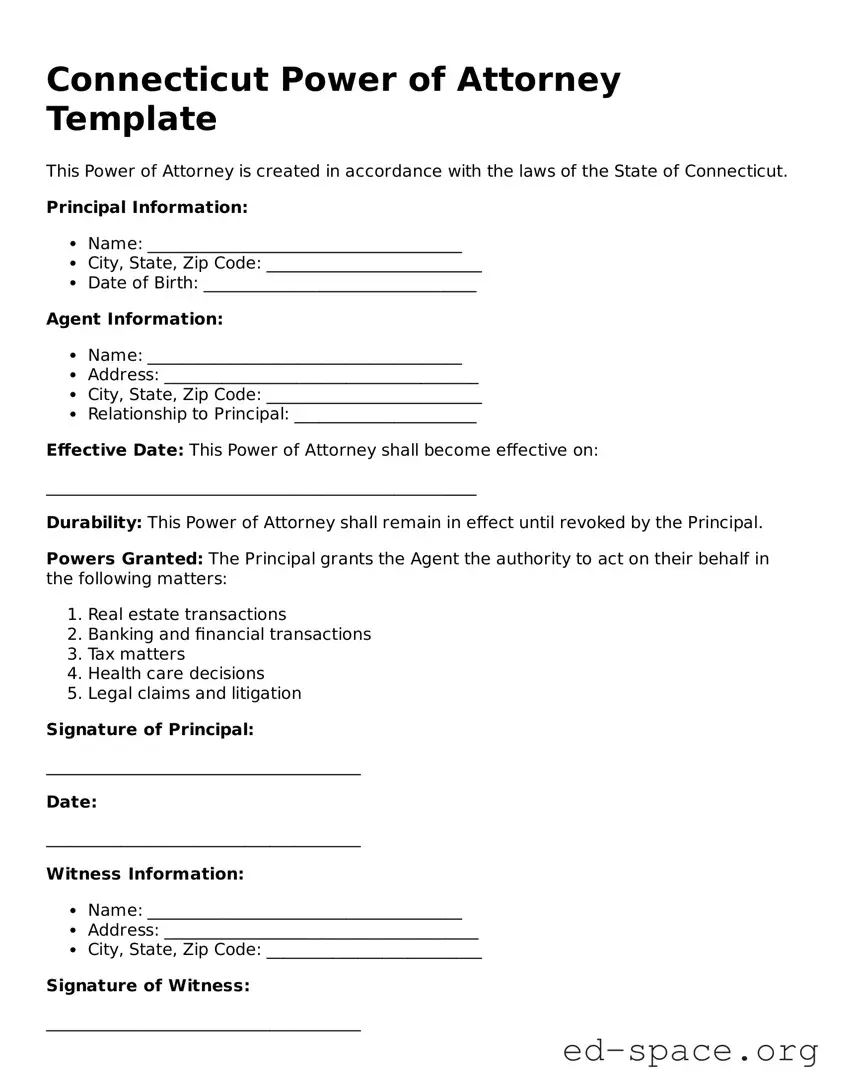
The Connecticut Power of Attorney form is an important legal document that allows individuals to appoint someone else to make decisions on their behalf. This form can be particularly useful in situations where a person is unable to manage their own affairs due to illness, absence, or other circumstances. The appointed individual, known as the agent or attorney-in-fact, can handle a variety of matters, including financial transactions, property management, and healthcare decisions. It is essential for the form to be completed accurately to ensure that the agent has the authority needed to act effectively. In Connecticut, the form must be signed by the principal and witnessed or notarized to be valid. Understanding the different types of powers that can be granted, as well as the responsibilities of the agent, is crucial for anyone considering this option. By taking the time to fill out the Connecticut Power of Attorney form, individuals can secure their interests and ensure that their wishes are respected in times of need.
Connecticut Power of Attorney Template
This Power of Attorney is created in accordance with the laws of the State of Connecticut.
Principal Information:
Agent Information:
Effective Date: This Power of Attorney shall become effective on:
____________________________________________________
Durability: This Power of Attorney shall remain in effect until revoked by the Principal.
Powers Granted: The Principal grants the Agent the authority to act on their behalf in the following matters:
Signature of Principal:
______________________________________
Date:
______________________________________
Witness Information:
Signature of Witness:
______________________________________
Date:
______________________________________
This document must be signed in the presence of a notary public to be valid.
| Fact Name | Description |
|---|---|
| Definition | A Power of Attorney (POA) allows an individual to appoint someone else to make decisions on their behalf. |
| Governing Law | The Connecticut Power of Attorney form is governed by Connecticut General Statutes, Chapter 743b. |
| Types of POA | Connecticut recognizes both durable and non-durable Power of Attorney forms, with durable POAs remaining effective even if the principal becomes incapacitated. |
| Principal's Capacity | The principal must be of sound mind and legal age to create a valid Power of Attorney. |
| Agent's Authority | The agent can be granted broad or limited powers, depending on the principal's wishes outlined in the document. |
| Revocation | The principal can revoke the Power of Attorney at any time, as long as they are mentally competent. |
| Execution Requirements | The Power of Attorney must be signed by the principal and acknowledged before a notary public. |
| Third-Party Acceptance | Financial institutions and other third parties may require the original document or a certified copy to recognize the agent's authority. |
| Limitations | Certain actions, such as making or revoking a will, cannot be delegated through a Power of Attorney. |
Filling out a Power of Attorney form in Connecticut is an important task that requires careful attention to detail. Once you have completed the form, it is essential to ensure that it is signed and witnessed appropriately to make it legally binding.
What is a Power of Attorney in Connecticut?
A Power of Attorney (POA) is a legal document that allows you to appoint someone else, known as an agent or attorney-in-fact, to make decisions on your behalf. This can include financial matters, medical decisions, or other personal affairs. In Connecticut, this document can be tailored to fit your specific needs, whether you want it to be effective immediately or only if you become incapacitated.
How do I create a Power of Attorney in Connecticut?
To create a Power of Attorney in Connecticut, you need to fill out the appropriate form. This form must be signed by you, the principal, in the presence of a notary public. If you are unable to sign, someone else can sign on your behalf, but this must also be done in front of a notary. It's important to ensure that the form clearly outlines the powers you wish to grant to your agent.
What powers can I grant to my agent?
You have the flexibility to grant a wide range of powers to your agent. Common powers include managing bank accounts, handling real estate transactions, and making healthcare decisions. However, you can limit the powers or specify conditions under which they can be exercised. It’s crucial to think carefully about what powers you want to delegate and to whom.
Can I revoke a Power of Attorney in Connecticut?
Yes, you can revoke a Power of Attorney at any time as long as you are mentally competent. To do this, you should create a written revocation document and notify your agent and any institutions or individuals who were relying on the original POA. This ensures that everyone is aware that the previous authority has been canceled.
What happens if I become incapacitated and have a Power of Attorney?
If you become incapacitated and have a valid Power of Attorney in place, your agent can step in to make decisions on your behalf. This is one of the main purposes of a POA. Your agent will act according to the powers granted in the document, ensuring that your affairs are managed according to your wishes.
Do I need a lawyer to create a Power of Attorney in Connecticut?
While it is not legally required to have a lawyer to create a Power of Attorney in Connecticut, consulting with one can be beneficial. A lawyer can help ensure that the document meets all legal requirements and accurately reflects your intentions. This can provide peace of mind, especially if your situation is complex.
Not specifying the powers granted. It's essential to clearly outline what authority the agent will have. Leaving this vague can lead to confusion and disputes.
Failing to date the document. A date is crucial for validating the form. Without it, the document may be questioned in terms of its effectiveness.
Not signing in front of a witness. In Connecticut, a witness is required to ensure the document is legitimate. Skipping this step can render the form invalid.
Neglecting to have the document notarized. Notarization adds an extra layer of authenticity. Without it, the document might face challenges later on.
Using outdated forms. Laws can change, and using an old version may lead to complications. Always ensure you have the most current form.
Overlooking the agent's responsibilities. It's important to understand what the agent can and cannot do. Failing to clarify this can lead to misuse of authority.
Not discussing the decision with the chosen agent. Communication is key. The agent should be aware of their role and responsibilities before the form is completed.
When creating a Power of Attorney (POA) in Connecticut, several other documents may be necessary to ensure comprehensive management of financial and legal matters. Each of these forms serves a specific purpose and can complement the POA effectively.
Utilizing these forms in conjunction with the Power of Attorney can help ensure that all aspects of an individual's legal and financial decisions are managed according to their wishes. It's advisable to consult with a legal professional to determine which documents are appropriate for your specific situation.
When filling out the Connecticut Power of Attorney form, there are several important dos and don'ts to keep in mind. These guidelines will help ensure that the document is completed accurately and effectively.
By following these guidelines, you can help ensure that your Power of Attorney form meets your needs and complies with Connecticut laws.
Many people have misunderstandings about the Connecticut Power of Attorney form. Here are four common misconceptions:
This is not true. While many people use a Power of Attorney for financial decisions, it can also cover medical decisions, legal matters, and more. The scope depends on how the document is drafted.
This is incorrect. The principal (the person who creates the Power of Attorney) can revoke it at any time, as long as they are mentally competent. Revocation should be documented properly to avoid confusion.
This is misleading. The agent, or attorney-in-fact, must act in the best interest of the principal and follow their instructions. Misuse of the Power of Attorney can lead to legal consequences.
This depends on the type of Power of Attorney. A durable Power of Attorney becomes effective immediately, while a springing Power of Attorney only activates under specific conditions, such as the principal's incapacity.
When filling out and using the Connecticut Power of Attorney form, keep these key takeaways in mind: