When forming a limited liability company (LLC) in Connecticut, one of the most essential documents to consider is the Operating Agreement. This document serves as a foundational blueprint for the organization, outlining the roles and responsibilities of each member, as well as the management structure of the company. It addresses critical aspects such as profit distribution, decision-making processes, and procedures for adding or removing members. By clearly defining these elements, the Operating Agreement helps to prevent misunderstandings and disputes among members, fostering a collaborative environment. Additionally, while Connecticut does not legally require an Operating Agreement, having one in place is highly advisable, as it enhances the credibility of the LLC and provides clarity in operations. This article will explore the key components of the Connecticut Operating Agreement form, guiding you through its significance and practical implications for your business.
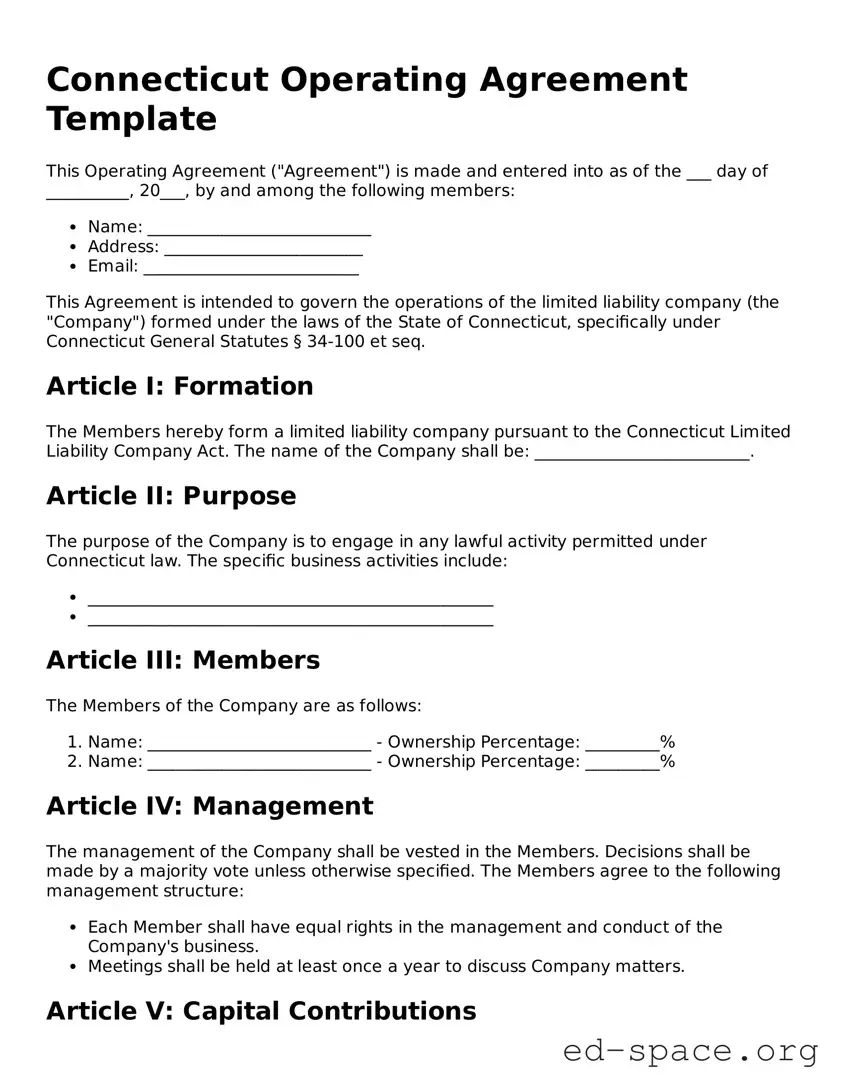
Connecticut Operating Agreement Template
This Operating Agreement ("Agreement") is made and entered into as of the ___ day of __________, 20___, by and among the following members:
This Agreement is intended to govern the operations of the limited liability company (the "Company") formed under the laws of the State of Connecticut, specifically under Connecticut General Statutes § 34-100 et seq.
Article I: Formation
The Members hereby form a limited liability company pursuant to the Connecticut Limited Liability Company Act. The name of the Company shall be: __________________________.
Article II: Purpose
The purpose of the Company is to engage in any lawful activity permitted under Connecticut law. The specific business activities include:
Article III: Members
The Members of the Company are as follows:
Article IV: Management
The management of the Company shall be vested in the Members. Decisions shall be made by a majority vote unless otherwise specified. The Members agree to the following management structure:
Article V: Capital Contributions
The Members agree to make the following initial capital contributions:
Article VI: Distributions
Distributions of profits and losses shall be allocated to the Members in proportion to their ownership percentages as outlined in Article III.
Article VII: Indemnification
The Company shall indemnify any Member or Manager against any losses, expenses, or liabilities incurred in connection with the Company, to the fullest extent permitted by law.
Article VIII: Amendments
This Agreement may be amended only by a written agreement signed by all Members.
Article IX: Governing Law
This Agreement shall be governed by and construed in accordance with the laws of the State of Connecticut.
IN WITNESS WHEREOF, the undersigned Members have executed this Operating Agreement as of the date first above written.
______________________________
Name: ________________________
Date: _________________________
______________________________
Name: ________________________
Date: _________________________
| Fact Name | Description |
|---|---|
| Purpose | The Connecticut Operating Agreement outlines the management structure and operating procedures of a limited liability company (LLC). |
| Governing Law | The agreement is governed by the Connecticut Limited Liability Company Act, specifically found in Connecticut General Statutes, Chapter 613. |
| Members | All members of the LLC should be included in the agreement to ensure clarity in rights and responsibilities. |
| Flexibility | Connecticut law allows for flexibility in how the LLC is managed, whether by members or appointed managers. |
| Dispute Resolution | The agreement can include provisions for resolving disputes among members, which can help avoid costly litigation. |
| Amendments | Changes to the Operating Agreement can be made as needed, provided all members agree to the amendments. |
| Tax Treatment | Operating Agreements can specify tax treatment options, influencing how profits and losses are distributed among members. |
| Not Mandatory | While not legally required, having an Operating Agreement is highly recommended for LLCs to prevent misunderstandings. |
Filling out the Connecticut Operating Agreement form is an important step for your business. This document outlines the management structure and operational procedures of your LLC. Once completed, you will have a clear framework for how your business will function.
What is a Connecticut Operating Agreement?
A Connecticut Operating Agreement is a legal document that outlines the management structure and operating procedures of a limited liability company (LLC) in Connecticut. It defines the rights and responsibilities of the members, how profits and losses will be distributed, and how the company will be managed. While it is not required by law, having one is highly recommended to prevent misunderstandings among members.
Is an Operating Agreement mandatory in Connecticut?
No, an Operating Agreement is not mandatory in Connecticut. However, it is highly advisable for LLCs to have one. Without an agreement, the state’s default rules will apply, which may not reflect the specific needs or intentions of the members. An Operating Agreement can provide clarity and help avoid potential disputes.
Who should draft the Operating Agreement?
The Operating Agreement can be drafted by any member of the LLC. However, it is often beneficial to consult with a legal professional to ensure that the document meets all legal requirements and adequately addresses the needs of the members. A well-crafted agreement can prevent future conflicts.
What should be included in the Operating Agreement?
An Operating Agreement should include several key components. These typically encompass the LLC’s name and purpose, member information, management structure, voting rights, profit and loss distribution, procedures for adding or removing members, and the process for dissolving the LLC. Each section should be tailored to the specific circumstances of the business.
Can the Operating Agreement be changed after it is signed?
Yes, the Operating Agreement can be amended after it is signed. Members can agree to changes through a formal amendment process outlined in the original agreement. It is important to document any changes in writing to maintain clarity and legal standing.
What happens if there is no Operating Agreement?
If there is no Operating Agreement, the LLC will be governed by Connecticut’s default laws. This may lead to situations where the members have less control over business operations and profit distribution. Disputes may arise more easily, as there are no agreed-upon terms to refer to. It is wise to create an agreement to set clear expectations.
How is the Operating Agreement executed?
The Operating Agreement is executed when all members sign the document. It is not required to be filed with the state, but it should be kept in a safe place for reference. Members may also want to provide copies to all involved parties to ensure everyone is on the same page.
Can an Operating Agreement be used for other types of business entities?
An Operating Agreement is specifically designed for LLCs. Other business entities, like corporations or partnerships, have their own governing documents, such as bylaws or partnership agreements. Each document serves a similar purpose but is tailored to the unique structure and needs of the business type.
Failing to include all members' names. Each member of the LLC must be clearly listed in the agreement. Omitting a member can lead to disputes later.
Not specifying the ownership percentages. Clearly defining how much of the company each member owns helps prevent misunderstandings.
Ignoring the management structure. It is essential to outline whether the LLC will be member-managed or manager-managed. This decision impacts how the business operates.
Leaving out the purpose of the LLC. Stating the business's purpose provides clarity and can be important for legal and tax purposes.
Neglecting to include provisions for profit and loss distribution. Clearly outlining how profits and losses will be shared is crucial for financial transparency.
Not addressing the process for adding or removing members. Having a clear procedure in place ensures smooth transitions when changes occur.
Failing to outline dispute resolution methods. Including how disputes will be handled can save time and money if conflicts arise.
Omitting the procedure for amending the agreement. It’s important to have a clear process for making changes to the Operating Agreement in the future.
Not having the agreement signed by all members. All members must sign the document for it to be legally binding.
Overlooking the need for legal review. Consulting with a legal professional before finalizing the agreement can help identify potential issues.
When forming a limited liability company (LLC) in Connecticut, the Operating Agreement is a crucial document that outlines the management structure and operational procedures. However, it is often accompanied by several other forms and documents that help establish the LLC's legal standing and ensure compliance with state regulations. Below is a list of these essential documents.
Each of these documents plays a significant role in the formation and operation of an LLC in Connecticut. By understanding their purposes and ensuring they are properly executed, members can establish a solid foundation for their business. This not only aids in legal compliance but also fosters clear communication and expectations among members, which is vital for the success of any enterprise.
The Operating Agreement is a crucial document for limited liability companies (LLCs), outlining the management structure and operating procedures. It shares similarities with several other important documents in the business realm. Here are four documents that are akin to the Operating Agreement:
Each of these documents plays a vital role in ensuring that a business operates smoothly and that all parties are on the same page regarding their rights and responsibilities.
When filling out the Connecticut Operating Agreement form, it is important to follow certain guidelines to ensure accuracy and compliance. Below is a list of things you should and shouldn't do:
Here are six common misconceptions about the Connecticut Operating Agreement form:
This is false. Every limited liability company (LLC), regardless of size, benefits from having an Operating Agreement. It provides a clear framework for operations and member responsibilities.
Many believe that the Operating Agreement must be filed with the state. In reality, it is a private document kept among the members and does not need to be submitted to any government agency.
Some think that a verbal agreement among members is enough. This is not true. A written Operating Agreement is essential for clarity and legal protection.
While it is highly recommended that all members sign, it is not a legal requirement in Connecticut. However, having all signatures adds to the document's validity.
This misconception is incorrect. An Operating Agreement can be amended as needed, provided that all members agree to the changes. Flexibility is key.
Existing LLCs can also benefit from creating or updating their Operating Agreement. It helps to clarify roles and responsibilities, regardless of how long the business has been operating.
When filling out and using the Connecticut Operating Agreement form, several important points should be considered to ensure compliance and clarity for all parties involved. Here are the key takeaways:
By keeping these key points in mind, individuals can create a comprehensive Operating Agreement that serves the needs of the LLC and its members effectively.