In the state of Connecticut, the Notary Acknowledgement form plays a crucial role in the realm of legal documentation and transactions. This form serves as a verification tool, affirming that a signature on a document was made voluntarily and in the presence of a notary public. The process begins when an individual appears before the notary, presenting the document that requires acknowledgment. The notary then confirms the identity of the signer, ensuring that they understand the contents of the document and are signing it willingly. This form is essential in various situations, such as real estate transactions, contracts, and other legal agreements, where the authenticity of a signature is paramount. By providing this assurance, the Notary Acknowledgement helps to prevent fraud and protects all parties involved in the transaction. Understanding the nuances of this form is vital for anyone engaged in legal or financial matters in Connecticut, as it not only facilitates the smooth execution of documents but also upholds the integrity of the legal process.
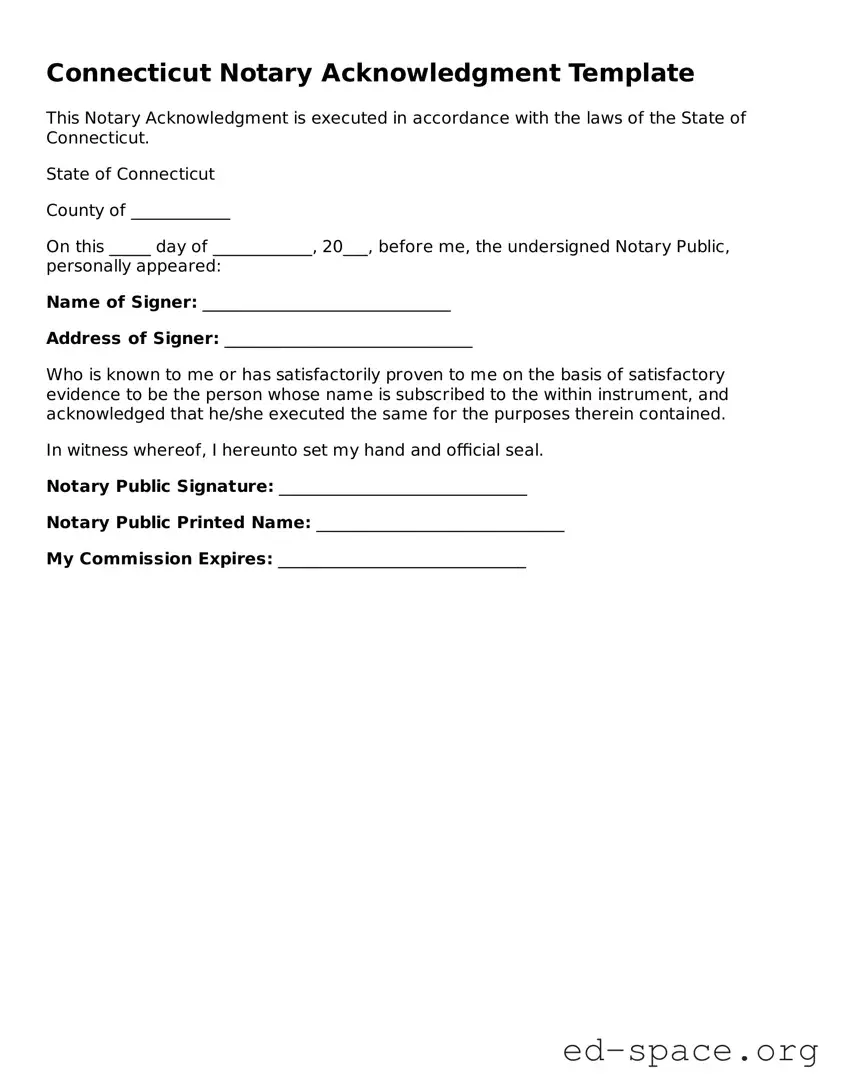
Connecticut Notary Acknowledgment Template
This Notary Acknowledgment is executed in accordance with the laws of the State of Connecticut.
State of Connecticut
County of ____________
On this _____ day of ____________, 20___, before me, the undersigned Notary Public, personally appeared:
Name of Signer: ______________________________
Address of Signer: ______________________________
Who is known to me or has satisfactorily proven to me on the basis of satisfactory evidence to be the person whose name is subscribed to the within instrument, and acknowledged that he/she executed the same for the purposes therein contained.
In witness whereof, I hereunto set my hand and official seal.
Notary Public Signature: ______________________________
Notary Public Printed Name: ______________________________
My Commission Expires: ______________________________
| Fact Name | Description |
|---|---|
| Purpose | The Connecticut Notary Acknowledgment form is used to verify the identity of individuals signing a document and to confirm that they did so willingly. |
| Governing Law | This form is governed by Connecticut General Statutes, specifically Section 1-30. |
| Signature Requirement | Signatures must be made in the presence of a notary public to ensure authenticity. |
| Notary Seal | A notary public must affix their official seal to the acknowledgment form to validate it. |
| Record Keeping | Notaries are required to keep a record of all acknowledgments they perform, including details of the transaction. |
| Validity | The acknowledgment remains valid as long as it is executed according to the state's regulations. |
| Use Cases | This form is commonly used for real estate transactions, legal documents, and other official matters requiring notarization. |
| Witness Requirement | While not always necessary, some documents may require additional witnesses alongside the notary acknowledgment. |
After completing the Connecticut Notary Acknowledgement form, you will need to ensure that it is signed and dated appropriately. Once filled out correctly, the form can be submitted along with any required documents to the relevant parties or authorities.
What is a Connecticut Notary Acknowledgement form?
The Connecticut Notary Acknowledgement form is a legal document used to verify that a person has willingly signed a document in front of a notary public. This form serves as proof that the signer was identified and acknowledged their signature, ensuring the document's authenticity. It is commonly used in various transactions, such as real estate deals, contracts, and other legal agreements.
When do I need to use a Notary Acknowledgement form?
You should use a Notary Acknowledgement form whenever you need to provide assurance that a document has been signed voluntarily and with proper identification. This is particularly important for legal documents like deeds, powers of attorney, and affidavits. Using this form helps protect against fraud and ensures that all parties involved have a clear understanding of the agreement being made.
How do I complete a Notary Acknowledgement form in Connecticut?
To complete a Notary Acknowledgement form, follow these steps: First, ensure that the signer is present and ready to sign the document. The notary public will then verify the signer's identity, usually by checking a government-issued ID. After confirming the identity, the signer will sign the document in the notary's presence. Finally, the notary will fill out the acknowledgment section, providing their signature, seal, and the date of the acknowledgment.
Is there a fee for notarizing a document in Connecticut?
Yes, notaries in Connecticut are allowed to charge a fee for their services. The maximum fee that a notary can charge for an acknowledgment is set by state law. As of the latest guidelines, this fee is typically around $5 per signature. However, it’s always a good idea to confirm the fee with the notary before the service is rendered, as some may have different rates or additional charges for travel or other services.
Where can I find a notary public in Connecticut?
Finding a notary public in Connecticut is relatively straightforward. Notaries can be found in various places, including banks, law offices, and public libraries. Additionally, many notaries offer mobile services and can travel to your location. Online directories and state resources can also help you locate a notary nearby. Always check that the notary is properly commissioned and in good standing with the state.
Failing to include the correct date. The date on the notary acknowledgment form is crucial. If it is missing or incorrect, it can lead to complications regarding the validity of the notarization.
Not providing the signer's name as it appears on their identification. This mistake can create confusion and may render the acknowledgment invalid. Always ensure the name matches the ID exactly.
Omitting the notary's signature. Without the notary's signature, the acknowledgment is incomplete. This signature serves as a verification of the notary's presence during the signing process.
Using an incorrect notary seal. Each notary must use their official seal. An outdated or incorrect seal can lead to questions about the legitimacy of the notarization.
Neglecting to indicate the type of identification used. The acknowledgment should specify the type of ID presented by the signer. This detail is important for establishing the identity of the individual.
The Connecticut Notary Acknowledgment form is a crucial document used to verify the identity of signers and confirm that they willingly signed a particular document. However, several other forms and documents often accompany it to ensure a smooth notarization process. Below are some commonly used forms that may be needed alongside the Connecticut Notary Acknowledgment form.
Each of these documents plays a vital role in the notarization process, ensuring that transactions are conducted legally and securely. Understanding their purpose can help streamline the process and enhance the integrity of the documents being executed.
The Notary Acknowledgment form serves a specific purpose in verifying the identity of signers and their willingness to sign a document. Several other documents share similar functions or characteristics. Below is a list of eight documents that are comparable to the Notary Acknowledgment form:
When filling out the Connecticut Notary Acknowledgement form, it’s important to follow specific guidelines to ensure accuracy and compliance. Here’s a list of things you should and shouldn’t do:
Understanding the Connecticut Notary Acknowledgement form can be challenging, especially with the presence of common misconceptions. Here are seven prevalent misunderstandings regarding this important legal document:
This is false. A notary must witness the signing of the document to provide an acknowledgment. Without a signature, the notary cannot perform their duty.
While both involve a notary, they serve different purposes. An acknowledgment confirms that a signer willingly signed a document, whereas a notarization can also include verifying the identity of the signer.
This is not true. Only certain documents, such as deeds or contracts, may require a notary acknowledgment. It’s important to check the specific requirements for each document.
Notaries are not authorized to give legal advice. Their role is to verify identities and witness signatures, not to interpret legal documents.
This misconception is misleading. A notarization does not guarantee that the document is free from dispute. Legal challenges can still arise based on the content of the document itself.
While notaries have discretion, they cannot refuse without a valid reason, such as concerns about the signer's identity or the legality of the document.
This is incorrect. Notary acknowledgments are used in various types of documents, including powers of attorney, affidavits, and many others beyond real estate.
Being aware of these misconceptions can help individuals navigate the process of using the Connecticut Notary Acknowledgement form more effectively. Understanding the role of a notary and the function of the acknowledgment can lead to smoother transactions and greater confidence in legal matters.
When filling out and using the Connecticut Notary Acknowledgement form, keep the following key points in mind: