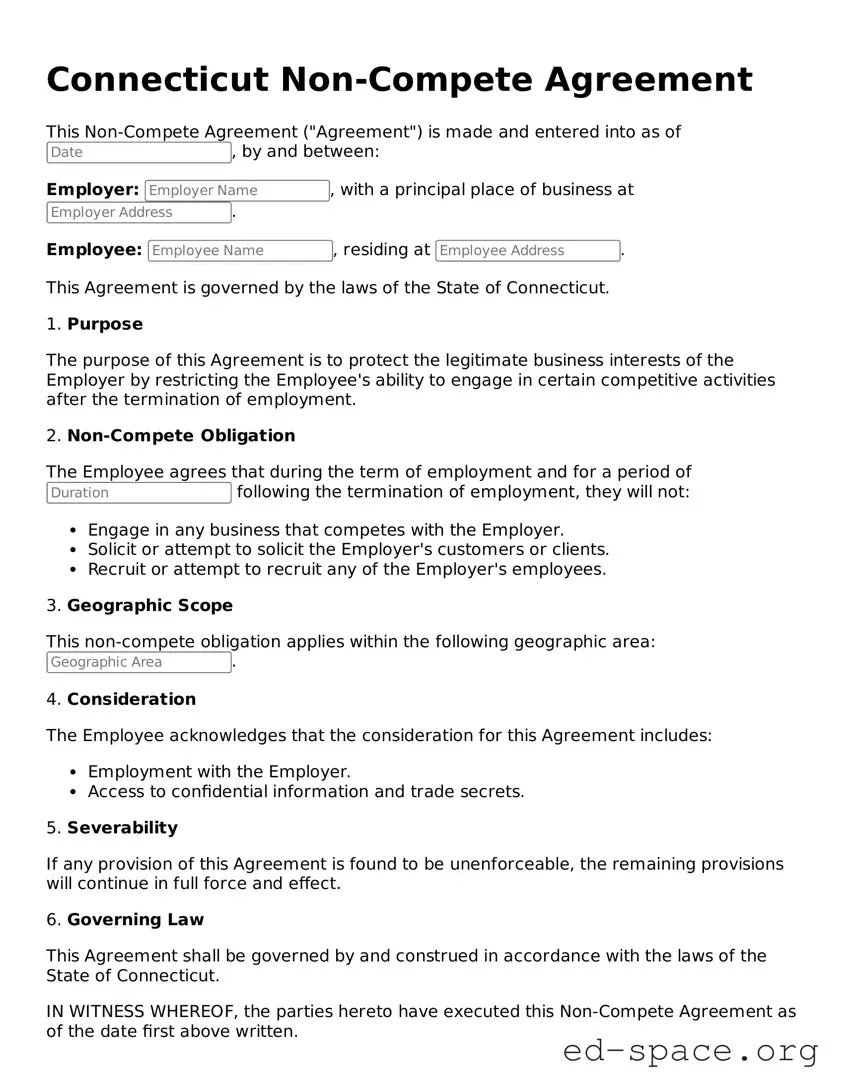
In Connecticut, the Non-compete Agreement form plays a crucial role in defining the boundaries of employment relationships. This form is designed to protect businesses by restricting employees from engaging in competitive activities after leaving the company. Key elements of the form include the duration of the non-compete period, the geographical area it covers, and the specific activities that are prohibited. Employers must ensure that the terms are reasonable and not overly restrictive, as Connecticut law requires that such agreements balance the interests of both parties. Additionally, the form may outline any potential penalties for violations, providing clarity and a sense of security for employers. Understanding the nuances of this agreement is essential for both employers and employees to navigate their rights and obligations effectively.
Connecticut Non-Compete Agreement
This Non-Compete Agreement ("Agreement") is made and entered into as of , by and between:
Employer: , with a principal place of business at .
Employee: , residing at .
This Agreement is governed by the laws of the State of Connecticut.
1. Purpose
The purpose of this Agreement is to protect the legitimate business interests of the Employer by restricting the Employee's ability to engage in certain competitive activities after the termination of employment.
2. Non-Compete Obligation
The Employee agrees that during the term of employment and for a period of following the termination of employment, they will not:
3. Geographic Scope
This non-compete obligation applies within the following geographic area: .
4. Consideration
The Employee acknowledges that the consideration for this Agreement includes:
5. Severability
If any provision of this Agreement is found to be unenforceable, the remaining provisions will continue in full force and effect.
6. Governing Law
This Agreement shall be governed by and construed in accordance with the laws of the State of Connecticut.
IN WITNESS WHEREOF, the parties hereto have executed this Non-Compete Agreement as of the date first above written.
___________________________
Employer Signature
___________________________
Employee Signature
| Fact Name | Details |
|---|---|
| Definition | A non-compete agreement is a contract that restricts an employee from working for competitors or starting a competing business for a specified time after leaving a job. |
| Governing Law | The governing law for non-compete agreements in Connecticut is found in Connecticut General Statutes § 34-1 et seq. |
| Enforceability | In Connecticut, non-compete agreements are enforceable if they are reasonable in duration, geographic scope, and protect legitimate business interests. |
| Duration | The duration of a non-compete agreement should be limited. Generally, agreements lasting one to two years are considered reasonable. |
| Geographic Scope | The geographic scope of a non-compete must be appropriate to the business interests being protected. Overly broad restrictions may be deemed unenforceable. |
| Legitimate Business Interests | Employers must demonstrate that the non-compete agreement protects legitimate business interests, such as trade secrets or customer relationships. |
| Consideration | For a non-compete agreement to be valid, there must be consideration, such as a job offer or a promotion, provided to the employee. |
| Judicial Review | Connecticut courts will review non-compete agreements to ensure they are not overly restrictive and serve a valid purpose. |
| Employee Rights | Employees in Connecticut have the right to challenge non-compete agreements in court if they believe the terms are unreasonable or unjust. |
Completing the Connecticut Non-compete Agreement form requires careful attention to detail. Once you have filled out the form, you will need to review it for accuracy before submitting it. Follow these steps to ensure you complete the form correctly.
After completing these steps, double-check all entries for accuracy. Ensure that all required fields are filled out correctly before submitting the form to the appropriate party.
What is a Non-compete Agreement in Connecticut?
A Non-compete Agreement is a legal contract between an employer and an employee. It restricts the employee from working for competitors or starting a competing business for a certain period after leaving the company. In Connecticut, these agreements must be reasonable in scope and duration to be enforceable. Courts will consider the specifics of each case, including the interests of both parties and the public interest.
Are Non-compete Agreements enforceable in Connecticut?
Yes, Non-compete Agreements can be enforceable in Connecticut, but there are important conditions. The agreement must protect legitimate business interests, such as trade secrets or client relationships. Additionally, the restrictions must not be overly broad in geographic area or duration. If a court finds the terms too harsh, it may refuse to enforce the agreement or modify it to make it reasonable.
How long can a Non-compete Agreement last in Connecticut?
The duration of a Non-compete Agreement in Connecticut varies based on the circumstances. Typically, agreements lasting six months to two years may be considered reasonable, depending on the industry and the employee's role. However, longer periods may be scrutinized more closely by courts. The key is to ensure that the duration aligns with the business interests being protected.
Can I negotiate a Non-compete Agreement before signing it?
Absolutely. It's advisable to negotiate the terms of a Non-compete Agreement before signing. You have the right to discuss any concerns you may have about the restrictions. Consider seeking legal advice to understand the implications of the agreement fully. A fair negotiation can lead to terms that protect both your interests and those of your employer.
Not Understanding the Terms: Many people do not take the time to read and understand the terms of the agreement. This can lead to confusion about what is allowed and what is not.
Leaving Sections Blank: Some individuals fill out the form but skip important sections. Leaving out key information can result in the agreement being incomplete or unenforceable.
Using Incorrect Dates: Filling in the wrong dates is a common mistake. This can affect the duration of the non-compete period and create issues later on.
Not Specifying Geographic Limits: Failing to define the geographic area where the non-compete applies can lead to misunderstandings. It's crucial to clearly outline these boundaries.
Ignoring State Laws: Each state has different laws regarding non-compete agreements. Some people overlook the specific requirements for Connecticut, which can lead to problems with enforceability.
When entering into a Non-compete Agreement in Connecticut, several other forms and documents may be relevant. These documents help clarify the terms of employment, protect business interests, and ensure compliance with state laws. Below is a list of commonly used forms that accompany a Non-compete Agreement.
These forms and documents work together to establish clear expectations and protect both parties involved in the employment relationship. It is important to understand each document's purpose and how they relate to the Non-compete Agreement to ensure a comprehensive understanding of the legal landscape surrounding employment agreements in Connecticut.
When filling out the Connecticut Non-compete Agreement form, it is essential to approach the task carefully. Here are some guidelines to consider:
Following these guidelines can help ensure that you make informed decisions when dealing with a Non-compete Agreement in Connecticut.
Understanding non-compete agreements in Connecticut can be challenging. Here are four common misconceptions that people often have about these agreements:
When filling out and using the Connecticut Non-compete Agreement form, keep these key points in mind:
By following these guidelines, you can effectively navigate the process of creating and using a non-compete agreement in Connecticut.