Homepage Free Motor Vehicle Power of Attorney Form for Connecticut
Content Overview

The Connecticut Motor Vehicle Power of Attorney form is a vital document that empowers an individual to designate another person to act on their behalf regarding motor vehicle transactions. This form is particularly useful for those who may be unable to attend to vehicle-related matters personally, such as buying, selling, or registering a vehicle. By completing this form, the principal grants specific authority to the agent, allowing them to handle tasks like signing titles, transferring ownership, or even dealing with the Department of Motor Vehicles. It's important to note that the form must be signed and dated by the principal, and it requires the agent's acceptance to ensure that both parties are in agreement. The document serves to protect the interests of the principal while providing the agent with the necessary authority to act effectively. Understanding the key components of this form can simplify the process of managing motor vehicle affairs and ensure that transactions proceed smoothly.

Document Preview

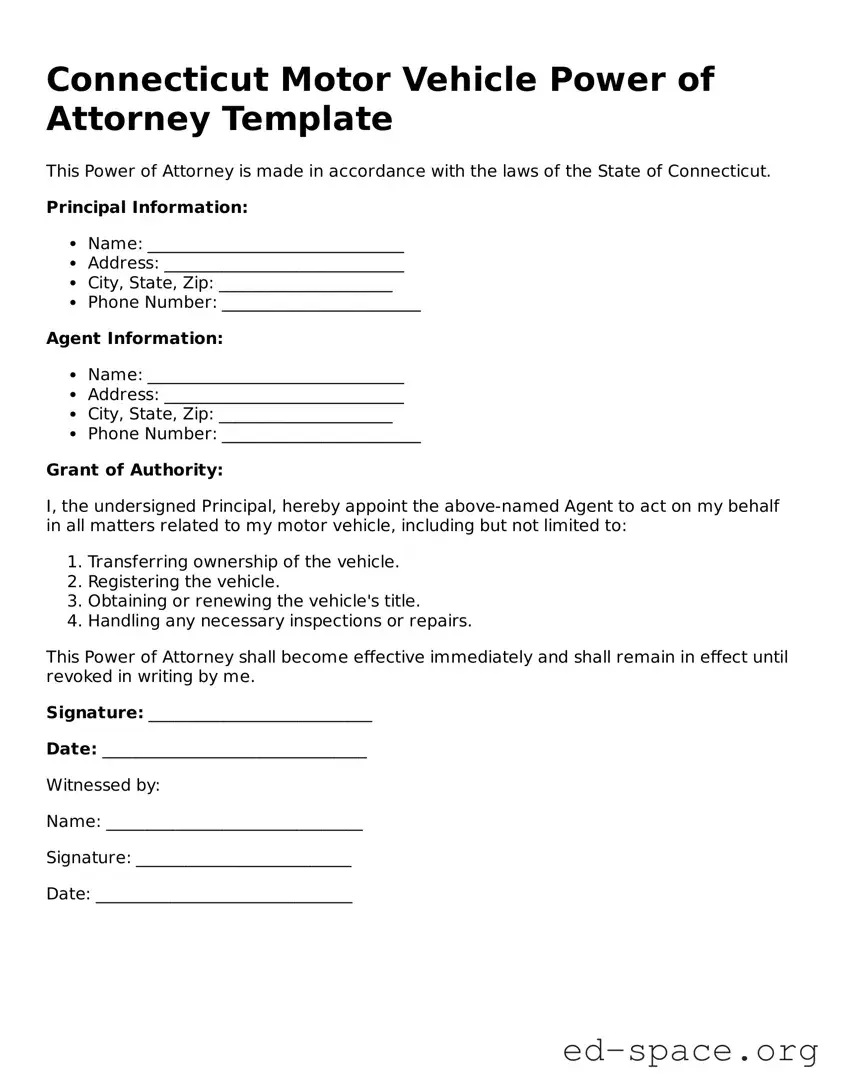
Connecticut Motor Vehicle Power of Attorney Template

This Power of Attorney is made in accordance with the laws of the State of Connecticut.

Principal Information:

  • Name: _______________________________
  • Address: _____________________________
  • City, State, Zip: _____________________
  • Phone Number: ________________________

Agent Information:

  • Name: _______________________________
  • Address: _____________________________
  • City, State, Zip: _____________________
  • Phone Number: ________________________

Grant of Authority:

I, the undersigned Principal, hereby appoint the above-named Agent to act on my behalf in all matters related to my motor vehicle, including but not limited to:

  1. Transferring ownership of the vehicle.
  2. Registering the vehicle.
  3. Obtaining or renewing the vehicle's title.
  4. Handling any necessary inspections or repairs.

This Power of Attorney shall become effective immediately and shall remain in effect until revoked in writing by me.

Signature: ___________________________

Date: ________________________________

Witnessed by:

Name: _______________________________

Signature: __________________________

Date: _______________________________

PDF Form Details

Fact Name Description
Purpose The Connecticut Motor Vehicle Power of Attorney form allows an individual to authorize another person to handle motor vehicle transactions on their behalf.
Governing Law This form is governed by Connecticut General Statutes, specifically Section 14-12.
Signatories The form must be signed by the principal, who is the person granting the power of attorney.
Agent Requirements The appointed agent must be at least 18 years old and can be a trusted friend, family member, or attorney.
Scope of Authority The agent can perform tasks such as transferring vehicle titles, registering vehicles, and obtaining license plates.
Revocation The principal can revoke the power of attorney at any time, as long as they provide a written notice to the agent.
Validity The form remains valid until the principal revokes it or until the principal's death.

Connecticut Motor Vehicle Power of Attorney: Usage Guidelines

Completing the Connecticut Motor Vehicle Power of Attorney form requires careful attention to detail. After filling out the form, it will be necessary to submit it to the appropriate authorities to ensure that the designated individual can act on behalf of the vehicle owner.

  1. Obtain the Connecticut Motor Vehicle Power of Attorney form from the Connecticut Department of Motor Vehicles website or your local DMV office.
  2. Begin by filling in the name of the vehicle owner in the designated space at the top of the form.
  3. Provide the owner's address, including city, state, and ZIP code.
  4. Enter the vehicle information, including the make, model, year, and Vehicle Identification Number (VIN).
  5. Identify the person you are granting power of attorney to by entering their full name and address.
  6. Specify the powers you are granting. This may include the ability to register, title, or transfer the vehicle.
  7. Include the date the power of attorney is being granted.
  8. Sign the form in the designated area to validate the document.
  9. Have the signature notarized, if required, to ensure its authenticity.
  10. Make copies of the completed form for your records before submitting it.

Your Questions, Answered

What is a Connecticut Motor Vehicle Power of Attorney form?

The Connecticut Motor Vehicle Power of Attorney form allows an individual, known as the principal, to authorize another person, called the agent, to handle specific tasks related to motor vehicles on their behalf. This can include signing documents for vehicle registration, transferring ownership, or obtaining titles. It is a useful tool when the principal cannot be present to complete these tasks themselves.

Who can be appointed as an agent on this form?

Any adult can be appointed as an agent in the Connecticut Motor Vehicle Power of Attorney form. This could be a family member, friend, or even a professional service. It’s essential to choose someone trustworthy, as they will have the authority to act in your best interest regarding your motor vehicle matters.

How do I complete the form?

To complete the Connecticut Motor Vehicle Power of Attorney form, you will need to provide your personal information, including your name and address, as well as the agent's details. You must specify the powers you are granting to the agent, which may include tasks like signing documents or transferring titles. Once filled out, both you and the agent should sign the form, and it may need to be notarized to be valid.

Is the form valid in other states?

The Connecticut Motor Vehicle Power of Attorney form is primarily valid within Connecticut. However, other states may recognize it if it meets their requirements. It’s advisable to check the specific regulations in the state where you intend to use the form. This ensures that your agent can act on your behalf without any issues.

Common mistakes

  1. Failing to provide complete information about the principal. The form requires accurate details, including the full name and address of the person granting the power of attorney.

  2. Not specifying the powers granted. It is essential to clearly outline what authority is being given to the agent, such as transferring vehicle ownership or handling registration.

  3. Overlooking the need for signatures. Both the principal and the agent must sign the document. Without these signatures, the form is invalid.

  4. Neglecting to have the form notarized. In Connecticut, a notary public must witness the signing of the document to ensure its legitimacy.

  5. Using outdated forms. It is crucial to use the most current version of the Connecticut Motor Vehicle Power of Attorney form to avoid any legal complications.

  6. Failing to date the form. A date is necessary to indicate when the power of attorney was executed, which can impact its validity.

  7. Not keeping copies of the completed form. Retaining copies for personal records and providing one to the agent ensures that all parties have access to the same information.

Documents used along the form

When dealing with motor vehicle transactions in Connecticut, the Motor Vehicle Power of Attorney form is a crucial document. However, it is often accompanied by other forms and documents that facilitate various aspects of vehicle ownership, transfer, and registration. Understanding these additional documents can help ensure a smooth process.

  • Connecticut Vehicle Registration Application: This form is used to register a vehicle with the Connecticut Department of Motor Vehicles (DMV). It includes details about the vehicle and the owner, and it is necessary for obtaining a license plate and registration certificate.
  • Bill of Sale: A Bill of Sale serves as a legal document that records the sale of a vehicle. It includes information about the buyer, seller, vehicle details, and the sale price, providing proof of the transaction.
  • Title Transfer Form: When a vehicle is sold or transferred, this form is used to officially change ownership on the vehicle's title. It must be completed and submitted to the DMV to update the records.
  • Odometer Disclosure Statement: This document is required when transferring ownership of a vehicle. It verifies the vehicle's mileage at the time of sale, helping to prevent fraud related to odometer tampering.
  • Application for Duplicate Title: If a vehicle's title is lost or damaged, this application is necessary to obtain a replacement title. It ensures that the owner can still prove their ownership of the vehicle.
  • Insurance Verification: Proof of insurance is often required for vehicle registration. This document confirms that the vehicle is insured, which is a legal requirement in Connecticut.
  • Affidavit of Heirship: In cases where a vehicle is inherited, this affidavit helps establish the rightful heir's claim to the vehicle. It is particularly useful when the original owner has passed away without a formal will.

Familiarity with these documents can greatly ease the process of handling motor vehicle transactions in Connecticut. Each plays a distinct role in ensuring compliance with state laws and protecting the interests of all parties involved.

Similar forms

The Motor Vehicle Power of Attorney (POA) form allows one person to authorize another to handle specific tasks related to their vehicle. This form is similar to several other legal documents that grant authority or facilitate decision-making. Here are seven documents that share similarities with the Motor Vehicle Power of Attorney:

  • General Power of Attorney: This document grants broad powers to an agent to act on behalf of the principal in various matters, including financial and legal decisions, similar to how a Motor Vehicle POA allows for specific vehicle-related actions.
  • Limited Power of Attorney: Like the Motor Vehicle POA, this form restricts the agent's authority to specific tasks or time frames, ensuring that control remains with the principal for other matters.
  • Durable Power of Attorney: This document remains effective even if the principal becomes incapacitated, providing ongoing authority for the agent, much like how a Motor Vehicle POA can be designed to remain valid under certain conditions.
  • Health Care Power of Attorney: This allows an agent to make medical decisions on behalf of the principal, similar to how a Motor Vehicle POA enables someone to make decisions about vehicle registration and title transfers.
  • Financial Power of Attorney: This document specifically allows an agent to manage financial matters, akin to how a Motor Vehicle POA handles financial aspects related to vehicle ownership.
  • Real Estate Power of Attorney: This grants authority to handle real estate transactions, paralleling the Motor Vehicle POA's role in facilitating vehicle transactions.
  • Vehicle Title Transfer Form: While not a power of attorney, this form is used to officially transfer ownership of a vehicle, similar to the purpose of a Motor Vehicle POA in executing such transfers on behalf of the owner.

Understanding these documents can help individuals navigate their legal needs more effectively. Each serves a unique purpose but shares the common theme of delegating authority to act on someone else's behalf.

Dos and Don'ts

When filling out the Connecticut Motor Vehicle Power of Attorney form, it is important to follow certain guidelines to ensure the process goes smoothly. Here are some things you should and shouldn't do:

  • Do read the entire form carefully before filling it out.
  • Do provide accurate information about the vehicle and the parties involved.
  • Do sign the form in the appropriate section.
  • Do keep a copy of the completed form for your records.
  • Don't leave any required fields blank.
  • Don't use white-out or any correction fluid on the form.
  • Don't forget to check the expiration date of the Power of Attorney.

Misconceptions

When it comes to the Connecticut Motor Vehicle Power of Attorney form, several misconceptions can cloud understanding. Let's clear the air and provide clarity on this important document.

  • It's only for businesses. Many believe that the Power of Attorney form is exclusively for business transactions. In reality, individuals can also use it to delegate authority for personal vehicle matters.
  • It must be notarized to be valid. While notarization adds a layer of authenticity, it is not a strict requirement for the Connecticut Motor Vehicle Power of Attorney form to be legally binding.
  • It can only be used for selling a vehicle. Although selling a vehicle is a common use, this form can also grant authority for tasks like registering a vehicle or obtaining a duplicate title.
  • Only one person can be appointed. Some think that only a single individual can be designated as an agent. In fact, you can appoint multiple agents to act on your behalf, ensuring that someone is always available to manage your vehicle affairs.
  • It expires after a certain period. The misconception that the Power of Attorney form has an automatic expiration is misleading. It remains effective until you revoke it or the specific task is completed.
  • It requires a lawyer to complete. While legal advice can be beneficial, it is not necessary to consult a lawyer to fill out the Power of Attorney form. Many individuals can complete it on their own with the right information.
  • It can only be used in Connecticut. Some believe that this form is only valid within Connecticut borders. However, if properly executed, it may be recognized in other states for specific vehicle-related transactions.
  • Once signed, it cannot be changed. This is simply not true. You have the right to modify or revoke your Power of Attorney at any time, as long as you follow the proper procedures.

Understanding these misconceptions can help you navigate the process of using the Connecticut Motor Vehicle Power of Attorney form with confidence and clarity. Empower yourself by knowing the facts!

Key takeaways

Filling out and using the Connecticut Motor Vehicle Power of Attorney form can be a straightforward process, but understanding its key aspects is essential. Here are some important takeaways:

  1. Purpose of the Form: This form allows an individual to designate another person to act on their behalf regarding motor vehicle transactions, such as registering a vehicle or transferring ownership.
  2. Eligibility: Any adult can serve as an agent, provided they are trustworthy and capable of handling the responsibilities outlined in the form.
  3. Completing the Form: Ensure that all required fields are filled out accurately, including the names and addresses of both the principal and the agent.
  4. Signature Requirement: The principal must sign the form in the presence of a notary public to validate the document.
  5. Scope of Authority: The form specifies the powers granted to the agent. It's crucial to understand what actions the agent can take on your behalf.
  6. Limitations: The power of attorney can be limited to specific transactions or be general. Clearly define the scope to avoid confusion.
  7. Revocation: The principal has the right to revoke the power of attorney at any time, provided they notify the agent and any relevant parties.
  8. Duration: The authority granted does not have an expiration date unless specified. Consider setting a time limit if needed.
  9. Keep Copies: After completing the form, retain copies for personal records and provide one to the agent for their reference.

Understanding these key points can help ensure that the process of designating a power of attorney for motor vehicle matters in Connecticut is smooth and effective.