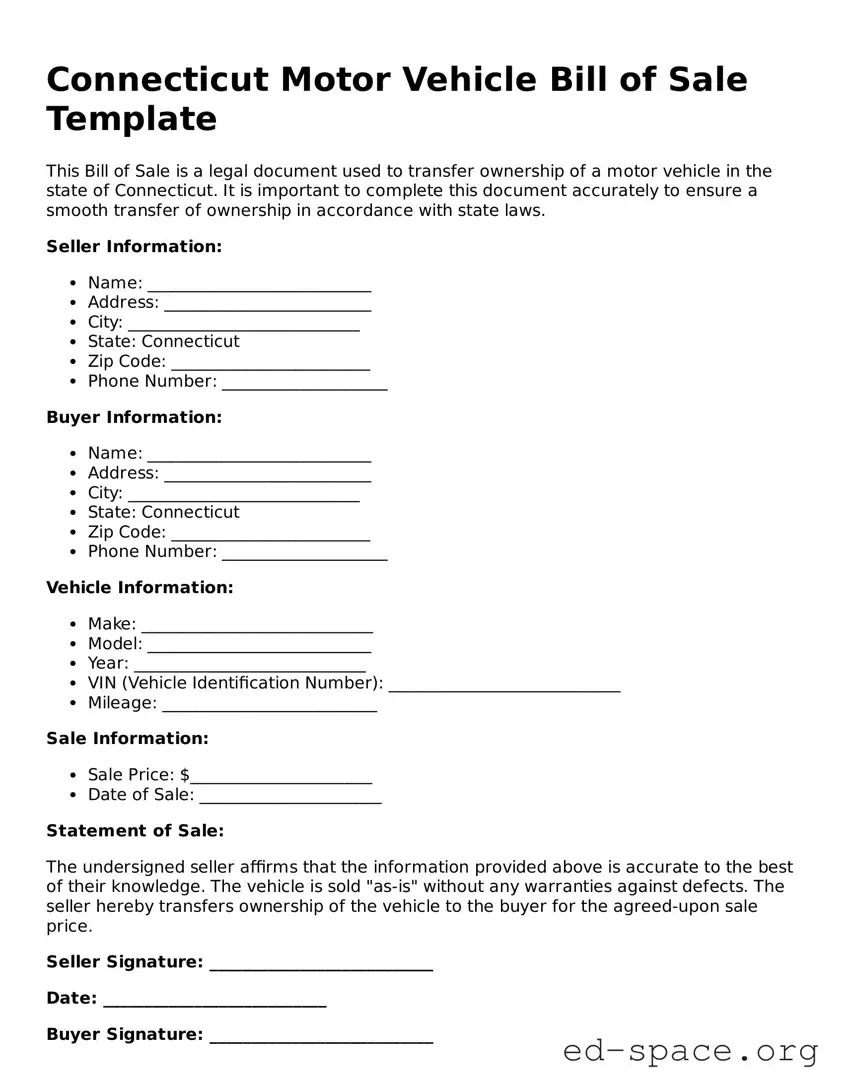
The Connecticut Motor Vehicle Bill of Sale form serves as a crucial document in the process of transferring ownership of a vehicle from one party to another. This form captures essential details such as the names and addresses of both the buyer and seller, the vehicle identification number (VIN), and the make and model of the vehicle. It also includes information about the sale price and the date of the transaction, ensuring that both parties have a clear record of the agreement. By documenting the sale, this form protects the interests of both the buyer and the seller, providing evidence of the transaction in case of future disputes. Additionally, the form may include spaces for signatures, which signifies that both parties agree to the terms outlined. Understanding the components and significance of the Bill of Sale is important for anyone involved in buying or selling a vehicle in Connecticut.
Connecticut Motor Vehicle Bill of Sale Template
This Bill of Sale is a legal document used to transfer ownership of a motor vehicle in the state of Connecticut. It is important to complete this document accurately to ensure a smooth transfer of ownership in accordance with state laws.
Seller Information:
Buyer Information:
Vehicle Information:
Sale Information:
Statement of Sale:
The undersigned seller affirms that the information provided above is accurate to the best of their knowledge. The vehicle is sold "as-is" without any warranties against defects. The seller hereby transfers ownership of the vehicle to the buyer for the agreed-upon sale price.
Seller Signature: ___________________________
Date: ___________________________
Buyer Signature: ___________________________
Date: ___________________________
Both parties should retain a copy of this Bill of Sale for their records. It is advisable to also report the sale to the Connecticut Department of Motor Vehicles to ensure proper registration and title transfer.
| Fact Name | Description |
|---|---|
| Purpose | The Connecticut Motor Vehicle Bill of Sale form is used to document the sale of a vehicle between a buyer and a seller. |
| Governing Law | This form is governed by the Connecticut General Statutes, particularly Section 14-185. |
| Required Information | The form must include details such as the vehicle identification number (VIN), make, model, year, and odometer reading. |
| Signatures | Both the buyer and the seller must sign the form to validate the transaction. |
| Notarization | While notarization is not required, it is recommended for added legal protection in case of disputes. |
| Record Keeping | Both parties should retain a copy of the completed Bill of Sale for their records. |
| Transfer of Ownership | The Bill of Sale serves as proof of ownership transfer and is often required for vehicle registration by the DMV. |
Once you have the Connecticut Motor Vehicle Bill of Sale form, you'll need to fill it out accurately. This document is important for transferring ownership of a vehicle. Make sure you have all the necessary information ready before you start.
What is a Connecticut Motor Vehicle Bill of Sale?
A Connecticut Motor Vehicle Bill of Sale is a legal document that records the sale of a vehicle between a buyer and a seller. This form serves as proof of the transaction and includes essential details about the vehicle, the parties involved, and the terms of the sale. It can be particularly useful for registration and titling purposes.
Why is a Bill of Sale necessary in Connecticut?
In Connecticut, a Bill of Sale is not just a formality; it protects both the buyer and the seller. It provides evidence of the transaction, which can help prevent disputes over ownership. Additionally, it is often required by the Department of Motor Vehicles (DMV) when transferring vehicle ownership.
What information is included in the Bill of Sale?
The Bill of Sale typically includes the names and addresses of both the buyer and seller, the vehicle's make, model, year, VIN (Vehicle Identification Number), odometer reading, sale price, and the date of the transaction. Both parties should sign the document to validate the sale.
Do I need to have the Bill of Sale notarized?
While it is not mandatory to have a Bill of Sale notarized in Connecticut, doing so can add an extra layer of security and authenticity to the document. If disputes arise, a notarized Bill of Sale can serve as stronger evidence in legal matters.
Can I create my own Bill of Sale?
Yes, you can create your own Bill of Sale as long as it includes all the necessary information. However, using a standard form can ensure that you don’t miss any critical details. Many templates are available online that comply with Connecticut’s requirements.
Is a Bill of Sale required for every vehicle sale?
While a Bill of Sale is not strictly required for every vehicle sale in Connecticut, it is highly recommended. Having this document can simplify the registration process and provide proof of ownership, which can be crucial if any issues arise later.
How does the Bill of Sale affect vehicle registration?
The Bill of Sale is often required when registering a vehicle with the DMV. It serves as proof that the buyer has purchased the vehicle from the seller. Without this document, the registration process may be delayed or complicated.
What should I do if I lose my Bill of Sale?
If you lose your Bill of Sale, it’s advisable to contact the seller to obtain a duplicate. If that’s not possible, you may need to provide other forms of proof of purchase, such as a canceled check or bank statement, when dealing with the DMV.
Can I use a Bill of Sale for a gift vehicle?
Yes, a Bill of Sale can also be used when transferring a vehicle as a gift. In this case, it should clearly state that the vehicle is being given as a gift and include any relevant details about the transaction. This helps establish the transfer of ownership for the DMV.
What happens if the vehicle has a lien?
If the vehicle has a lien, it’s crucial to address this before completing the sale. The lienholder must be informed, and the lien should be paid off to ensure that the buyer receives clear title to the vehicle. The Bill of Sale should also reflect any agreements regarding the lien.
Incomplete Information: One common mistake is failing to provide all required details. Buyers and sellers must ensure that names, addresses, and vehicle information are filled out completely. Missing information can lead to complications later on.
Incorrect Vehicle Identification Number (VIN): It is crucial to accurately record the VIN. A simple typo can create issues with registration and ownership transfer. Always double-check this number against the vehicle's title or registration documents.
Not Signing the Document: Both parties must sign the bill of sale. Neglecting to do so can render the document invalid. Ensure that signatures are present before finalizing the transaction.
Failure to Date the Form: Omitting the date on which the sale occurred can lead to confusion regarding the transaction timeline. Including the date is essential for record-keeping and legal purposes.
Not Keeping a Copy: After completing the bill of sale, individuals often forget to retain a copy for their records. Keeping a copy can be vital for future reference, especially if any disputes arise regarding the sale.
When buying or selling a vehicle in Connecticut, the Motor Vehicle Bill of Sale form is a crucial document. However, several other forms and documents are often used in conjunction with it to ensure a smooth transaction and proper registration of the vehicle. Below is a list of these important documents.
Having these documents ready can help facilitate the sale and ensure compliance with state regulations. Always double-check that everything is filled out correctly to avoid any issues during the registration process.
When filling out the Connecticut Motor Vehicle Bill of Sale form, it's important to follow some key guidelines. Here are nine things you should and shouldn't do:
By following these tips, you can help ensure a smooth transaction when buying or selling a vehicle in Connecticut.
Many people have misunderstandings about the Connecticut Motor Vehicle Bill of Sale form. These misconceptions can lead to confusion when buying or selling a vehicle. Here are nine common misconceptions:
Some believe that a Bill of Sale is only needed for dealership transactions. In reality, it is important for private sales as well. It provides proof of the transaction and protects both the buyer and seller.
Many think that only the seller's signature is required. However, both the buyer and seller should sign the document to confirm the agreement.
Some assume that notarization is mandatory. In Connecticut, notarization is not required for the Bill of Sale, although it can add an extra layer of security.
People may think that they can skip filling out certain sections. In fact, providing complete and accurate information is crucial for the form to be valid.
There is a belief that this form is only applicable to used cars. However, it can also be used for new vehicles sold privately.
Some sellers think that signing the Bill of Sale releases them from all responsibilities. However, they may still be liable for any issues that arise from the sale, such as undisclosed defects.
Many people mistakenly believe that the Bill of Sale acts as the vehicle title. In reality, it is a separate document that does not replace the need for a proper title transfer.
Some individuals think they can use any Bill of Sale template found online. However, using the specific Connecticut form ensures compliance with state laws.
Lastly, some believe that not using a Bill of Sale is harmless. This can lead to legal issues, especially if disputes arise after the sale.
Understanding these misconceptions can help both buyers and sellers navigate the vehicle sale process more effectively in Connecticut.
When completing the Connecticut Motor Vehicle Bill of Sale form, it's important to keep several key points in mind to ensure a smooth transaction. Below are essential takeaways that will guide you through the process.
By paying attention to these points, you can ensure that the Bill of Sale serves its purpose effectively and protects both parties involved in the transaction.