In Connecticut, the Medical Power of Attorney form plays a crucial role in ensuring that individuals can make their healthcare preferences known, even when they are unable to communicate those wishes themselves. This legal document allows a person, often referred to as the "principal," to designate a trusted individual, known as the "agent," to make medical decisions on their behalf. The form covers a variety of important aspects, including the types of medical treatments that the principal would or would not want, as well as the authority granted to the agent in making these decisions. It also addresses scenarios such as life-sustaining treatments, organ donation, and palliative care, ensuring that the agent understands the principal's values and desires. Understanding the nuances of this form is essential for anyone looking to safeguard their healthcare choices, as it provides clarity and direction during what can be a challenging time for families and healthcare providers alike. By taking the time to complete a Medical Power of Attorney, individuals can ensure that their healthcare wishes are respected, offering peace of mind for themselves and their loved ones.
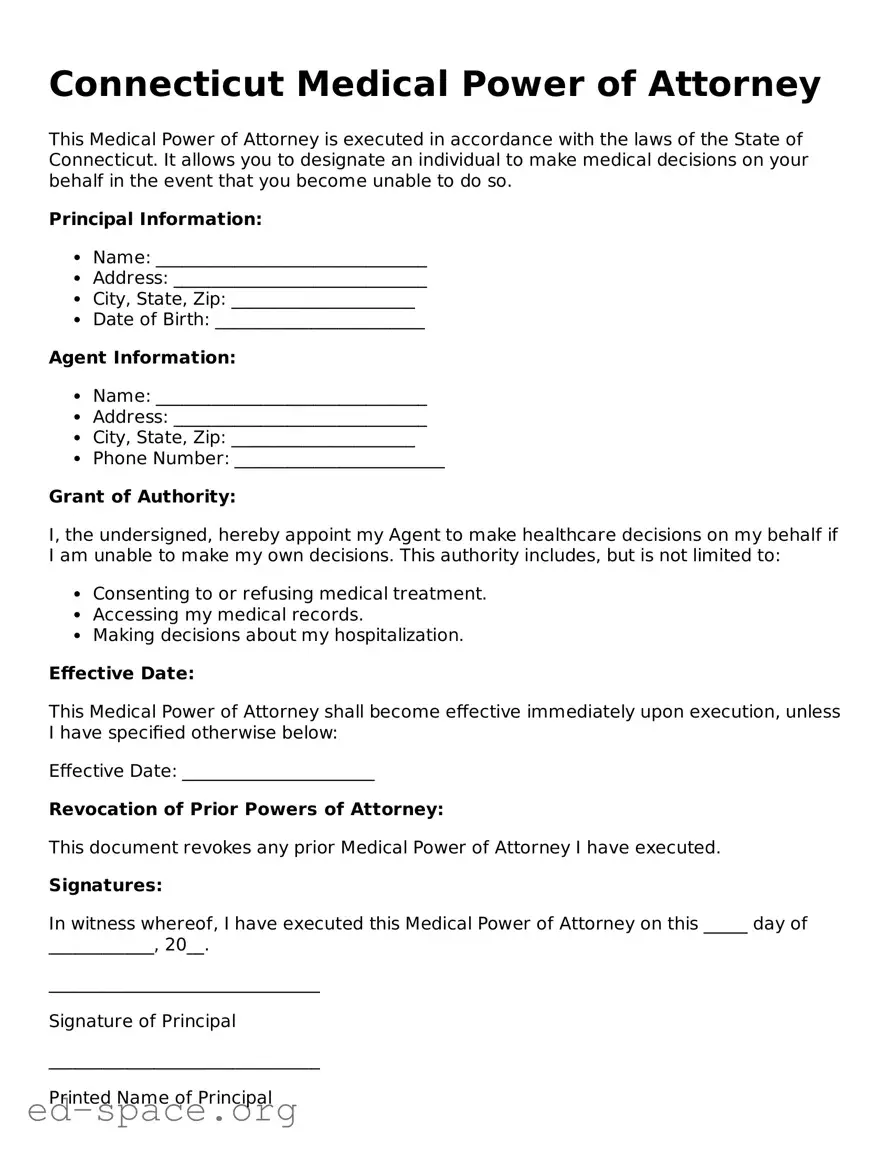
Connecticut Medical Power of Attorney
This Medical Power of Attorney is executed in accordance with the laws of the State of Connecticut. It allows you to designate an individual to make medical decisions on your behalf in the event that you become unable to do so.
Principal Information:
Agent Information:
Grant of Authority:
I, the undersigned, hereby appoint my Agent to make healthcare decisions on my behalf if I am unable to make my own decisions. This authority includes, but is not limited to:
Effective Date:
This Medical Power of Attorney shall become effective immediately upon execution, unless I have specified otherwise below:
Effective Date: ______________________
Revocation of Prior Powers of Attorney:
This document revokes any prior Medical Power of Attorney I have executed.
Signatures:
In witness whereof, I have executed this Medical Power of Attorney on this _____ day of ____________, 20__.
_______________________________
Signature of Principal
_______________________________
Printed Name of Principal
Witnesses:
Two witnesses are required. They must not be related to the Principal or the Agent.
Notary Public:
State of Connecticut, County of ______________
Subscribed and sworn to before me this _____ day of ____________, 20__.
_______________________________
Notary Public
My Commission Expires: ______________
| Fact Name | Description |
|---|---|
| Definition | The Connecticut Medical Power of Attorney form allows an individual to designate someone to make medical decisions on their behalf if they become unable to do so. |
| Governing Law | This form is governed by Connecticut General Statutes, specifically Section 1-56r. |
| Eligibility | Any competent adult can create a Medical Power of Attorney in Connecticut. |
| Agent Requirements | The appointed agent must be at least 18 years old and cannot be the individual's healthcare provider or an employee of the healthcare provider. |
| Signature Requirement | The form must be signed by the principal (the person granting authority) and witnessed by at least one person who is not the agent. |
| Revocation | The principal can revoke the Medical Power of Attorney at any time, as long as they are competent to do so. |
| Durability | This form remains effective even if the principal becomes incapacitated, unless revoked. |
Completing the Connecticut Medical Power of Attorney form is an important step in ensuring your healthcare decisions are made according to your wishes. This document allows you to designate a trusted individual to make medical decisions on your behalf if you become unable to do so. Follow the steps below to accurately fill out the form.
What is a Medical Power of Attorney in Connecticut?
A Medical Power of Attorney is a legal document that allows you to appoint someone you trust to make healthcare decisions on your behalf if you become unable to do so. This person, known as your agent or proxy, will have the authority to make medical decisions in line with your wishes and best interests.
Who can serve as my agent for the Medical Power of Attorney?
Your agent can be any adult you trust, such as a family member, friend, or trusted advisor. However, it is important to choose someone who understands your values and preferences regarding medical treatment. In Connecticut, your agent cannot be your healthcare provider or an employee of your healthcare provider, unless they are also a family member.
How do I create a Medical Power of Attorney in Connecticut?
To create a Medical Power of Attorney, you must complete a form that outlines your wishes and appoints your agent. This form must be signed by you and witnessed by at least one person. It is advisable to consult with a legal professional to ensure that your document meets all requirements and accurately reflects your intentions.
Can I change or revoke my Medical Power of Attorney?
Yes, you can change or revoke your Medical Power of Attorney at any time, as long as you are mentally competent. To revoke it, you should notify your agent and any healthcare providers who have a copy of the document. It is also a good idea to create a new Medical Power of Attorney if you wish to appoint a different agent or make changes to your wishes.
What happens if I do not have a Medical Power of Attorney?
If you do not have a Medical Power of Attorney and become unable to make your own medical decisions, your family members or friends may need to go through a legal process to obtain authority to make decisions for you. This can be time-consuming and may not reflect your personal wishes, which is why having a Medical Power of Attorney is so important.
Will my Medical Power of Attorney be valid in other states?
While a Medical Power of Attorney created in Connecticut is generally valid in other states, the laws can vary. It is advisable to check the specific requirements of the state where you may receive medical care. Some states may have their own forms or additional requirements, so it’s wise to consult with a legal expert if you travel frequently or reside in multiple states.
What types of decisions can my agent make?
Your agent can make a wide range of medical decisions on your behalf, including choices about treatment options, surgeries, and end-of-life care. They are expected to act in accordance with your wishes, which is why it is essential to communicate your preferences clearly with them. You can also specify any limitations on their authority in the Medical Power of Attorney document.
Is there a specific age requirement to create a Medical Power of Attorney?
In Connecticut, you must be at least 18 years old to create a Medical Power of Attorney. It is important that you are of sound mind and able to understand the nature and consequences of your decisions when you complete the document.
Can I include specific medical wishes in my Medical Power of Attorney?
Yes, you can include specific medical wishes in your Medical Power of Attorney. This may involve outlining your preferences for certain treatments, interventions, or end-of-life care. Clearly stating your wishes can help guide your agent in making decisions that align with your values and beliefs.
Not Choosing an Appropriate Agent: One of the most critical mistakes is failing to select a trustworthy and competent agent. This person will make medical decisions on your behalf, so it is essential to choose someone who understands your values and wishes.
Leaving Sections Blank: Some individuals mistakenly leave parts of the form incomplete. Omitting information can lead to confusion or misinterpretation when medical decisions need to be made.
Failing to Specify Preferences: It is vital to clearly outline your medical treatment preferences. Without specific instructions, your agent may not know your desires, potentially leading to decisions that do not align with your wishes.
Not Signing and Dating the Document: A common oversight is neglecting to sign and date the form. Without your signature, the document may not be considered valid, which could jeopardize your intended decisions.
Forgetting to Notify Your Agent: After completing the form, it is crucial to inform your chosen agent of their role. If they are unaware of their responsibilities, they may be unprepared to act when needed.
Not Reviewing Regularly: Life circumstances change, and so may your preferences. Failing to review and update your Medical Power of Attorney regularly can result in outdated decisions that no longer reflect your current wishes.
When creating a comprehensive healthcare plan, individuals often utilize various legal documents alongside the Connecticut Medical Power of Attorney form. Each of these documents serves a specific purpose, ensuring that healthcare decisions align with personal values and preferences. Below is a list of commonly used forms and documents that complement the Medical Power of Attorney.
Utilizing these documents in conjunction with the Connecticut Medical Power of Attorney can create a robust framework for managing healthcare decisions. By clearly outlining preferences and appointing trusted individuals, individuals can ensure that their medical care aligns with their values and wishes.
When filling out the Connecticut Medical Power of Attorney form, it is essential to approach the task with care and attention to detail. This document allows you to designate someone to make healthcare decisions on your behalf if you become unable to do so. Below are important considerations to keep in mind.
By following these guidelines, you can help ensure that your Medical Power of Attorney accurately reflects your wishes and is legally effective when needed.
Many people have misunderstandings about the Connecticut Medical Power of Attorney form. Here are seven common misconceptions and the facts that clarify them.
Misconception 1: A Medical Power of Attorney is only for the elderly.
This is not true. Anyone, regardless of age, can benefit from having a Medical Power of Attorney. Accidents or unexpected health issues can happen to anyone at any time.
Misconception 2: A Medical Power of Attorney can make financial decisions.
A Medical Power of Attorney specifically allows someone to make healthcare decisions on your behalf. For financial decisions, you would need a different document, such as a Financial Power of Attorney.
Misconception 3: You can only have one Medical Power of Attorney.
You can appoint multiple agents in your Medical Power of Attorney. However, it’s important to clarify their roles to avoid confusion during a medical crisis.
Misconception 4: The form must be notarized to be valid.
In Connecticut, a Medical Power of Attorney does not require notarization. It must be signed by you and two witnesses to be legally binding.
Misconception 5: You can’t change your Medical Power of Attorney once it’s created.
This is incorrect. You can revoke or update your Medical Power of Attorney at any time, as long as you are mentally competent to do so.
Misconception 6: A Medical Power of Attorney is only necessary if you are terminally ill.
Many people think this way, but a Medical Power of Attorney is important for anyone who wants to ensure their healthcare wishes are followed, regardless of their current health status.
Misconception 7: The agent can make any decision they want.
Your agent must act in your best interest and follow your wishes as outlined in the document. They cannot make decisions that go against your stated preferences.
Understanding these misconceptions can help you make informed decisions about your healthcare planning. It's always best to consult with a legal professional for personalized advice.
When considering a Medical Power of Attorney in Connecticut, it is important to understand the key aspects of the process. Here are five essential takeaways:
Being informed about these key points can help ensure that your Medical Power of Attorney is effective and aligns with your healthcare preferences.