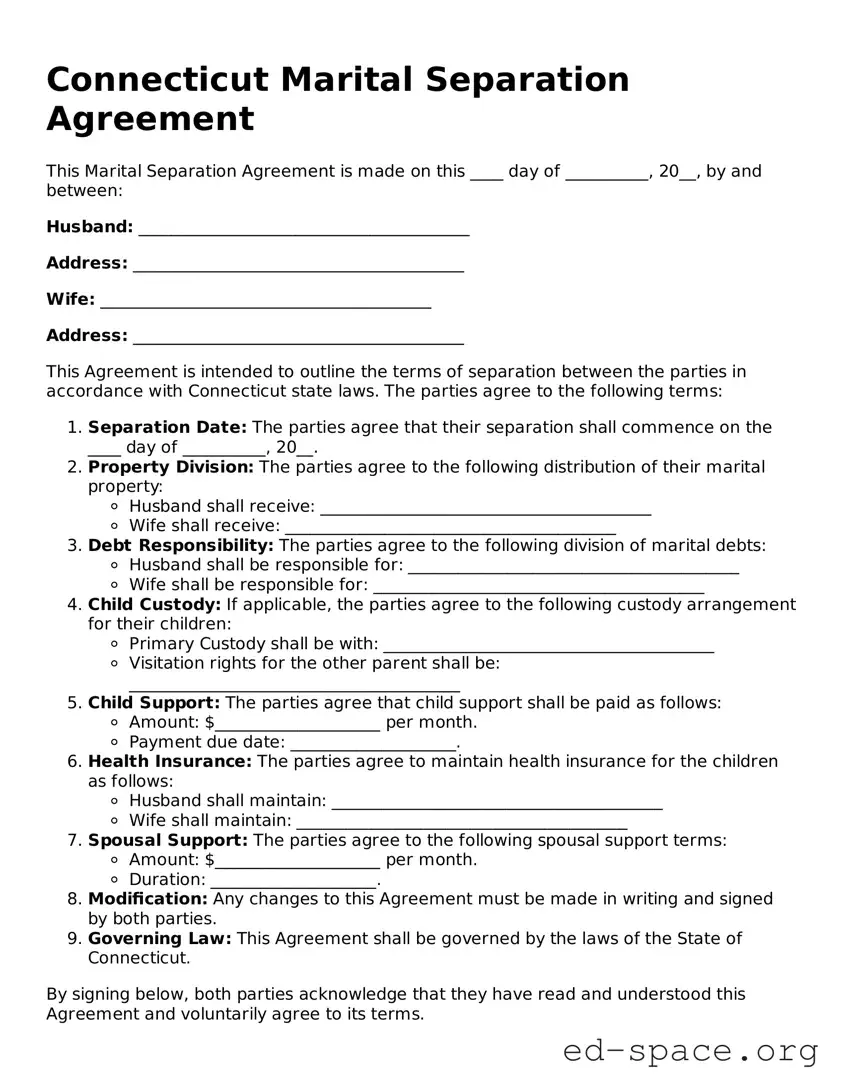
When couples in Connecticut decide to separate, a Marital Separation Agreement can play a crucial role in outlining the terms of their separation. This document serves as a legal contract that details how assets will be divided, child custody arrangements, and financial responsibilities, including spousal support and child support. It is essential for both parties to agree on these terms to avoid future disputes and ensure a smooth transition during this challenging time. The agreement can cover various aspects, such as the division of property, debt allocation, and visitation schedules, providing a clear framework for both partners. While the form itself may seem straightforward, the implications of the decisions made within it can be significant, making it vital for individuals to understand each component thoroughly. By carefully crafting this agreement, couples can establish a foundation for their post-separation lives, helping to minimize conflict and promote clarity as they move forward.
Connecticut Marital Separation Agreement
This Marital Separation Agreement is made on this ____ day of __________, 20__, by and between:
Husband: ________________________________________
Address: ________________________________________
Wife: ________________________________________
Address: ________________________________________
This Agreement is intended to outline the terms of separation between the parties in accordance with Connecticut state laws. The parties agree to the following terms:
By signing below, both parties acknowledge that they have read and understood this Agreement and voluntarily agree to its terms.
Husband's Signature: ____________________________ Date: ________________
Wife's Signature: ____________________________ Date: ________________
| Fact Name | Details |
|---|---|
| Definition | A Connecticut Marital Separation Agreement is a legal document that outlines the terms of separation between spouses. |
| Governing Law | This agreement is governed by Connecticut General Statutes, Section 46b-66. |
| Purpose | The agreement helps to clarify the rights and responsibilities of each spouse during separation. |
| Contents | It typically includes details on property division, child custody, and support obligations. |
| Mutual Agreement | Both parties must agree to the terms outlined in the document for it to be valid. |
| Not Mandatory | Filing a separation agreement is not a requirement for legal separation in Connecticut. |
| Enforceability | The agreement can be enforced in court if properly executed and signed by both parties. |
| Modification | Either party can request modifications to the agreement, but both must consent to any changes. |
| Legal Advice | It is advisable for both parties to seek legal counsel before signing the agreement. |
| Filing | While the agreement itself does not need to be filed with the court, it may be referenced in divorce proceedings. |
Once you have your Connecticut Marital Separation Agreement form ready, you’ll need to fill it out carefully. This form is essential for outlining the terms of your separation, ensuring that both parties are clear on their responsibilities and rights. Take your time to provide accurate information, as this will help avoid confusion later on.
What is a Connecticut Marital Separation Agreement?
A Connecticut Marital Separation Agreement is a legal document that outlines the terms and conditions under which a married couple agrees to live separately. It addresses various aspects of the separation, such as division of assets, child custody, support obligations, and other relevant matters. This agreement can serve as a foundation for future divorce proceedings, should the couple decide to go that route later on.
Do both parties need to agree to the terms of the separation agreement?
Yes, both parties must mutually agree to the terms laid out in the Marital Separation Agreement. It is crucial that both spouses are on the same page regarding the division of property, responsibilities towards children, and any financial arrangements. A lack of agreement can lead to disputes, making it essential to communicate openly and negotiate terms that work for both individuals.
Can the Marital Separation Agreement be modified after it is signed?
Absolutely. If circumstances change, either party can request modifications to the agreement. It’s important to document any changes in writing and have both parties sign the revised agreement. This ensures that everyone is aware of and agrees to the new terms, which can help prevent future conflicts.
Is a Marital Separation Agreement legally binding?
Yes, once signed by both parties, the Marital Separation Agreement is legally binding. However, it is advisable to consult with a legal professional before signing to ensure that the agreement complies with state laws and adequately protects both parties’ interests. Courts generally uphold these agreements, provided they are fair and entered into voluntarily.
What happens if one party does not comply with the agreement?
If one party fails to comply with the terms of the Marital Separation Agreement, the other party has the right to seek legal remedies. This may involve going to court to enforce the agreement. The court can compel compliance or modify the agreement if it finds that the terms are not being followed. It’s crucial to keep a record of any violations to present in court.
Do I need a lawyer to draft a Marital Separation Agreement?
While it is not legally required to have a lawyer draft a Marital Separation Agreement, it is highly recommended. A lawyer can help ensure that the agreement is comprehensive, fair, and legally sound. They can also provide guidance on state laws and any potential implications of the agreement. Having legal advice can help prevent misunderstandings and disputes down the line.
How long does it take to create a Marital Separation Agreement?
The time it takes to create a Marital Separation Agreement can vary significantly based on the complexity of the issues involved and the willingness of both parties to negotiate. Simple agreements may be drafted in a matter of days, while more complex situations involving significant assets or child custody arrangements might take weeks or longer. Open communication can expedite the process.
What should be included in a Marital Separation Agreement?
A comprehensive Marital Separation Agreement should include several key components. These typically encompass the division of marital property and debts, child custody arrangements, visitation schedules, child support obligations, and spousal support if applicable. It’s also wise to address how future decisions regarding children will be made and any provisions for health insurance or tax matters. Clarity in these areas can help minimize future conflicts.
Incomplete Information: Many individuals fail to provide all necessary details, such as full names, addresses, and relevant dates. This omission can lead to delays in processing the agreement.
Not Understanding Legal Terms: Some people do not fully grasp the legal implications of the terms they are agreeing to. This misunderstanding can result in unintended consequences down the line.
Failure to Address Financial Matters: A common mistake is neglecting to include comprehensive financial arrangements. This includes property division, spousal support, and debt responsibilities, which are crucial for a fair agreement.
Ignoring State Requirements: Each state has specific requirements for a valid separation agreement. Ignoring these can render the agreement invalid, causing further complications.
A Connecticut Marital Separation Agreement is an important document that outlines the terms of a couple's separation. However, it is often accompanied by other forms and documents that help clarify various aspects of the separation process. Below is a list of additional forms commonly used alongside the Marital Separation Agreement.
These documents play a vital role in the separation and divorce process, ensuring that all parties understand their rights and obligations. Utilizing these forms can help facilitate a smoother transition during what is often a challenging time.
When filling out the Connecticut Marital Separation Agreement form, it is essential to approach the process with care and attention to detail. Below are ten guidelines to consider, divided into what you should and shouldn't do.
When it comes to the Connecticut Marital Separation Agreement form, several misconceptions often arise. Understanding these can help individuals navigate the separation process more smoothly. Here are seven common misconceptions:
A marital separation agreement is not a divorce. It is a legal document that outlines the terms of separation, including asset division and child custody, but it does not terminate the marriage.
Many believe that a marital separation agreement is just a temporary arrangement. In reality, once signed, it is legally binding and enforceable in court.
While consulting a lawyer is advisable, individuals can create their own separation agreements. However, legal advice can ensure that the agreement is comprehensive and fair.
Some think that a marital separation agreement is only necessary for couples with children. In fact, it is beneficial for any couple looking to separate, regardless of whether children are involved.
Another common misconception is that once signed, the agreement cannot be changed. In truth, couples can modify the agreement if both parties agree to the changes.
A marital separation agreement does not cover all legal matters. For example, issues related to taxes or future financial obligations may still require separate legal attention.
Even if both parties agree on all terms, having a written agreement is crucial. It provides clarity and protection for both parties in the future.
By dispelling these misconceptions, individuals can better prepare for the separation process and ensure that their rights and interests are protected.
When filling out and using the Connecticut Marital Separation Agreement form, keep these key takeaways in mind: