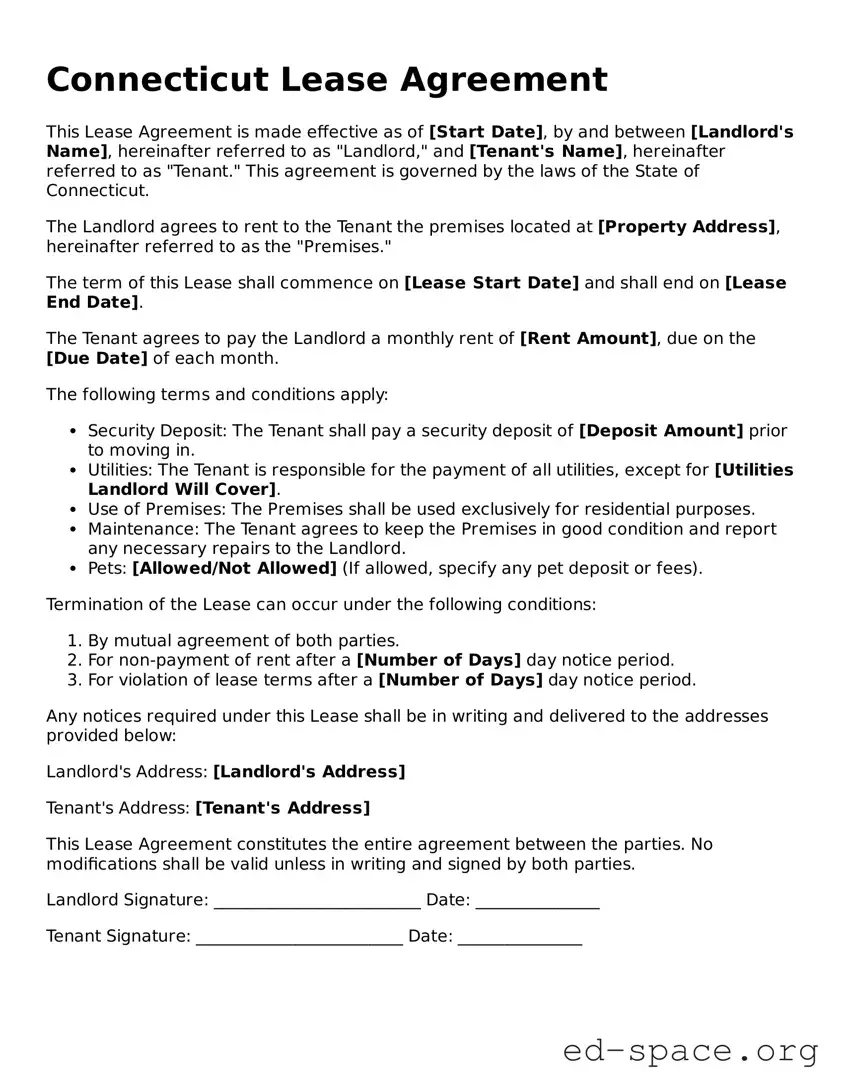
When entering into a rental agreement in Connecticut, understanding the Connecticut Lease Agreement form is essential for both landlords and tenants. This legally binding document outlines the rights and responsibilities of each party, ensuring a clear understanding of the terms of the lease. Key components of the form typically include the duration of the lease, rental payment details, and security deposit requirements. Additionally, the agreement addresses maintenance responsibilities, rules regarding pets, and procedures for terminating the lease. By carefully reviewing these aspects, both landlords and tenants can foster a positive rental experience, minimizing misunderstandings and disputes throughout the tenancy.
Connecticut Lease Agreement
This Lease Agreement is made effective as of [Start Date], by and between [Landlord's Name], hereinafter referred to as "Landlord," and [Tenant's Name], hereinafter referred to as "Tenant." This agreement is governed by the laws of the State of Connecticut.
The Landlord agrees to rent to the Tenant the premises located at [Property Address], hereinafter referred to as the "Premises."
The term of this Lease shall commence on [Lease Start Date] and shall end on [Lease End Date].
The Tenant agrees to pay the Landlord a monthly rent of [Rent Amount], due on the [Due Date] of each month.
The following terms and conditions apply:
Termination of the Lease can occur under the following conditions:
Any notices required under this Lease shall be in writing and delivered to the addresses provided below:
Landlord's Address: [Landlord's Address]
Tenant's Address: [Tenant's Address]
This Lease Agreement constitutes the entire agreement between the parties. No modifications shall be valid unless in writing and signed by both parties.
Landlord Signature: _________________________ Date: _______________
Tenant Signature: _________________________ Date: _______________
| Fact Name | Description |
|---|---|
| Governing Law | The Connecticut Lease Agreement is governed by the Connecticut General Statutes. |
| Parties Involved | The lease agreement typically involves a landlord and a tenant. |
| Duration | The lease can be for a fixed term or month-to-month, depending on the agreement. |
| Security Deposit | Landlords can require a security deposit, usually capped at two months' rent for unfurnished units. |
| Notice Requirements | Both parties must provide notice for termination or non-renewal, typically 30 days for month-to-month leases. |
| Maintenance Responsibilities | The lease should outline maintenance responsibilities for both the landlord and the tenant. |
| Disclosures | Landlords must provide specific disclosures, including lead paint information if the property was built before 1978. |
| Rent Payment | The agreement should specify the rent amount, payment method, and due date. |
| Pet Policy | The lease may include a pet policy, outlining any restrictions or additional fees. |
| Modifications | Any changes to the lease must be made in writing and agreed upon by both parties. |
Filling out the Connecticut Lease Agreement form is an important step in establishing a clear understanding between landlords and tenants. By completing this form accurately, both parties can ensure their rights and responsibilities are well-defined. Below are the steps to guide you through the process of filling out the form.
What is a Connecticut Lease Agreement form?
A Connecticut Lease Agreement form is a legally binding document that outlines the terms and conditions under which a landlord rents property to a tenant in the state of Connecticut. This form typically includes details such as the duration of the lease, rental amount, security deposit, and responsibilities of both parties. It serves to protect the rights of both the landlord and tenant, ensuring clarity and mutual understanding.
What essential elements should be included in the lease?
When drafting a Connecticut Lease Agreement, it is important to include several key elements. These include the names of the landlord and tenant, the rental property address, the lease term (fixed or month-to-month), the amount of rent and due date, security deposit requirements, maintenance responsibilities, and any rules or regulations specific to the property. Including these details helps prevent misunderstandings and disputes in the future.
Is a security deposit required in Connecticut?
Yes, a security deposit is commonly required in Connecticut. The law allows landlords to collect a security deposit, which typically cannot exceed two months’ rent for leases of one year or longer. For shorter leases, the maximum deposit is one month’s rent. This deposit serves as a financial safeguard for landlords against potential damages or unpaid rent. It must be returned to the tenant within a specified time frame after the lease ends, minus any lawful deductions.
Can a landlord enter the rental property without notice?
In Connecticut, landlords must provide reasonable notice before entering a tenant's rental property, except in emergencies. Typically, a 24-hour notice is considered reasonable. This requirement ensures that tenants have privacy and can prepare for the landlord's visit. However, landlords may enter without notice in urgent situations, such as a fire or significant water leak.
What happens if the lease is broken early?
If a tenant breaks a lease early, they may face financial penalties, such as forfeiting their security deposit or being responsible for rent until a new tenant is found. However, Connecticut law requires landlords to make reasonable efforts to re-rent the property. If the landlord successfully finds a new tenant, the original tenant may not be liable for the remaining rent. It is advisable to review the lease terms and discuss any potential consequences with the landlord.
Are there any specific laws regarding lease agreements in Connecticut?
Yes, Connecticut has specific laws that govern lease agreements. These laws address various aspects, including security deposits, tenant rights, and eviction processes. It is crucial for both landlords and tenants to be familiar with these laws to ensure compliance and protect their rights. Additionally, landlords must provide tenants with a written notice of their rights regarding security deposits and other essential information.
Can a lease agreement be modified after it has been signed?
Yes, a lease agreement can be modified after it has been signed, but both parties must agree to the changes. Any modifications should be documented in writing and signed by both the landlord and tenant to ensure clarity and enforceability. Verbal agreements may not be legally binding, so it is best to keep all changes in writing to avoid future disputes.
Omitting essential tenant information. It is crucial to provide complete and accurate details about all tenants. This includes full names, contact information, and any other relevant personal details. Incomplete information can lead to complications later.
Failing to specify the lease term. Clearly stating the duration of the lease is vital. Whether it is a month-to-month arrangement or a fixed-term lease, both parties need to understand the timeline to avoid misunderstandings.
Not addressing maintenance responsibilities. The lease should outline who is responsible for repairs and maintenance. Without this clarity, disputes may arise regarding who should handle issues like plumbing or electrical problems.
Ignoring the inclusion of rules and regulations. Every lease should contain a section that details the property rules. This may include pet policies, noise restrictions, and guidelines for common areas. Clear rules help maintain a harmonious living environment.
When entering into a lease agreement in Connecticut, several additional forms and documents may be necessary to ensure a clear understanding between landlords and tenants. These documents help outline responsibilities, rights, and other important details related to the rental property. Below is a list of commonly used forms that may accompany a Connecticut Lease Agreement.
These documents play a crucial role in the rental process, ensuring that both landlords and tenants have a clear understanding of their rights and responsibilities. It is advisable for both parties to review and retain copies of all relevant documents throughout the duration of the lease.
When filling out the Connecticut Lease Agreement form, there are several important guidelines to follow. Here’s a list of things you should and shouldn't do:
Understanding the Connecticut Lease Agreement form can be challenging. Many misconceptions surround it, which can lead to confusion for both landlords and tenants. Here are seven common misconceptions:
Many people believe that lease agreements are interchangeable. However, each lease can vary significantly based on the specific terms negotiated between the landlord and tenant.
While verbal agreements may hold some weight, they are often difficult to enforce. A written lease provides clarity and protection for both parties.
Some tenants assume that security deposits are automatically forfeited. In Connecticut, landlords must return the deposit or provide an itemized list of deductions after the lease ends.
This is a common misunderstanding. Landlords must provide reasonable notice before entering a tenant’s unit, except in emergencies.
While landlords are typically responsible for major repairs, tenants may be expected to handle minor issues or maintenance in some cases.
Breaking a lease can lead to financial penalties. Tenants should understand the terms of their lease and the potential repercussions of early termination.
In Connecticut, landlords must follow specific regulations regarding rent increases. Tenants should be aware of their rights regarding notice and timing.
By clearing up these misconceptions, both landlords and tenants can navigate the leasing process more effectively and avoid potential disputes.
When filling out and using the Connecticut Lease Agreement form, it is essential to understand several key aspects to ensure a smooth leasing experience. Here are some important takeaways:
By keeping these points in mind, both landlords and tenants can foster a positive rental relationship and minimize potential disputes.