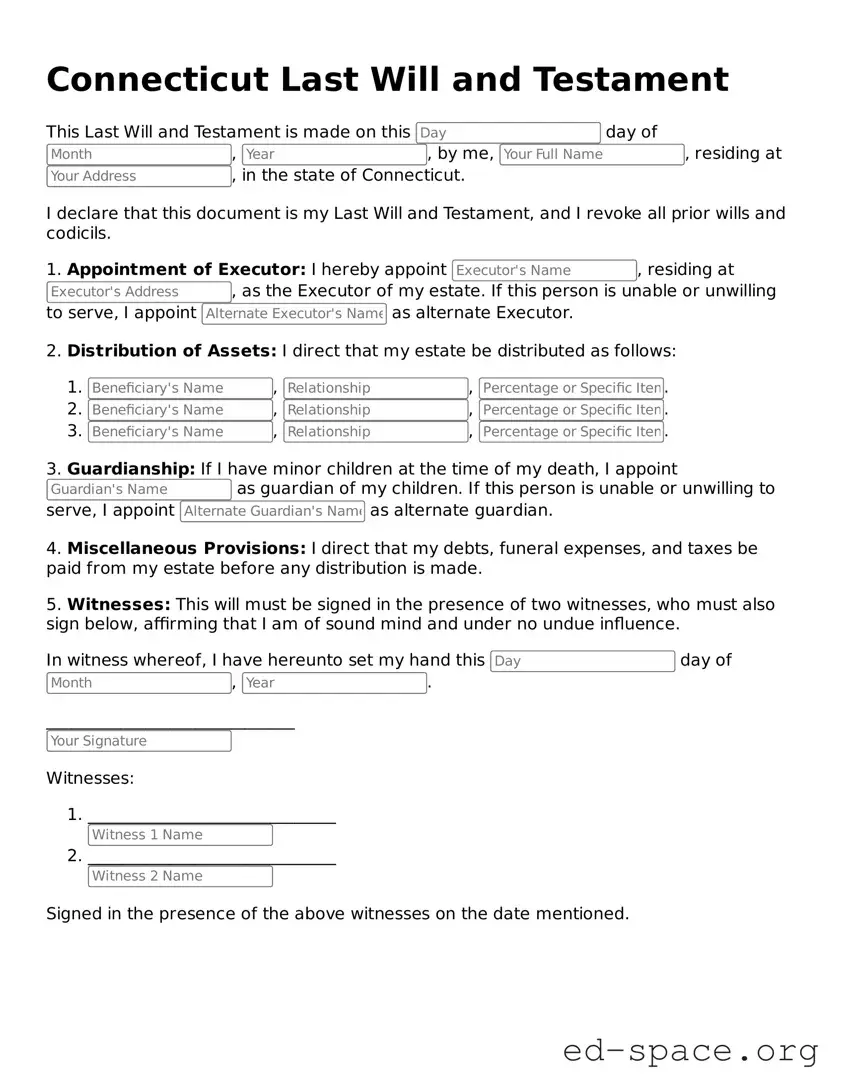
Creating a Last Will and Testament is a crucial step in ensuring that your wishes are honored after your passing. In Connecticut, this legal document serves as a guide for how your assets will be distributed and who will take care of any minor children you may have. The form outlines your intentions clearly, specifying beneficiaries and detailing how your property should be allocated. Additionally, it allows you to appoint an executor, a trusted individual responsible for carrying out the terms of your will. This document can also include provisions for guardianship, ensuring that your children are cared for by someone you trust. Understanding the components of the Connecticut Last Will and Testament form is essential for anyone looking to secure their legacy and provide peace of mind for their loved ones.
Connecticut Last Will and Testament
This Last Will and Testament is made on this day of , , by me, , residing at , in the state of Connecticut.
I declare that this document is my Last Will and Testament, and I revoke all prior wills and codicils.
1. Appointment of Executor: I hereby appoint , residing at , as the Executor of my estate. If this person is unable or unwilling to serve, I appoint as alternate Executor.
2. Distribution of Assets: I direct that my estate be distributed as follows:
3. Guardianship: If I have minor children at the time of my death, I appoint as guardian of my children. If this person is unable or unwilling to serve, I appoint as alternate guardian.
4. Miscellaneous Provisions: I direct that my debts, funeral expenses, and taxes be paid from my estate before any distribution is made.
5. Witnesses: This will must be signed in the presence of two witnesses, who must also sign below, affirming that I am of sound mind and under no undue influence.
In witness whereof, I have hereunto set my hand this day of , .
______________________________
Witnesses:
Signed in the presence of the above witnesses on the date mentioned.
| Fact Name | Description |
|---|---|
| Governing Law | The Connecticut Last Will and Testament is governed by Connecticut General Statutes, Chapter 802. |
| Age Requirement | To create a valid will in Connecticut, an individual must be at least 18 years old. |
| Signature Requirement | The testator (the person making the will) must sign the will at the end, or direct someone else to sign it in their presence. |
| Witnesses | Connecticut requires at least two witnesses to sign the will, who must be present at the same time. |
| Holographic Wills | Holographic wills (handwritten wills) are recognized in Connecticut if the signature and material provisions are in the handwriting of the testator. |
| Revocation | A will can be revoked in Connecticut by a subsequent will or by physically destroying the original document. |
| Probate Process | After death, the will must be submitted to probate court for validation and to initiate the distribution of assets. |
| No Limit on Executors | Connecticut does not impose a limit on the number of executors a testator can name in their will. |
Creating a Last Will and Testament is an important step in ensuring that your wishes are honored after you pass away. Once you have filled out the form, you’ll need to sign it in front of witnesses and take care of any additional requirements specific to Connecticut. Here’s how to fill out the form step-by-step.
What is a Last Will and Testament?
A Last Will and Testament is a legal document that outlines how a person's assets and affairs should be handled after their death. It allows individuals to specify who will inherit their property, appoint guardians for minor children, and designate an executor to manage the estate. Creating a will ensures that your wishes are respected and can help reduce disputes among family members.
Why is it important to have a Last Will and Testament in Connecticut?
Having a Last Will and Testament in Connecticut is crucial for several reasons. It provides clarity on your wishes regarding asset distribution, which can prevent confusion and conflicts among family members. Additionally, it allows you to appoint a trusted individual as your executor, ensuring that your estate is managed according to your preferences. Without a will, state laws will dictate how your assets are distributed, which may not align with your wishes.
Who can create a Last Will and Testament in Connecticut?
In Connecticut, any individual who is at least 18 years old and of sound mind can create a Last Will and Testament. This means you must understand the nature of the document and the consequences of your decisions. It’s important to take the time to think about your wishes and consult with trusted individuals if needed.
What are the requirements for a valid Last Will and Testament in Connecticut?
To be considered valid in Connecticut, a Last Will and Testament must be in writing and signed by the testator (the person making the will) in the presence of at least two witnesses. These witnesses must also sign the will. It's essential that the witnesses are not beneficiaries of the will to avoid any potential conflicts of interest. Additionally, the will should clearly express your intentions regarding your assets.
Can I make changes to my Last Will and Testament after it is created?
Yes, you can make changes to your Last Will and Testament at any time. This is often done through a document called a codicil, which allows you to add, modify, or revoke certain provisions of your original will. Alternatively, you may choose to create a new will altogether. Just ensure that any changes comply with the legal requirements for validity.
What happens if I die without a Last Will and Testament in Connecticut?
If you pass away without a will, your estate will be distributed according to Connecticut's intestacy laws. This means that the state will determine how your assets are divided among your relatives, which may not reflect your wishes. Additionally, this process can be more complicated and time-consuming for your loved ones. Having a will helps to avoid these issues and provides peace of mind.
Can I include specific bequests in my Last Will and Testament?
Yes, you can include specific bequests in your will. This means you can designate particular items or amounts of money to specific individuals or organizations. For example, you might leave your jewelry to a daughter or a specific sum of money to a charitable organization. Clearly outlining these bequests helps ensure that your wishes are honored.
How can I ensure my Last Will and Testament is executed properly?
To ensure that your Last Will and Testament is executed properly, it is advisable to consult with a legal professional who specializes in estate planning. They can guide you through the process, ensuring that all legal requirements are met. Additionally, keeping your will in a safe place and informing your executor of its location can help facilitate the process after your passing.
Is it necessary to have a lawyer to create a Last Will and Testament in Connecticut?
While it is not legally required to have a lawyer to create a Last Will and Testament in Connecticut, seeking legal advice can be beneficial. A lawyer can help you navigate complex situations, ensure that your will complies with state laws, and address any specific concerns you may have. This can provide peace of mind, knowing that your will is properly prepared.
How often should I review my Last Will and Testament?
It is a good practice to review your Last Will and Testament regularly, especially after significant life events such as marriage, divorce, the birth of a child, or the death of a beneficiary. Changes in your financial situation or changes in your relationships may also warrant a review. Regularly updating your will ensures that it accurately reflects your current wishes and circumstances.
Not clearly identifying the testator. It is essential to include the full legal name and address of the person creating the will.
Failing to sign the document. A will must be signed by the testator to be valid. Without a signature, the will may be considered invalid.
Not having witnesses. Connecticut law requires that a will be signed in the presence of at least two witnesses. Omitting this step can lead to complications.
Using outdated forms. Laws change, and using an old version of the form may result in errors or invalid provisions.
Leaving out specific bequests. Failing to clearly state who receives specific items or assets can lead to disputes among heirs.
Not considering contingencies. It is important to plan for scenarios where beneficiaries predecease the testator or cannot inherit for other reasons.
Failing to update the will. Major life changes, such as marriage, divorce, or the birth of children, may necessitate revisions to the will.
Not including a residuary clause. This clause addresses any assets not specifically mentioned in the will, preventing them from being distributed according to state law.
Overlooking the importance of legal advice. Consulting with an attorney can help ensure that the will meets all legal requirements and reflects the testator's wishes accurately.
When creating a Last Will and Testament in Connecticut, several other documents may be necessary to ensure that your wishes are carried out effectively. These documents can help clarify your intentions, manage your estate, and provide guidance for your loved ones.
These documents can play a crucial role in estate planning. They help clarify your wishes and provide a clear framework for your loved ones to follow. Consider consulting with a professional to ensure that all necessary documents are in place and accurately reflect your intentions.
The Last Will and Testament is an important legal document that outlines how a person's assets will be distributed after their death. Several other documents serve similar purposes or complement the functions of a will. Here are six documents that share similarities with a Last Will and Testament:
When filling out the Connecticut Last Will and Testament form, it is essential to approach the task with care. Here are four important guidelines to follow.
Following these guidelines will help ensure that your Last Will and Testament reflects your wishes accurately and effectively.
When it comes to creating a Last Will and Testament in Connecticut, many people hold misconceptions that can lead to confusion or mistakes. Here are ten common misunderstandings:
Understanding these misconceptions can help you navigate the process of creating a Last Will and Testament more effectively. Clarity in your intentions can make a significant difference for your loved ones.
Filling out a Last Will and Testament form in Connecticut is a crucial step in ensuring your wishes are honored after your passing. Here are some key takeaways to keep in mind:
Taking the time to carefully fill out and use your Last Will and Testament can provide peace of mind for you and your loved ones. Don't delay in getting your affairs in order.