Homeschooling in Connecticut offers families the flexibility to tailor education to their children's unique needs. A crucial step in this process is submitting a Homeschool Letter of Intent. This form serves as a formal notification to the local school district of a family's decision to homeschool. It typically includes essential information such as the names and ages of the children being homeschooled, the address of the residence, and the educational program or curriculum being used. By completing and submitting this letter, parents not only comply with state regulations but also establish a clear record of their intent to provide an alternative education. Understanding the requirements and implications of this form can help ensure a smooth transition into homeschooling, allowing families to focus on creating enriching learning experiences for their children.
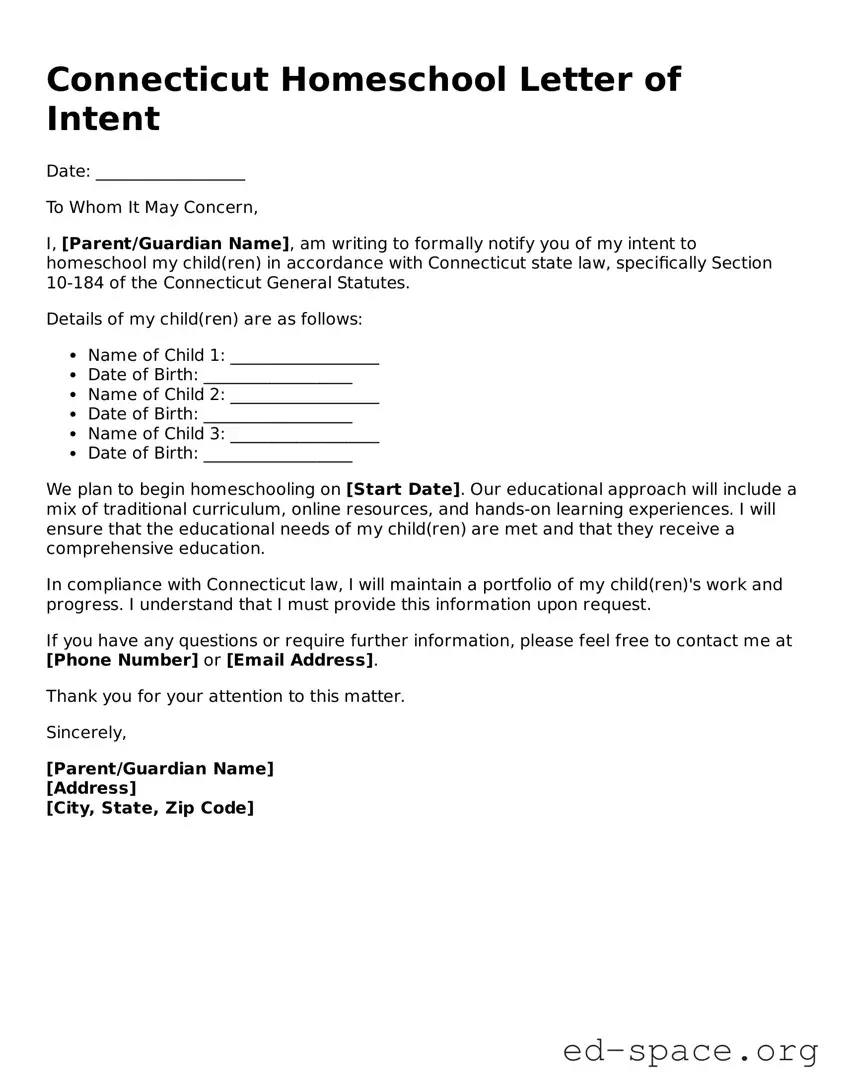
Connecticut Homeschool Letter of Intent
Date: __________________
To Whom It May Concern,
I, [Parent/Guardian Name], am writing to formally notify you of my intent to homeschool my child(ren) in accordance with Connecticut state law, specifically Section 10-184 of the Connecticut General Statutes.
Details of my child(ren) are as follows:
We plan to begin homeschooling on [Start Date]. Our educational approach will include a mix of traditional curriculum, online resources, and hands-on learning experiences. I will ensure that the educational needs of my child(ren) are met and that they receive a comprehensive education.
In compliance with Connecticut law, I will maintain a portfolio of my child(ren)'s work and progress. I understand that I must provide this information upon request.
If you have any questions or require further information, please feel free to contact me at [Phone Number] or [Email Address].
Thank you for your attention to this matter.
Sincerely,
[Parent/Guardian Name]
[Address]
[City, State, Zip Code]
| Fact Name | Details |
|---|---|
| Governing Law | The Connecticut homeschool letter of intent is governed by Connecticut General Statutes §10-184 and §10-220. |
| Purpose | The letter of intent serves as a formal notification to the local school district that a parent intends to homeschool their child. |
| Submission Timeline | Parents must submit the letter of intent to the local school district at least 30 days before the start of homeschooling. |
| Required Information | The letter must include the child's name, age, and address, along with the name of the parent or guardian. |
| Annual Requirement | Parents are required to submit a new letter of intent each year to continue homeschooling. |
| Record Keeping | While not required to submit a curriculum, parents should keep records of educational activities and progress. |
| Notification of Withdrawal | If a child is currently enrolled in public school, parents must notify the school of the intent to withdraw before submitting the letter. |
| Local District Variations | Some local school districts may have additional requirements or forms, so it is advisable to check with the district. |
Once you have the Connecticut Homeschool Letter of Intent form ready, you will need to fill it out accurately to ensure compliance with state requirements. Follow these steps carefully to complete the form.
After completing the form, make a copy for your records. Then, submit the original to your local school district to formally notify them of your intent to homeschool.
What is the Connecticut Homeschool Letter of Intent?
The Connecticut Homeschool Letter of Intent is a formal document that parents or guardians must submit to their local school district to notify them of their intention to homeschool their children. This letter serves as a declaration that the parent or guardian has chosen to provide education at home rather than through a traditional school setting.
Who needs to submit the Letter of Intent?
Any parent or guardian who wishes to homeschool their child in Connecticut must submit this letter. It is required for children who are between the ages of five and eighteen, which is the compulsory education age in the state.
When should the Letter of Intent be submitted?
The Letter of Intent should be submitted at the beginning of the homeschooling period. If you are withdrawing your child from a public or private school to begin homeschooling, it's best to submit the letter as soon as possible to ensure compliance with state laws.
What information is required in the Letter of Intent?
The Letter of Intent typically needs to include the names and addresses of the children being homeschooled, the names of the parents or guardians, and a statement of intent to provide home education. Some districts may request additional information, so it’s wise to check with your local school district for specific requirements.
Is there a specific format for the Letter of Intent?
While there is no mandated format for the Letter of Intent, it should be clear and concise. A simple letter format that includes all necessary information will usually suffice. Some parents choose to use templates available online, but personalizing the letter is always a good practice.
What happens after submitting the Letter of Intent?
Once the Letter of Intent is submitted, the local school district may acknowledge receipt of the letter. However, they do not have the authority to approve or deny your homeschooling plans. You are free to begin your homeschooling journey as long as you comply with state education laws.
Are there any follow-up requirements after submitting the Letter of Intent?
Connecticut law does not require ongoing reporting to the school district after the Letter of Intent is submitted. However, parents should keep records of their homeschooling activities and curriculum, as they may be beneficial for future educational assessments or if questions arise.
What if I change my mind about homeschooling?
If you decide to return your child to a traditional school after submitting the Letter of Intent, you should notify your local school district. This ensures that they are aware of your child’s educational status and can assist with the re-enrollment process.
When filling out the Connecticut Homeschool Letter of Intent form, families may encounter several common mistakes. These errors can lead to delays or complications in the homeschooling process. Below is a list of four frequent mistakes:
Incomplete Information: One of the most common errors is failing to provide all required details. Ensure that names, addresses, and contact information are fully filled out. Missing even a small piece of information can cause issues.
Incorrect Dates: Sometimes, individuals mistakenly write the wrong dates for the school year. Double-check the start and end dates to ensure they align with your educational plans.
Not Signing the Form: It may seem trivial, but forgetting to sign the form is a frequent oversight. A signature is necessary to validate the document, so always remember to sign and date it before submission.
Failure to Submit on Time: Some families overlook the deadline for submitting the form. Be aware of the specific timeline required by Connecticut law to avoid any potential issues with your homeschooling status.
By being mindful of these common mistakes, families can ensure a smoother process when submitting their Homeschool Letter of Intent in Connecticut.
When families decide to homeschool in Connecticut, several documents and forms may accompany the Homeschool Letter of Intent. These forms help ensure compliance with state regulations and provide necessary information about the homeschooling process. Below are some commonly used documents.
These documents support the homeschooling process and help maintain a structured educational environment. By preparing them, families can ensure a smoother transition into homeschooling and stay organized throughout the academic year.
Notice of Intent to Homeschool: This document is often the first step in the homeschooling process. It informs the local school district of a parent's decision to educate their child at home. Like the Homeschool Letter of Intent, it serves as a formal declaration of intent.
Curriculum Plan: A curriculum plan outlines the educational materials and methods a parent will use. Similar to the Homeschool Letter of Intent, it provides clarity and structure to the homeschooling approach.
Educational Assessment Report: This report evaluates a child's progress and learning outcomes. Much like the Homeschool Letter of Intent, it documents the educational journey and ensures accountability.
Withdrawal Notice: When a child is removed from a public or private school, a withdrawal notice is often required. This document is similar in that it formally communicates a change in the child's educational status.
Annual Progress Review: This document summarizes a child's academic progress over the year. It shares a purpose with the Homeschool Letter of Intent by keeping records and demonstrating educational growth.
When filling out the Connecticut Homeschool Letter of Intent form, it is essential to approach the process with care and attention to detail. Below is a list of things you should and shouldn't do to ensure that your submission is complete and accurate.
By following these guidelines, you can help facilitate a smooth process for your homeschooling journey in Connecticut.
Homeschooling in Connecticut can be a rewarding experience for families, but there are several misconceptions surrounding the Homeschool Letter of Intent form that can create confusion. Here are five common misunderstandings:
Many people believe that the Homeschool Letter of Intent is filled with legal jargon and complex requirements. In reality, the form is straightforward and designed to be user-friendly. It simply requires basic information about the student and the educational plan.
Some families think they need to file a new Letter of Intent each year. However, once you submit the letter, it remains valid as long as you continue homeschooling. You only need to resubmit if there are significant changes, such as moving to a different town.
People often worry that they must provide an extensive curriculum plan when submitting the Letter of Intent. While you should have a general idea of your educational approach, the form does not require a detailed breakdown of every subject or lesson.
There is a fear that filing the Homeschool Letter of Intent opens the door to state oversight or frequent evaluations. This is not the case. The submission is primarily for notification purposes, and parents maintain control over their homeschooling process.
Some believe that once they submit their Letter of Intent, they are locked into a specific educational plan. In fact, families are free to adjust their approach as needed. Flexibility is a key advantage of homeschooling.
Understanding these misconceptions can help families navigate the homeschooling process in Connecticut with greater confidence and clarity.
Filling out the Connecticut Homeschool Letter of Intent form is an important step for families choosing to homeschool their children. Here are some key takeaways to keep in mind:
By following these guidelines, families can ensure a smooth start to their homeschooling journey in Connecticut.