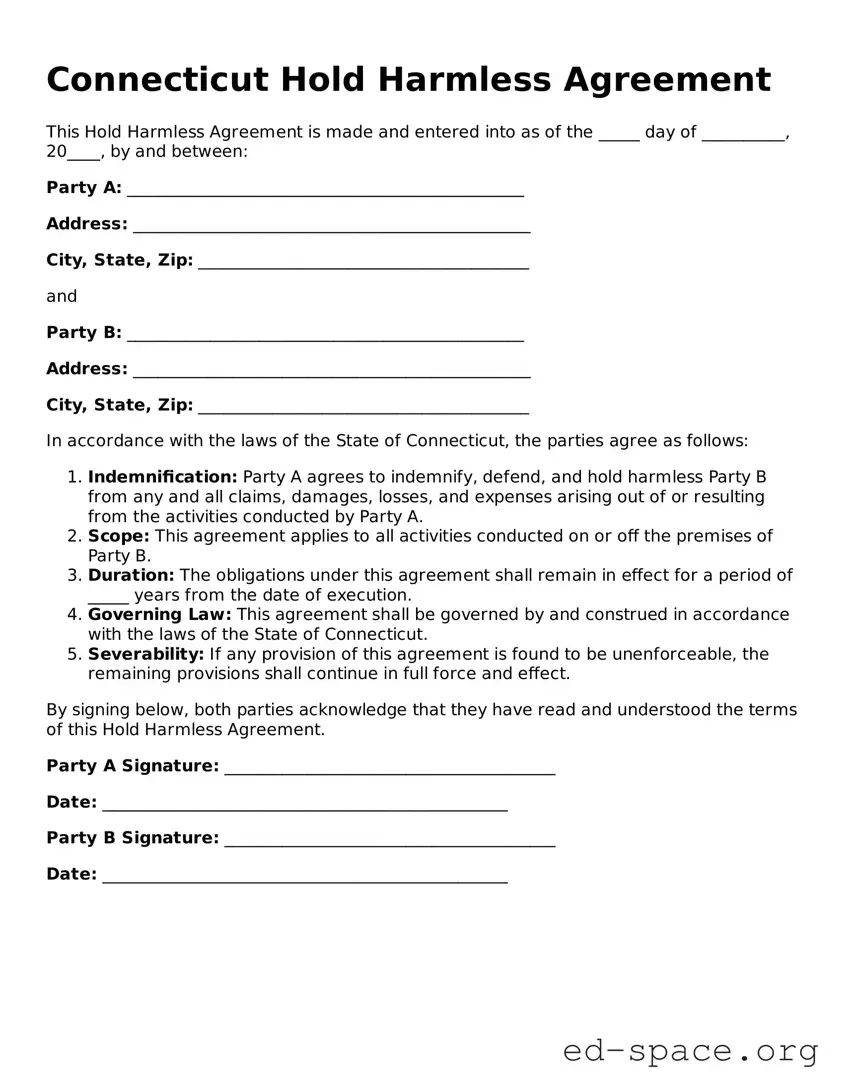
The Connecticut Hold Harmless Agreement form serves as a vital legal document designed to protect individuals and organizations from liability in various situations. This agreement outlines the responsibilities of the parties involved, ensuring that one party agrees to assume the risks associated with certain activities or events. By signing this form, individuals can safeguard themselves against potential claims or damages that may arise during the course of their engagement. The document typically includes essential details such as the names of the parties, a description of the activity or event, and any specific conditions or limitations that may apply. Additionally, it emphasizes the importance of understanding the risks involved, promoting transparency and informed consent. As a result, this agreement plays a crucial role in fostering trust and cooperation among participants while minimizing legal exposure for all parties involved.
Connecticut Hold Harmless Agreement
This Hold Harmless Agreement is made and entered into as of the _____ day of __________, 20____, by and between:
Party A: ________________________________________________
Address: ________________________________________________
City, State, Zip: ________________________________________
and
Party B: ________________________________________________
Address: ________________________________________________
City, State, Zip: ________________________________________
In accordance with the laws of the State of Connecticut, the parties agree as follows:
By signing below, both parties acknowledge that they have read and understood the terms of this Hold Harmless Agreement.
Party A Signature: ________________________________________
Date: _________________________________________________
Party B Signature: ________________________________________
Date: _________________________________________________
| Fact Name | Description |
|---|---|
| Definition | A Hold Harmless Agreement is a legal document where one party agrees not to hold another party liable for any damages or losses. |
| Purpose | This agreement is commonly used to protect individuals and organizations from legal claims arising from specific activities or events. |
| Governing Law | In Connecticut, these agreements are governed by state contract law. |
| Enforceability | Hold Harmless Agreements are generally enforceable in Connecticut, provided they are clear and unambiguous. |
| Mutual vs. Unilateral | Agreements can be mutual, where both parties agree to hold each other harmless, or unilateral, where only one party assumes the risk. |
| Common Uses | These agreements are often used in construction contracts, rental agreements, and event planning. |
| Limitations | They cannot protect against gross negligence or willful misconduct in Connecticut. |
| Requirement of Consideration | For the agreement to be valid, there must be consideration, meaning something of value must be exchanged. |
| Legal Advice | It is advisable to seek legal counsel before signing a Hold Harmless Agreement to ensure it meets your needs. |
| State-Specific Language | Connecticut may require specific language to be included for the agreement to be enforceable, depending on the context. |
Filling out the Connecticut Hold Harmless Agreement form is an important step in ensuring that all parties involved understand their responsibilities and liabilities. After completing the form, you will need to submit it to the appropriate party or authority as required.
What is a Hold Harmless Agreement in Connecticut?
A Hold Harmless Agreement is a legal document that protects one party from liability for any injuries or damages that may occur during an event or activity. In Connecticut, this agreement is often used in various situations, such as when renting facilities, hosting events, or engaging in activities that could pose risks. By signing this agreement, one party agrees not to hold the other responsible for certain claims, thereby providing a level of security and peace of mind.
Who typically uses a Hold Harmless Agreement?
Hold Harmless Agreements are commonly used by businesses, organizations, and individuals who are hosting events or providing services. For example, a gym might require members to sign this agreement before participating in a class, or a venue might ask event organizers to sign it before renting out the space. It’s a way to ensure that everyone understands the risks involved and agrees to assume responsibility for any potential issues that arise.
What should be included in a Hold Harmless Agreement?
A comprehensive Hold Harmless Agreement should clearly outline the parties involved, the specific activities covered, and the extent of the liability being waived. It’s essential to include language that specifies the risks associated with the activity and any limitations on liability. Additionally, it’s a good practice to have both parties sign and date the agreement to ensure mutual understanding and consent.
Is a Hold Harmless Agreement enforceable in Connecticut?
Yes, Hold Harmless Agreements can be enforceable in Connecticut, provided they are drafted properly. Courts generally uphold these agreements as long as they are clear, specific, and not against public policy. However, there are limits. For instance, a Hold Harmless Agreement cannot protect a party from gross negligence or intentional misconduct. It’s always wise to consult with a legal professional to ensure that the agreement meets all legal requirements and adequately protects your interests.
Failing to include all necessary parties: When completing the Hold Harmless Agreement, it is crucial to list all individuals or entities involved. Omitting a party can lead to confusion and potential legal issues.
Not specifying the scope of the agreement: Clarity is key. The agreement should clearly outline what activities or situations are covered to avoid misunderstandings later.
Using vague language: Ambiguous terms can create loopholes. It is important to use precise language to ensure that all parties understand their responsibilities.
Neglecting to date the agreement: A date provides context and validity. Without a date, it may be unclear when the agreement takes effect.
Forgetting signatures: All parties must sign the agreement for it to be enforceable. Missing signatures can invalidate the document.
Not reviewing the agreement before submission: A final review can catch errors or omissions. Taking the time to read through the document can prevent future issues.
Ignoring local laws and regulations: Understanding the specific legal context in Connecticut is essential. Failing to consider local laws may render the agreement ineffective.
Assuming all forms are the same: Each Hold Harmless Agreement may have unique requirements. Relying on a generic template can lead to mistakes.
Overlooking the importance of witnesses: Some agreements may require witnesses to be legally binding. Not including witnesses when necessary can weaken the agreement.
Not keeping copies of the signed agreement: Retaining a copy for personal records is essential. This ensures that all parties have access to the terms agreed upon.
When entering into agreements, especially in contexts like real estate, construction, or event planning, various forms and documents can complement a Connecticut Hold Harmless Agreement. Each of these documents serves a specific purpose, ensuring that all parties understand their rights and responsibilities. Below is a list of commonly used forms that often accompany the Hold Harmless Agreement.
Understanding these documents can help ensure that all parties are protected and aware of their obligations. By utilizing the appropriate forms alongside the Connecticut Hold Harmless Agreement, individuals and organizations can mitigate risks and foster clearer communication in their agreements.
When filling out the Connecticut Hold Harmless Agreement form, it's important to approach the task with care. Here are some essential dos and don’ts to keep in mind:
By following these guidelines, you can help ensure that your Hold Harmless Agreement is filled out correctly and serves its intended purpose effectively.
Misconceptions about the Connecticut Hold Harmless Agreement form can lead to confusion and misinterpretation of its purpose and implications. Here are six common misconceptions:
Understanding these misconceptions can help individuals and businesses navigate the complexities of Hold Harmless Agreements more effectively.
When considering the Connecticut Hold Harmless Agreement form, there are several important points to keep in mind. This agreement serves to protect one party from legal liability for certain actions or events. Understanding its use and implications can help ensure that all parties are aware of their responsibilities.