In Connecticut, the General Power of Attorney form serves as a vital legal instrument that empowers individuals to designate someone they trust to manage their financial and legal affairs. This document becomes particularly significant when an individual is unable to make decisions due to illness, disability, or absence. By completing this form, the principal— the person granting authority— can specify the extent of the agent’s powers, which may include handling banking transactions, managing real estate, or making investment decisions. Importantly, the General Power of Attorney can be tailored to meet specific needs, allowing for broad or limited authority. It is also crucial to note that this form can be effective immediately or can be set to activate upon a certain event, such as the principal's incapacitation. Understanding the nuances of this form is essential for both the principal and the agent, as it establishes a legal framework that governs their relationship and the responsibilities involved. As individuals navigate the complexities of life, having a General Power of Attorney in place can provide peace of mind, ensuring that one's affairs are managed according to their wishes when they are unable to do so themselves.
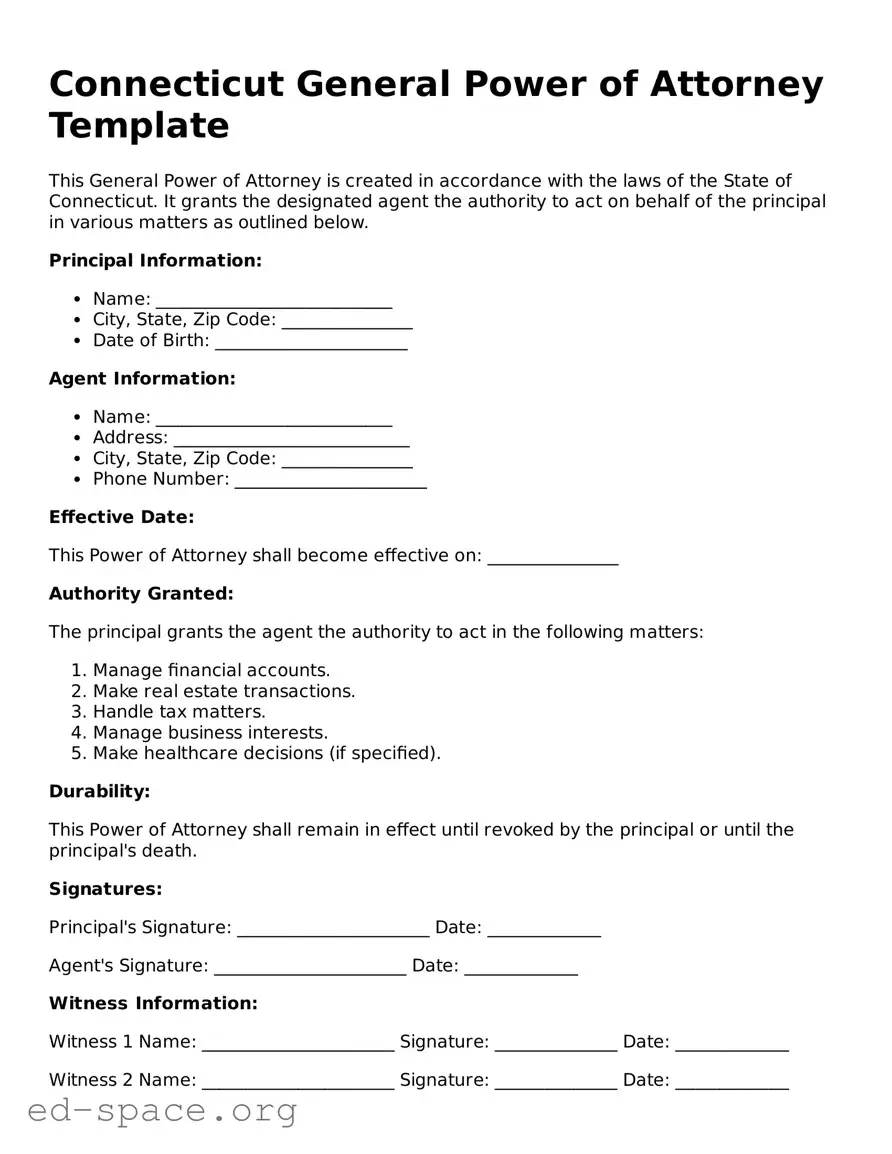
Connecticut General Power of Attorney Template
This General Power of Attorney is created in accordance with the laws of the State of Connecticut. It grants the designated agent the authority to act on behalf of the principal in various matters as outlined below.
Principal Information:
Agent Information:
Effective Date:
This Power of Attorney shall become effective on: _______________
Authority Granted:
The principal grants the agent the authority to act in the following matters:
Durability:
This Power of Attorney shall remain in effect until revoked by the principal or until the principal's death.
Signatures:
Principal's Signature: ______________________ Date: _____________
Agent's Signature: ______________________ Date: _____________
Witness Information:
Witness 1 Name: ______________________ Signature: ______________ Date: _____________
Witness 2 Name: ______________________ Signature: ______________ Date: _____________
Notary Public:
State of Connecticut, County of ________________
On this ____ day of ___________, 20__, before me, a Notary Public, personally appeared ______________________, known to me (or satisfactorily proven) to be the person whose name is subscribed to this instrument, and acknowledged that he/she executed the same for the purposes therein contained.
Notary Public Signature: ______________________
My Commission Expires: ______________________
| Fact Name | Details |
|---|---|
| Definition | The Connecticut General Power of Attorney form allows one person to grant another person the authority to act on their behalf in financial matters. |
| Governing Law | This form is governed by Connecticut General Statutes Section 1-42. |
| Durability | A General Power of Attorney can be durable, meaning it remains effective even if the principal becomes incapacitated. |
| Agent's Authority | The appointed agent can perform a wide range of financial transactions, including managing bank accounts and real estate. |
| Revocation | The principal can revoke the Power of Attorney at any time, as long as they are mentally competent. |
| Witness Requirement | The form must be signed in the presence of a notary public or two witnesses to be valid. |
| Limitations | Some actions, like making a will or changing beneficiaries, cannot be authorized through this form. |
| Expiration | The General Power of Attorney does not have a built-in expiration date unless specified by the principal. |
| Use Cases | This form is commonly used for managing finances during travel or in cases of temporary incapacity. |
| Legal Advice | It is advisable to consult with a legal professional when drafting or executing a Power of Attorney to ensure it meets specific needs. |
Completing the Connecticut General Power of Attorney form is essential for designating someone to manage your financial affairs. After filling out the form, ensure that it is signed and dated appropriately to make it legally binding.
What is a General Power of Attorney in Connecticut?
A General Power of Attorney (POA) in Connecticut is a legal document that allows one person, known as the principal, to grant another person, called the agent or attorney-in-fact, the authority to make decisions and act on their behalf. This can include managing financial matters, handling real estate transactions, and making legal decisions. The powers granted can be broad or limited, depending on the principal's preferences.
Who can serve as an agent under a General Power of Attorney?
Any competent adult can serve as an agent under a General Power of Attorney in Connecticut. This includes family members, friends, or professionals such as attorneys or financial advisors. It's important to choose someone trustworthy, as the agent will have significant control over the principal's affairs.
How is a General Power of Attorney created in Connecticut?
To create a General Power of Attorney in Connecticut, the principal must complete a written document that specifies the powers being granted. The document must be signed by the principal in the presence of a notary public. While witnesses are not required, having them can provide additional validation. It is advisable to keep the document in a safe place and provide copies to the agent and any relevant institutions.
Can a General Power of Attorney be revoked?
Yes, a General Power of Attorney can be revoked at any time by the principal, as long as they are mentally competent. To revoke the document, the principal should create a written revocation notice and notify the agent and any institutions that have a copy of the original POA. It is recommended to formally destroy the original document to prevent any confusion.
What happens if the principal becomes incapacitated?
If the principal becomes incapacitated, a General Power of Attorney typically remains in effect unless it was specifically stated to terminate upon such an event. However, for more comprehensive protection, individuals may consider a Durable Power of Attorney, which explicitly remains valid even if the principal becomes incapacitated. This ensures that the agent can continue to act on behalf of the principal during their inability to make decisions.
Is it necessary to have a lawyer to create a General Power of Attorney?
While it is not legally required to have a lawyer to create a General Power of Attorney in Connecticut, consulting with one is highly recommended. A legal professional can provide guidance on the specific powers to include, ensure that the document complies with state laws, and help address any potential concerns or complexities related to the principal's situation.
Not specifying the powers granted. It's crucial to clearly outline the specific powers you wish to give to your agent. Leaving this section vague can lead to misunderstandings.
Failing to date the form. A date provides context for when the document was created and can impact its validity. Always include the date when you fill out the form.
Not signing the document in the presence of a witness. Connecticut law requires that the General Power of Attorney be signed in front of a witness to be valid.
Neglecting to have the document notarized. While not always required, notarization adds an extra layer of authenticity and can help prevent disputes later on.
Choosing an unreliable agent. Selecting someone who is not trustworthy or lacks the ability to handle your affairs can lead to complications. Choose your agent carefully.
Overlooking the need for alternate agents. Life is unpredictable. Designating an alternate agent ensures that your wishes can still be honored if your primary agent is unable to serve.
Ignoring state-specific requirements. Each state has its own laws regarding power of attorney forms. Make sure you are familiar with Connecticut's specific requirements to avoid invalidating your document.
Not reviewing the document regularly. Life circumstances change, and so do your needs. Regularly reviewing and updating your General Power of Attorney ensures it remains aligned with your current wishes.
A General Power of Attorney (POA) is a significant document that allows an individual, known as the principal, to appoint someone else, called the agent, to make decisions on their behalf. While this form is essential for managing financial and legal matters, there are several other documents that may be used in conjunction with it to ensure comprehensive planning and protection. Below is a list of related forms and documents that are often utilized alongside the Connecticut General Power of Attorney form.
In summary, while the Connecticut General Power of Attorney form is a vital tool for delegating authority, it is often accompanied by other important documents that enhance decision-making and ensure that an individual's wishes are respected. Careful consideration of these forms can provide peace of mind and clarity in various situations.
When filling out the Connecticut General Power of Attorney form, it's important to keep a few things in mind. Here are some do's and don'ts to help you through the process.
Do:
Don't:
When it comes to the Connecticut General Power of Attorney form, there are several misconceptions that can lead to confusion. Understanding the facts can help individuals make informed decisions. Here are five common misconceptions:
Many people believe that a power of attorney only activates in the event of incapacitation. However, in Connecticut, you can create a durable power of attorney that remains effective even if you become incapacitated. Alternatively, a non-durable power of attorney only remains valid while you are capable of making decisions.
While your agent does have broad authority, there are limitations. For example, they cannot make decisions about your medical care unless explicitly granted that power. It's crucial to specify the powers you wish to grant in the document.
This is not true. You can revoke or change your power of attorney at any time, as long as you are mentally competent. It’s advisable to inform your agent and any institutions involved when you make changes.
These are two distinct legal documents. A power of attorney allows someone to manage your affairs while you are alive, whereas a will dictates how your assets will be distributed after your death. Understanding the differences is essential for proper estate planning.
Family members do not have the authority to act for you unless you have granted them that power through a power of attorney. Without the proper documentation, they may face legal hurdles in managing your affairs.
By dispelling these misconceptions, individuals can better navigate the complexities of the Connecticut General Power of Attorney form and ensure their wishes are respected.
When considering the Connecticut General Power of Attorney form, it’s essential to understand its implications and requirements. Here are some key takeaways to keep in mind: