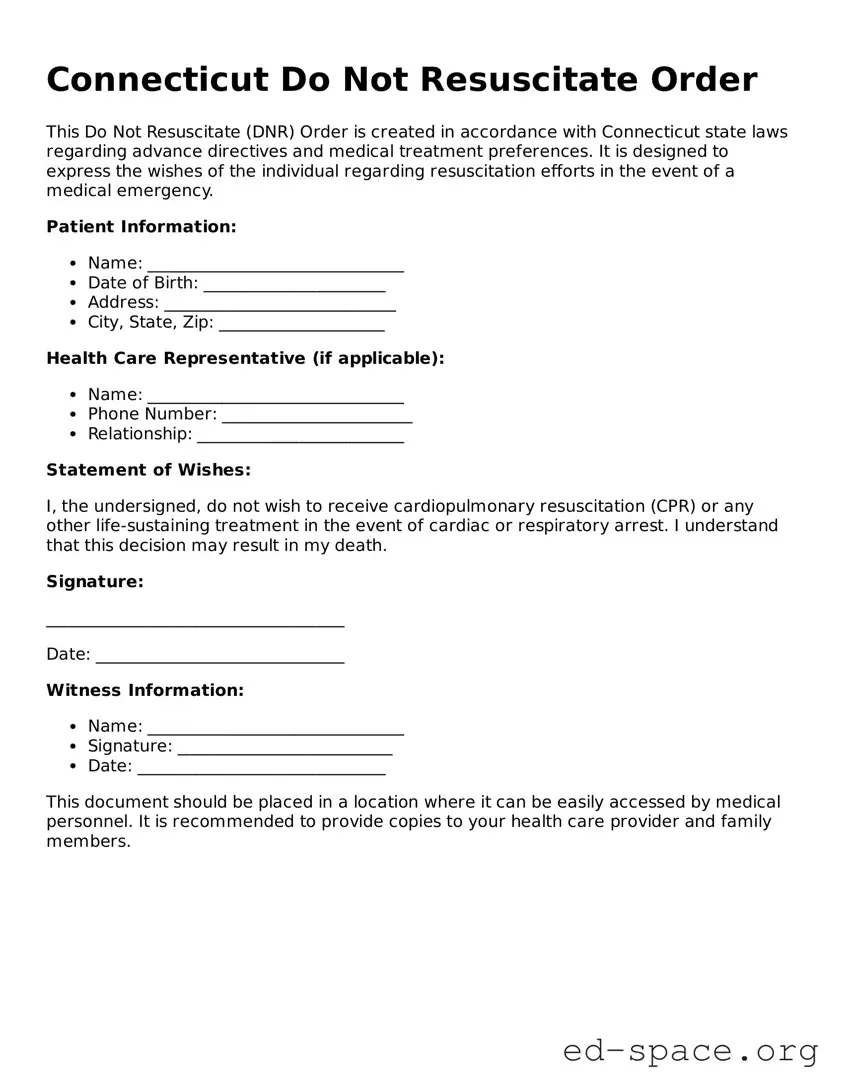
The Connecticut Do Not Resuscitate (DNR) Order form is a crucial document designed to honor an individual's wishes regarding medical treatment in the event of a life-threatening emergency. This form allows patients, or their authorized representatives, to communicate their desire not to receive cardiopulmonary resuscitation (CPR) or other life-sustaining measures when their heart stops or they stop breathing. It is important to understand that the DNR Order is not a declaration of intent to end life; rather, it is a means to ensure that medical interventions align with a person’s values and preferences. The form must be completed and signed by a physician, providing a clear directive for emergency medical personnel. Additionally, the DNR Order should be readily accessible, often kept in a visible location or carried by the patient, so that first responders can act according to the patient's wishes without delay. Understanding the implications of this form is essential for individuals and families as they navigate end-of-life decisions, ensuring that their choices are respected in critical moments.
Connecticut Do Not Resuscitate Order
This Do Not Resuscitate (DNR) Order is created in accordance with Connecticut state laws regarding advance directives and medical treatment preferences. It is designed to express the wishes of the individual regarding resuscitation efforts in the event of a medical emergency.
Patient Information:
Health Care Representative (if applicable):
Statement of Wishes:
I, the undersigned, do not wish to receive cardiopulmonary resuscitation (CPR) or any other life-sustaining treatment in the event of cardiac or respiratory arrest. I understand that this decision may result in my death.
Signature:
____________________________________
Date: ______________________________
Witness Information:
This document should be placed in a location where it can be easily accessed by medical personnel. It is recommended to provide copies to your health care provider and family members.
| Fact Name | Details |
|---|---|
| Governing Law | The Connecticut Do Not Resuscitate Order is governed by Connecticut General Statutes § 19a-575. |
| Eligibility | The form can be completed by a patient who is at least 18 years old and has the capacity to make medical decisions. |
| Signature Requirements | The form must be signed by the patient and a physician to be valid. |
| Effectiveness | Once completed, the order must be presented to healthcare providers to ensure it is honored during medical emergencies. |
Completing the Connecticut Do Not Resuscitate Order form is an important step in expressing your healthcare preferences. After filling out the form, it is essential to ensure that it is properly signed and shared with your healthcare providers to ensure your wishes are honored.
What is a Do Not Resuscitate (DNR) Order in Connecticut?
A Do Not Resuscitate Order is a legal document that allows a person to refuse resuscitation efforts in the event of a cardiac arrest or respiratory failure. In Connecticut, this order ensures that medical personnel do not perform CPR or other life-saving measures if the individual has specified their wishes in advance. It is a critical component of end-of-life planning, allowing individuals to maintain control over their medical care.
Who can complete a DNR Order in Connecticut?
In Connecticut, a DNR Order can be completed by an adult who is capable of making their own medical decisions. This includes individuals who are at least 18 years old and have the mental capacity to understand the implications of their choices. Additionally, a physician must sign the order to validate it. Family members or legal representatives cannot complete the form on behalf of someone else unless they have been granted specific legal authority.
How is a DNR Order created and documented?
To create a DNR Order in Connecticut, individuals must fill out the official DNR form, which is available through various healthcare providers and online resources. The form requires personal information, the individual’s wishes regarding resuscitation, and the signature of a physician. Once completed, it should be kept in an accessible location, such as with other important medical documents, and shared with family members and healthcare providers to ensure everyone is aware of the individual’s wishes.
Is a DNR Order valid in all healthcare settings?
Yes, a properly completed DNR Order is valid across all healthcare settings in Connecticut, including hospitals, nursing homes, and emergency medical services. However, it is crucial that the order is readily available and easily identifiable. Medical personnel must be able to access and review the DNR Order quickly in emergency situations to honor the individual’s wishes effectively.
Can a DNR Order be revoked or changed?
Absolutely. An individual has the right to revoke or change their DNR Order at any time. This can be done verbally or in writing, and it is essential to communicate any changes to healthcare providers and family members. If a person decides to revoke their DNR Order, they should ensure that any previous copies of the order are destroyed to prevent confusion during medical emergencies.
What if a person does not have a DNR Order?
If an individual does not have a DNR Order in place, healthcare providers are legally obligated to perform resuscitation efforts if the person experiences cardiac arrest or respiratory failure. This can lead to unwanted medical interventions, which may not align with the individual’s wishes. Therefore, it is advisable for individuals to discuss their preferences with family members and healthcare providers and consider creating a DNR Order if they wish to refuse resuscitation.
How does a DNR Order differ from an Advance Directive?
A DNR Order is specifically focused on resuscitation efforts, while an Advance Directive is a broader legal document that outlines a person’s overall healthcare preferences, including decisions about medical treatments, life support, and end-of-life care. While a DNR Order can be part of an Advance Directive, the two documents serve different purposes. It is essential for individuals to understand both and consider having both in place to ensure their healthcare wishes are honored.
Where can I find more information about DNR Orders in Connecticut?
For more information about DNR Orders in Connecticut, individuals can visit the Connecticut Department of Public Health website or consult with healthcare providers. Additionally, local hospitals and hospice organizations often provide resources and guidance on creating and understanding DNR Orders. It is vital to be informed and proactive in making healthcare decisions that align with personal values and wishes.
Failing to provide accurate personal information. It is crucial to ensure that the patient's name, date of birth, and other identifying details are correct. Inaccuracies can lead to complications during medical emergencies.
Not obtaining the necessary signatures. The form must be signed by both the patient (or their legally authorized representative) and a physician. Without these signatures, the order may not be valid.
Leaving sections of the form blank. All relevant sections should be completed to avoid ambiguity. Incomplete forms can create confusion for medical personnel during critical moments.
Not discussing the order with healthcare providers. It is important to have conversations with doctors and family members about the implications of a Do Not Resuscitate Order. This ensures that everyone understands the patient's wishes.
Using outdated forms. Always use the most current version of the Do Not Resuscitate Order form. Regulations and requirements may change, and using an outdated form can render the order invalid.
Failing to review and update the order as needed. A Do Not Resuscitate Order should be revisited periodically. Changes in health status or personal preferences may necessitate updates to the order.
In Connecticut, the Do Not Resuscitate (DNR) Order form is an important document that allows individuals to express their wishes regarding resuscitation efforts in the event of a medical emergency. However, there are several other forms and documents that often accompany the DNR Order to ensure that a person's healthcare preferences are clearly communicated and respected. Below are some of these essential documents.
Each of these documents plays a crucial role in ensuring that healthcare providers and loved ones understand and respect an individual's wishes regarding medical treatment. By having these forms in place, individuals can have greater peace of mind knowing their preferences will be honored in times of medical crisis.
A Do Not Resuscitate (DNR) Order is an important document that outlines a person's wishes regarding medical treatment in the event of a life-threatening situation. Several other documents serve similar purposes in terms of expressing healthcare preferences. Here are four documents that are comparable to a DNR Order:
When filling out the Connecticut Do Not Resuscitate Order form, it is crucial to approach the process with care. Here are six important dos and don'ts to keep in mind:
Understanding the Connecticut Do Not Resuscitate (DNR) Order form is crucial for both patients and their families. However, several misconceptions exist that can lead to confusion. Here are five common misunderstandings:
This is not true. A DNR order specifically addresses resuscitation efforts in the event of cardiac arrest. Patients with a DNR can still receive other forms of medical care, including medications, comfort measures, and treatments that do not involve resuscitation.
This misconception overlooks the fact that a DNR can be appropriate for anyone who wishes to avoid resuscitation in the event of cardiac arrest, regardless of their overall health status. The decision is personal and can be made for various reasons.
In reality, a DNR order can be revoked or modified at any time. Patients or their authorized representatives can communicate their wishes to healthcare providers, and adjustments can be made as circumstances change.
While healthcare providers respect DNR orders, there are exceptions. For instance, if a patient is in a hospital and their condition improves, medical teams may take action to stabilize the patient, even if a DNR is in place.
This is a common misunderstanding. A living will outlines a person's wishes regarding various medical treatments and end-of-life care, while a DNR specifically addresses resuscitation efforts. Both documents serve different purposes and can complement each other.
Clarifying these misconceptions can help individuals make informed decisions about their healthcare preferences and ensure that their wishes are respected. Always consult with a healthcare provider or legal advisor for personalized guidance.
When considering the Connecticut Do Not Resuscitate Order (DNR) form, it is essential to understand its purpose and how to use it effectively. Here are some key takeaways: