In Connecticut, the deed form plays a crucial role in the transfer of real estate ownership. This document serves as a legal instrument that outlines the specifics of the property being conveyed, including its description, the names of the parties involved, and any conditions that may apply to the transfer. It is essential for the grantor, the person transferring the property, to clearly state their intentions and ensure that all necessary information is accurately presented. The grantee, the individual receiving the property, must also be properly identified to avoid any future disputes. Various types of deeds exist in Connecticut, including warranty deeds and quitclaim deeds, each serving different purposes and providing varying levels of protection for the parties involved. Proper execution and recording of the deed with the local town clerk are vital steps that secure the legal transfer and protect the rights of the new owner. Understanding these key aspects can help individuals navigate the process of property transfer with confidence and clarity.
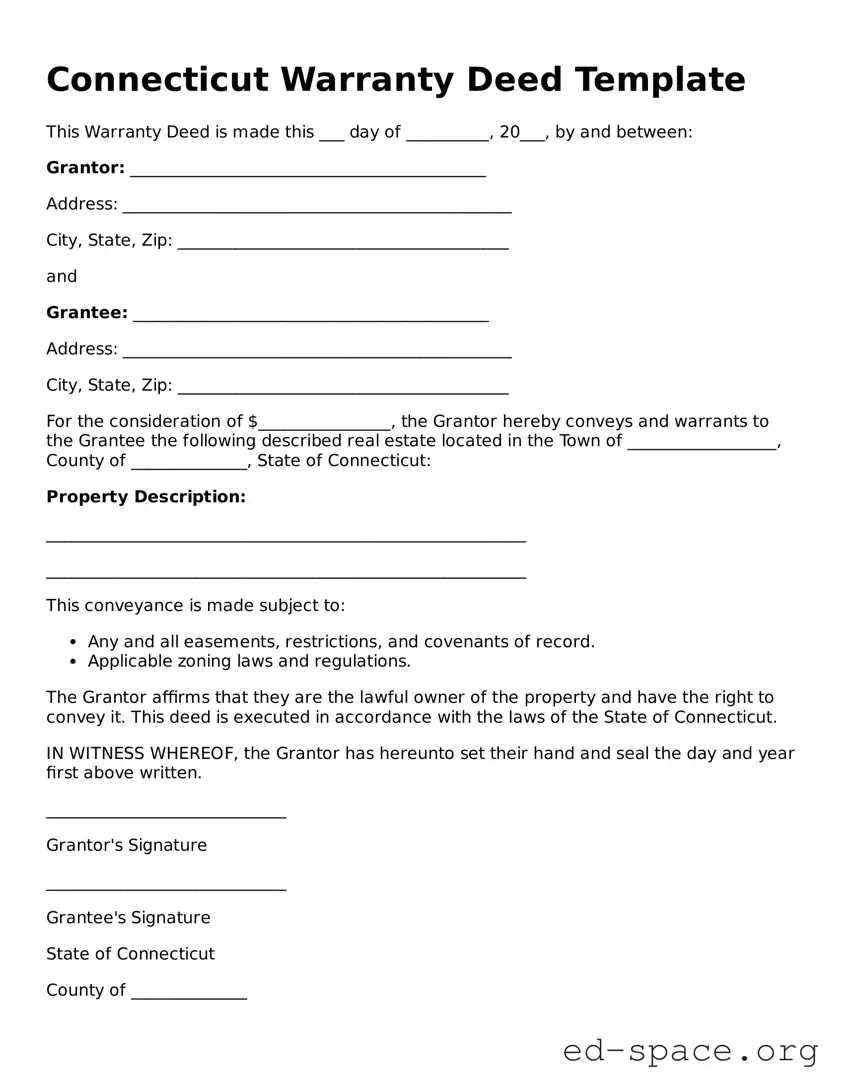
Connecticut Warranty Deed Template
This Warranty Deed is made this ___ day of __________, 20___, by and between:
Grantor: ___________________________________________
Address: _______________________________________________
City, State, Zip: ________________________________________
and
Grantee: ___________________________________________
Address: _______________________________________________
City, State, Zip: ________________________________________
For the consideration of $________________, the Grantor hereby conveys and warrants to the Grantee the following described real estate located in the Town of __________________, County of ______________, State of Connecticut:
Property Description:
__________________________________________________________
__________________________________________________________
This conveyance is made subject to:
The Grantor affirms that they are the lawful owner of the property and have the right to convey it. This deed is executed in accordance with the laws of the State of Connecticut.
IN WITNESS WHEREOF, the Grantor has hereunto set their hand and seal the day and year first above written.
_____________________________
Grantor's Signature
_____________________________
Grantee's Signature
State of Connecticut
County of ______________
On this ___ day of __________, 20___, before me, a Notary Public, personally appeared __________________________________, known to me (or satisfactorily proven) to be the person whose name is subscribed to this instrument, and acknowledged that they executed the same for the purposes therein contained.
In witness whereof, I hereunto set my hand and official seal.
_____________________________
Notary Public
My Commission Expires: _______________
| Fact Name | Description |
|---|---|
| Governing Law | The Connecticut Deed form is governed by the Connecticut General Statutes, specifically Title 47, which pertains to property and conveyances. |
| Types of Deeds | Connecticut recognizes several types of deeds, including Warranty Deeds, Quitclaim Deeds, and Bargain and Sale Deeds, each serving different purposes in property transfer. |
| Recording Requirements | To ensure legal validity, the deed must be recorded in the town clerk’s office where the property is located. This protects the interests of the parties involved. |
| Signature Requirement | The deed must be signed by the grantor (the person transferring the property) and acknowledged by a notary public to be legally effective. |
Once you have the Connecticut Deed form ready, it’s important to fill it out accurately. This document will need to be signed and submitted to the appropriate local authority. Follow these steps to ensure you complete the form correctly.
What is a Connecticut Deed form?
A Connecticut Deed form is a legal document used to transfer ownership of real estate from one party to another in the state of Connecticut. It serves as proof of the transaction and outlines the details of the property being transferred, including the names of the buyer and seller, the property description, and any conditions of the transfer.
What types of Deeds are available in Connecticut?
In Connecticut, there are several types of deeds, including Warranty Deeds, Quitclaim Deeds, and Special Warranty Deeds. A Warranty Deed provides the highest level of protection to the buyer, guaranteeing that the seller holds clear title to the property. A Quitclaim Deed transfers whatever interest the seller has in the property without any guarantees. A Special Warranty Deed offers some protections but is limited to the seller's period of ownership.
How do I fill out a Connecticut Deed form?
To fill out a Connecticut Deed form, you need to provide specific information, such as the names of the grantor (seller) and grantee (buyer), a legal description of the property, and the consideration (price) for the transfer. It's important to ensure that all information is accurate and complete. If you are unsure about any part of the process, consulting with a real estate attorney can be helpful.
Do I need to notarize the Connecticut Deed form?
Yes, the Connecticut Deed form must be notarized. Both the grantor and the grantee should sign the deed in the presence of a notary public. The notary will then verify the identities of the signers and affix their seal, which is necessary for the deed to be legally valid.
Where do I file the Connecticut Deed form?
After completing and notarizing the Connecticut Deed form, it must be filed with the town clerk's office in the town where the property is located. Filing the deed ensures that the transfer of ownership is officially recorded and protects the rights of the new owner.
Is there a fee to file the Connecticut Deed form?
Yes, there is typically a fee associated with filing a Connecticut Deed form. The fee varies by town and may depend on the value of the property being transferred. It is advisable to check with the local town clerk’s office for specific fee amounts and payment methods.
What happens after I file the Connecticut Deed form?
Once the Connecticut Deed form is filed, the town clerk will record the deed in the land records. This process officially updates the ownership of the property in public records. The new owner should receive a copy of the recorded deed, which serves as proof of ownership.
Can I create my own Connecticut Deed form?
While it is possible to create your own Connecticut Deed form, it is highly recommended to use a standard form or consult with a legal professional. Real estate transactions can be complex, and using a properly drafted deed can help avoid potential issues in the future.
Filling out a Connecticut Deed form can be a straightforward process, but mistakes can lead to delays or complications. Here are four common errors people often make:
Incorrect Property Description: One of the most critical parts of the deed is accurately describing the property. Failing to include the correct address, lot number, or boundaries can create confusion and may invalidate the deed.
Missing Signatures: All parties involved in the transaction must sign the deed. Forgetting to obtain a signature from one of the owners or failing to have the signatures notarized can result in the deed being rejected.
Improper Notarization: Notaries play a vital role in the deed process. If the notarization is not done correctly—such as not using the proper notary seal or failing to complete the notary acknowledgment—this can lead to legal issues down the line.
Omitting the Date: The date of the transaction is essential. Leaving this field blank or incorrectly dating the deed can cause problems when trying to establish a timeline for ownership.
By being aware of these common mistakes, you can help ensure that your deed is filled out correctly, making the process smoother and more efficient.
When transferring property in Connecticut, several forms and documents complement the Deed form. Each of these plays a crucial role in ensuring a smooth transaction and protecting the interests of all parties involved.
Understanding these documents can significantly enhance your real estate transaction experience. Each form serves a specific purpose, and together, they help ensure a clear and legally sound transfer of property ownership.
The Deed form shares similarities with several other legal documents. Each of these documents serves a specific purpose but often overlaps in function or intent. Here’s a list of documents that are similar to the Deed form:
When filling out the Connecticut Deed form, it is important to follow certain guidelines to ensure accuracy and compliance. Here are five things you should and shouldn't do:
Understanding the Connecticut Deed form is essential for anyone involved in real estate transactions in the state. However, several misconceptions can lead to confusion. Here are seven common misconceptions:
Many people believe that all deeds serve the same purpose. In reality, there are different types of deeds, such as warranty deeds and quitclaim deeds, each with its own legal implications and protections.
While notarization adds a layer of authenticity, not all deeds require notarization to be legally valid in Connecticut. However, having a deed notarized can help prevent disputes.
This is not true. A deed can be amended or revoked, but the process must follow specific legal procedures to ensure that the changes are valid.
While recording a deed is highly recommended to protect ownership rights, it is not legally required in Connecticut. However, failure to record can lead to complications if disputes arise.
Many believe that only individuals can transfer property through deeds. In fact, entities such as corporations and trusts can also hold and transfer property using deeds.
Fees associated with deed transactions can vary based on multiple factors, including the value of the property and local regulations. It is important to check specific requirements for each transaction.
This misconception overlooks the possibility of legal challenges. Deeds can be contested in court under certain circumstances, such as claims of fraud or lack of capacity of the signer.
Being aware of these misconceptions can help individuals navigate the complexities of real estate transactions in Connecticut more effectively.
When filling out and using the Connecticut Deed form, it is important to keep several key points in mind. The following takeaways can help ensure the process is completed correctly and efficiently.