When starting a business in Connecticut, one of the essential steps is completing the Articles of Incorporation form. This document serves as the foundation for your corporation, outlining key information that defines your business structure and purpose. It typically includes the corporation's name, which must be unique and compliant with state regulations, as well as the principal office address. Additionally, the form requires the designation of a registered agent, who will serve as the official point of contact for legal documents. You will also need to specify the number of shares the corporation is authorized to issue and the par value of those shares, if applicable. Understanding these components is crucial, as they not only establish the legal identity of your corporation but also play a significant role in your business operations and compliance with state laws. By carefully completing the Articles of Incorporation, you set the stage for your corporation’s growth and success in Connecticut.
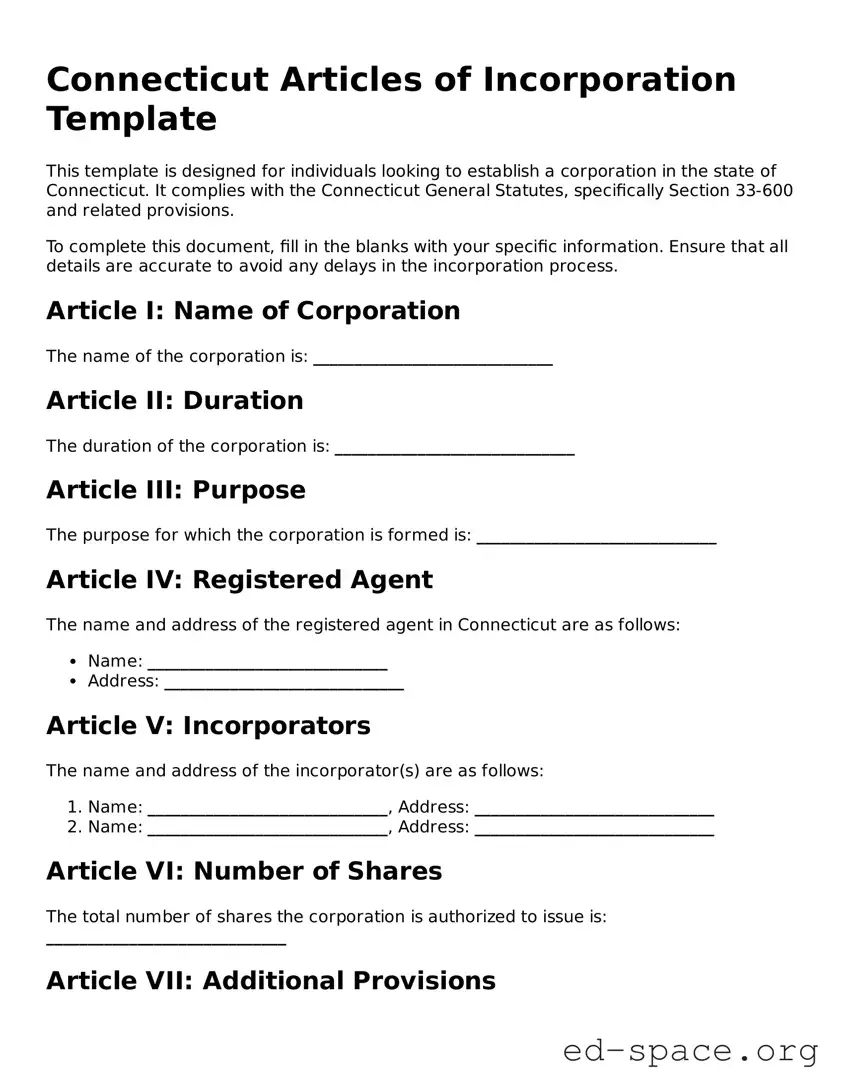
Connecticut Articles of Incorporation Template
This template is designed for individuals looking to establish a corporation in the state of Connecticut. It complies with the Connecticut General Statutes, specifically Section 33-600 and related provisions.
To complete this document, fill in the blanks with your specific information. Ensure that all details are accurate to avoid any delays in the incorporation process.
Article I: Name of Corporation
The name of the corporation is: _____________________________
Article II: Duration
The duration of the corporation is: _____________________________
Article III: Purpose
The purpose for which the corporation is formed is: _____________________________
Article IV: Registered Agent
The name and address of the registered agent in Connecticut are as follows:
Article V: Incorporators
The name and address of the incorporator(s) are as follows:
Article VI: Number of Shares
The total number of shares the corporation is authorized to issue is: _____________________________
Article VII: Additional Provisions
Any additional provisions the incorporators wish to include are: _____________________________
Signature
Incorporator's Signature: _____________________________
Date: _____________________________
Once completed, this document must be submitted to the Connecticut Secretary of State along with the required filing fee. Ensure you retain a copy for your records.
| Fact Name | Description |
|---|---|
| Purpose | The Connecticut Articles of Incorporation form is used to legally establish a corporation in the state of Connecticut. |
| Governing Law | This form is governed by the Connecticut General Statutes, specifically Title 33, Chapter 601. |
| Filing Requirement | Filing the Articles of Incorporation with the Connecticut Secretary of the State is mandatory for all corporations. |
| Information Needed | Key information required includes the corporation's name, address, and the names of the initial directors. |
After completing the Connecticut Articles of Incorporation form, it is important to review the information for accuracy before submitting it to the appropriate state office. This ensures that your incorporation process proceeds smoothly and without delays.
What is the purpose of the Connecticut Articles of Incorporation form?
The Connecticut Articles of Incorporation form is used to officially create a corporation in the state of Connecticut. This document outlines essential information about the corporation, including its name, purpose, registered agent, and the number of shares it is authorized to issue. Filing this form is a critical step in establishing a legal entity for business operations.
Who needs to file the Articles of Incorporation?
Any individual or group looking to form a corporation in Connecticut must file the Articles of Incorporation. This includes businesses of various types, such as for-profit corporations, non-profit organizations, and professional corporations. It is essential for anyone intending to operate under a corporate structure.
What information is required on the form?
The form requires several key pieces of information. This includes the corporation's name, the purpose of the corporation, the address of the principal office, the name and address of the registered agent, and the number of shares the corporation is authorized to issue. Additional details, such as the names of the incorporators, may also be necessary.
How do I file the Articles of Incorporation?
To file the Articles of Incorporation, you can complete the form online through the Connecticut Secretary of the State's website or submit a paper form by mail. Ensure that all required information is accurately filled out. There is a filing fee that must be paid at the time of submission, which varies based on the type of corporation.
What is the filing fee for the Articles of Incorporation?
The filing fee for the Articles of Incorporation in Connecticut typically ranges from $100 to $250, depending on the type of corporation being formed. It is advisable to check the Connecticut Secretary of the State's website for the most current fee schedule before submitting your application.
How long does it take to process the Articles of Incorporation?
Processing times for the Articles of Incorporation can vary. Generally, online filings are processed more quickly, often within a few business days. Paper filings may take longer, sometimes up to several weeks. It is important to plan accordingly and allow sufficient time for processing.
Can I amend the Articles of Incorporation after filing?
Yes, you can amend the Articles of Incorporation after they have been filed. To do this, you will need to complete and submit an amendment form to the Connecticut Secretary of the State. There may be a fee associated with the amendment, and it is crucial to ensure that the changes comply with state regulations.
What happens if I do not file the Articles of Incorporation?
If you do not file the Articles of Incorporation, your business will not be recognized as a legal entity in Connecticut. This means you will not have the liability protections that come with incorporation, and you may face personal liability for business debts and obligations. Additionally, you will not be able to conduct business under a corporate name.
Is there a specific format for the Articles of Incorporation?
Yes, the Articles of Incorporation must follow a specific format as outlined by the Connecticut Secretary of the State. The form must be filled out completely and accurately, adhering to the guidelines provided. Using the official form available on the Secretary of the State’s website will help ensure compliance with the required format.
Do I need a lawyer to file the Articles of Incorporation?
While it is not mandatory to hire a lawyer to file the Articles of Incorporation, it can be beneficial. A lawyer can provide guidance on the incorporation process, help ensure that all necessary information is included, and advise on compliance with state laws. However, many individuals successfully file the form on their own.
Incorrect Business Name: One common mistake is failing to ensure that the chosen business name is unique and not already in use by another entity in Connecticut. This can lead to delays in processing.
Omitting Required Information: Some individuals forget to include essential details, such as the registered agent's name and address. This information is crucial for official communications.
Improperly Completing the Form: Filling out the form without following the specified instructions can result in errors. It's important to read each section carefully to avoid mistakes.
Neglecting to Sign the Form: A signature is required for the form to be valid. Omitting a signature can lead to rejection of the application.
Failing to Include the Filing Fee: Not submitting the appropriate filing fee can delay the incorporation process. Ensure that the payment method is acceptable and that the correct amount is included.
When forming a corporation in Connecticut, the Articles of Incorporation is a crucial document. However, it is not the only paperwork required to ensure your corporation is legally recognized and compliant with state regulations. Here are several other forms and documents that are often used alongside the Articles of Incorporation.
Completing the Articles of Incorporation is just the beginning of establishing a corporation in Connecticut. Understanding and preparing these additional documents is vital for ensuring that the corporation operates smoothly and remains in good standing with state authorities.
Bylaws: Bylaws serve as the internal rules governing a corporation's operations. While Articles of Incorporation establish the corporation's existence, bylaws detail how it will function, including the roles of officers and procedures for meetings.
Operating Agreement: Similar to bylaws for LLCs, an operating agreement outlines the management structure and operating procedures of a limited liability company. It defines the rights and responsibilities of members, akin to how Articles of Incorporation define a corporation's structure.
Certificate of Incorporation: Often used interchangeably with Articles of Incorporation, this document serves the same purpose of officially creating a corporation. It typically includes similar information, such as the business name, purpose, and registered agent.
Partnership Agreement: This document outlines the terms and conditions of a partnership. Like Articles of Incorporation, it defines the relationship between parties, although it applies to partnerships rather than corporations.
Shareholder Agreement: This document governs the relationship between shareholders of a corporation. It complements the Articles of Incorporation by addressing issues like share transfer and voting rights, ensuring smooth operations among shareholders.
Business License: A business license grants permission to operate within a certain jurisdiction. While Articles of Incorporation establish a corporation legally, a business license is necessary for compliance with local regulations.
Employer Identification Number (EIN): An EIN is a unique number assigned by the IRS for tax purposes. Although it does not establish a corporation, it is often required for tax filings, similar to how Articles of Incorporation are necessary for legal recognition.
Annual Report: This document provides updates on a corporation’s status and financial performance. While Articles of Incorporation are filed at the formation stage, annual reports are submitted periodically to maintain good standing with the state.
Certificate of Good Standing: This certificate confirms that a corporation is legally registered and compliant with state regulations. It is related to Articles of Incorporation, as it reflects the ongoing validity of the corporation after its formation.
Nonprofit Articles of Incorporation: For nonprofit organizations, this document serves a similar purpose as traditional Articles of Incorporation but includes specific provisions related to the nonprofit's mission and tax-exempt status.
When filling out the Connecticut Articles of Incorporation form, it is important to follow certain guidelines to ensure accuracy and compliance. Below are four recommendations regarding what to do and what to avoid.
The Articles of Incorporation form in Connecticut is essential for anyone looking to establish a corporation. However, several misconceptions surround this important document. Understanding these misconceptions can help ensure a smoother incorporation process.
This is not true. While larger corporations often attract more attention, small businesses and startups also need to file Articles of Incorporation to legally establish their entity. This document lays the foundation for any corporation, regardless of size.
Filing the form does not automatically provide legal protection. While it is a crucial step in creating a corporation, additional requirements, such as obtaining necessary licenses and permits, must be fulfilled to ensure full legal compliance.
This is misleading. In addition to the Articles of Incorporation, corporations may need to draft bylaws, hold an organizational meeting, and obtain an Employer Identification Number (EIN). These steps are vital for proper governance and operation.
This misconception is incorrect. Amendments can be made to the Articles of Incorporation if necessary. Corporations often need to update their articles to reflect changes in structure, name, or purpose, and the state allows for these modifications.
When filling out and using the Connecticut Articles of Incorporation form, several key points should be considered to ensure compliance and accuracy.
Completing the form accurately is crucial for the successful establishment of a corporation in Connecticut.