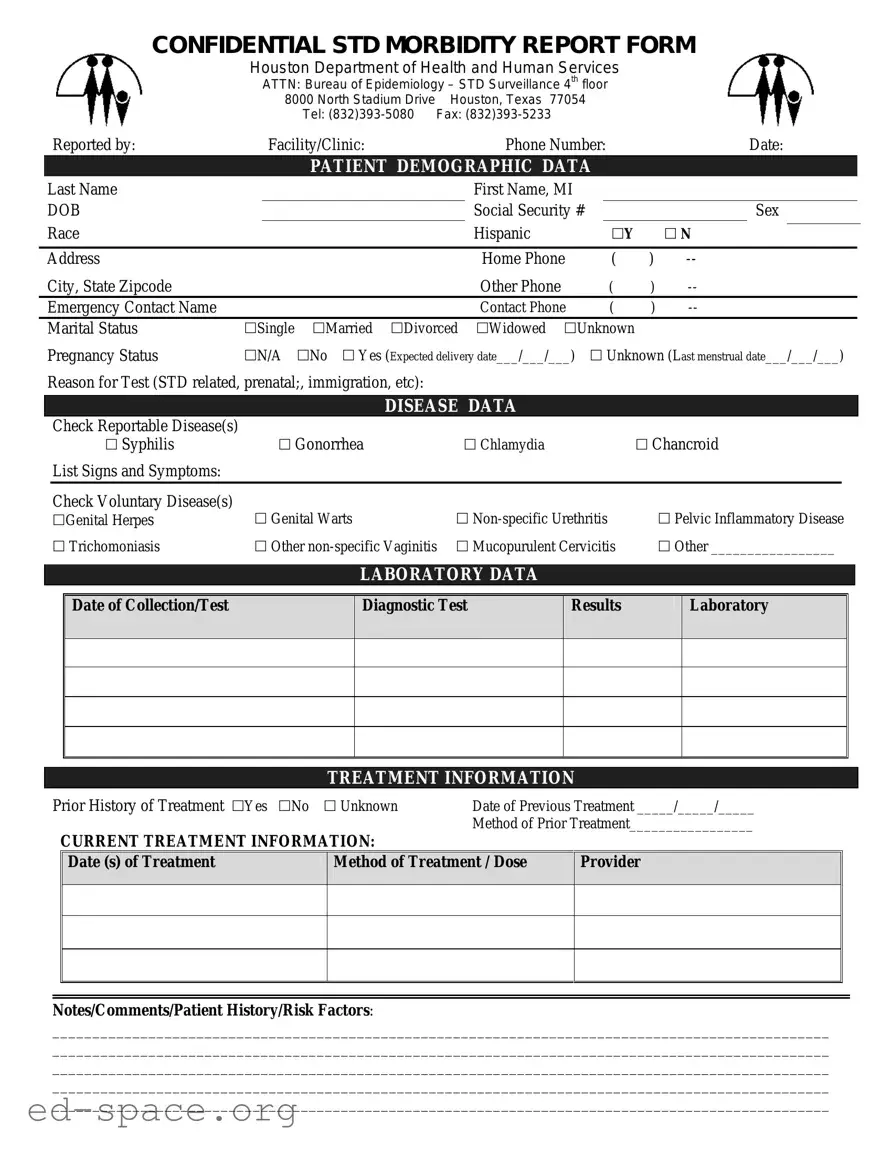
The Confidential STD Morbidity Report form serves a critical role in public health surveillance and disease tracking. This form is utilized by healthcare providers to report cases of sexually transmitted diseases (STDs) to the Houston Department of Health and Human Services. It collects essential patient demographic data, including the individual's name, date of birth, and contact information. Additionally, it captures detailed information about the patient's medical history, pregnancy status, and marital status. The form requires the reporting of specific STD diagnoses, such as syphilis, gonorrhea, and chlamydia, alongside any associated symptoms. Laboratory data, including test results and collection dates, are also documented to ensure accurate tracking of disease prevalence. Treatment history is another vital component, with sections dedicated to prior treatments and current treatment methods. The information gathered through this form not only aids in individual patient care but also contributes to broader public health initiatives aimed at controlling and preventing the spread of STDs in the community.
CONFIDENTIAL STD MORBIDITY REPORT FORM
Houston Department of Health and Human Services
|
|
|
|
ATTN: Bureau of Epidemiology – STD Surveillance 4th floor |
|
|
|
|
|
|
|
|
||||||
|
|
|
|
8000 North Stadium Drive |
Houston, Texas 77054 |
|
|
|
|
|
|
|
|
|
|
|
||
|
|
|
|
|
Tel: |
|
|
|
|
|
|
|
|
|
|
|
||
|
|
Reported by: |
|
Facility/Clinic: |
|
Phone Number: |
|
|
|
|
Date: |
|
|
|||||
|
|
|
|
|
PATIENT DEMOGRAPHIC DATA |
|
|
|
|
|
|
|
|
|||||
|
Last Name |
|
|
|
|
First Name, MI |
|
|
|
|
|
|
|
|
|
|
|
|
|
DOB |
|
|
|
|
Social Security # |
|
|
|
|
|
|
Sex |
|
|
|||
|
Race |
|
|
|
|
Hispanic |
|
|
|
|
|
|
||||||
|
|
|
|
|
|
Y |
|
N |
|
|
|
|||||||
|
|
|
|
|
|
|
|
|
|
|
|
|
|
|
|
|
|
|
|
Address |
|
|
|
|
Home Phone |
( |
|
) |
|
|
|
|
|
|
|||
|
City, State Zipcode |
|
|
|
|
Other Phone |
( |
|
) |
|
|
|
|
|
|
|||
|
Emergency Contact Name |
|
|
|
|
Contact Phone |
( |
|
) |
|
|
|
|
|
|
|||
|
Marital Status |
Single |
Married Divorced Widowed Unknown |
|
|
|
|
|
|
|
|
|||||||
|
Pregnancy Status |
N/A |
No Yes (Expected delivery date___/___/___) |
Unknown (Last menstrual date___/___/___) |
|
|
||||||||||||
|
Reason for Test (STD related, prenatal;, immigration, etc): |
|
|
|
|
|
|
|
|
|
|
|
|
|
||||
|
|
|
|
|
|
|
|
|
|
|
|
|
|
|
|
|
||
|
|
|
|
|
DISEASE DATA |
|
|
|
|
|
|
|
|
|
|
|
||
|
|
Check Reportable Disease(s) |
|
|
|
|
|
|
|
|
|
|
|
|
|
|
|
|
|
|
Syphilis |
|
Gonorrhea |
Chlamydia |
|
|
|
Chancroid |
|
|
|||||||
|
|
List Signs and Symptoms: |
|
|
|
|
|
|
|
|
|
|
|
|
|
|
|
|
|
|
Check Voluntary Disease(s) |
Genital Warts |
|
|
Pelvic Inflammatory Disease |
|
|
||||||||||
|
|
Genital Herpes |
|
|
|
|||||||||||||
|
|
Trichomoniasis |
Other |
Mucopurulent Cervicitis |
|
Other _________________ |
|
|
||||||||||
LABORATORY DATA
Date of Collection/Test
Diagnostic Test
Results
Laboratory
TREATMENT INFORMATION
Prior History of Treatment Yes No |
Unknown |
Date of Previous Treatment _____/_____/_____ |
|
|
|||||
|
CURRENT TREATMENT INFORMATION: |
Method of Prior Treatment_________________ |
|
|
|||||
|
|
|
|
|
|
||||
|
|
Date (s) of Treatment |
|
Method of Treatment / Dose |
|
Provider |
|
|
|
|
|
|
|
|
|
|
|
|
|
|
|
|
|
|
|
|
|
|
|
|
|
|
|
|
|
|
|
|
|
|
|
|
|
|
|
|
|
|
|
|
|
|
|
|
|
|
|
|
|
|
|
|
|
|
|
|
|
|
|
Notes/Comments/Patient History/Risk Factors:
_________________________________________________________________________________________________
_________________________________________________________________________________________________
_________________________________________________________________________________________________
_________________________________________________________________________________________________
_________________________________________________________________________________________________
| Fact Name | Description |
|---|---|
| Purpose | The Confidential STD Morbidity Report Form is designed to collect data on sexually transmitted diseases for public health surveillance and epidemiology. |
| Confidentiality | All information submitted through this form is confidential, ensuring patient privacy and compliance with health regulations. |
| State-Specific Laws | In Texas, the governing laws include the Texas Health and Safety Code, Chapter 81, which mandates reporting of certain diseases, including STDs. |
| Data Collection | The form collects comprehensive patient demographic data, disease information, and treatment history to assist in tracking STD trends. |
| Reporting Requirements | Facilities and clinics are required to report confirmed cases of STDs within a specific timeframe to local health authorities. |
Filling out the Confidential STD Morbidity Report form is an important step in reporting and tracking sexually transmitted diseases. This form collects essential information about the patient and their treatment history. Once completed, the form should be submitted to the designated department for processing.
What is the purpose of the Confidential STD Morbidity Report form?
The Confidential STD Morbidity Report form is used to report cases of sexually transmitted diseases (STDs) to the Houston Department of Health and Human Services. This helps public health officials monitor and respond to STD trends in the community. It ensures that appropriate treatment and follow-up can be provided to affected individuals.
Who needs to fill out this form?
This form should be completed by healthcare providers who diagnose or treat patients with STDs. This includes clinics, hospitals, and private practices. It’s essential that the information is accurate to support public health efforts.
What information is required on the form?
The form requires various details about the patient, including their name, date of birth, contact information, and demographic data. Additionally, it asks for information about the STD diagnosis, treatment history, and laboratory test results. This comprehensive data helps health officials understand the scope of STDs in the area.
Is the information on the form confidential?
Yes, the information provided on the Confidential STD Morbidity Report form is treated with strict confidentiality. Personal identifiers are protected to ensure the privacy of the patient. Only authorized personnel involved in public health surveillance and response will access this information.
How can I submit the form?
The completed form can be submitted via fax to the Bureau of Epidemiology at (832) 393-5233. Alternatively, it can be mailed to the address provided on the form: Houston Department of Health and Human Services, ATTN: Bureau of Epidemiology – STD Surveillance, 8000 North Stadium Drive, 4th floor, Houston, Texas 77054.
What happens after the form is submitted?
Once the form is submitted, health officials will review the information for accuracy and completeness. They may follow up with the reporting facility for additional details if needed. The data collected helps in tracking STD trends and implementing public health interventions.
Where can I get more information about STDs and this reporting process?
For more information, you can contact the Bureau of Epidemiology at (832) 393-5080. They can provide guidance on the reporting process and answer any questions related to STDs and public health resources available in Houston.
Incomplete Patient Information: Failing to provide all required demographic data, such as last name, first name, and date of birth, can lead to processing delays.
Incorrect Contact Information: Listing inaccurate phone numbers or addresses makes it difficult for health officials to follow up.
Missing Reason for Test: Not specifying the reason for the test can hinder the appropriate categorization of the case.
Failure to Check Reportable Diseases: Omitting checkmarks next to reportable diseases may result in underreporting and a lack of necessary public health interventions.
Inaccurate Treatment History: Providing incorrect information about prior treatments can mislead healthcare providers in their current treatment decisions.
Neglecting Laboratory Data: Leaving out the date of collection or test results can complicate the evaluation of the patient’s condition.
Skipping Patient History: Failing to include relevant notes or risk factors may limit the understanding of the patient's situation.
Improper Signature or Reporting Facility: Not signing the report or misidentifying the facility can lead to issues with accountability and follow-up.
Not Keeping a Copy: Failing to retain a copy of the submitted report can create challenges if there are questions or discrepancies later.
The Confidential STD Morbidity Report form is an important document for reporting sexually transmitted diseases. Along with this form, there are several other documents that may be used to provide additional information or fulfill legal requirements. Here is a list of those documents:
These documents work together to support the reporting and management of sexually transmitted diseases. Each serves a specific purpose, contributing to the overall care and understanding of the patient's health needs.
The Confidential STD Morbidity Report form plays a crucial role in public health reporting and surveillance. Several other documents share similarities with this form, each contributing to the collection and management of health data. Here are six documents that are comparable:
Understanding these documents can enhance the efficiency of health data management and improve patient outcomes. Each plays a specific role in the broader context of healthcare, ensuring that critical information is accurately captured and utilized.
When filling out the Confidential STD Morbidity Report form, it’s important to follow specific guidelines to ensure accuracy and compliance. Here are nine things to keep in mind:
Misconceptions about the Confidential STD Morbidity Report form can lead to confusion and misinformation. Here are ten common misunderstandings, along with clarifications to help provide a clearer picture.
When filling out the Confidential STD Morbidity Report form, it is essential to ensure accuracy and completeness. Here are some key takeaways: