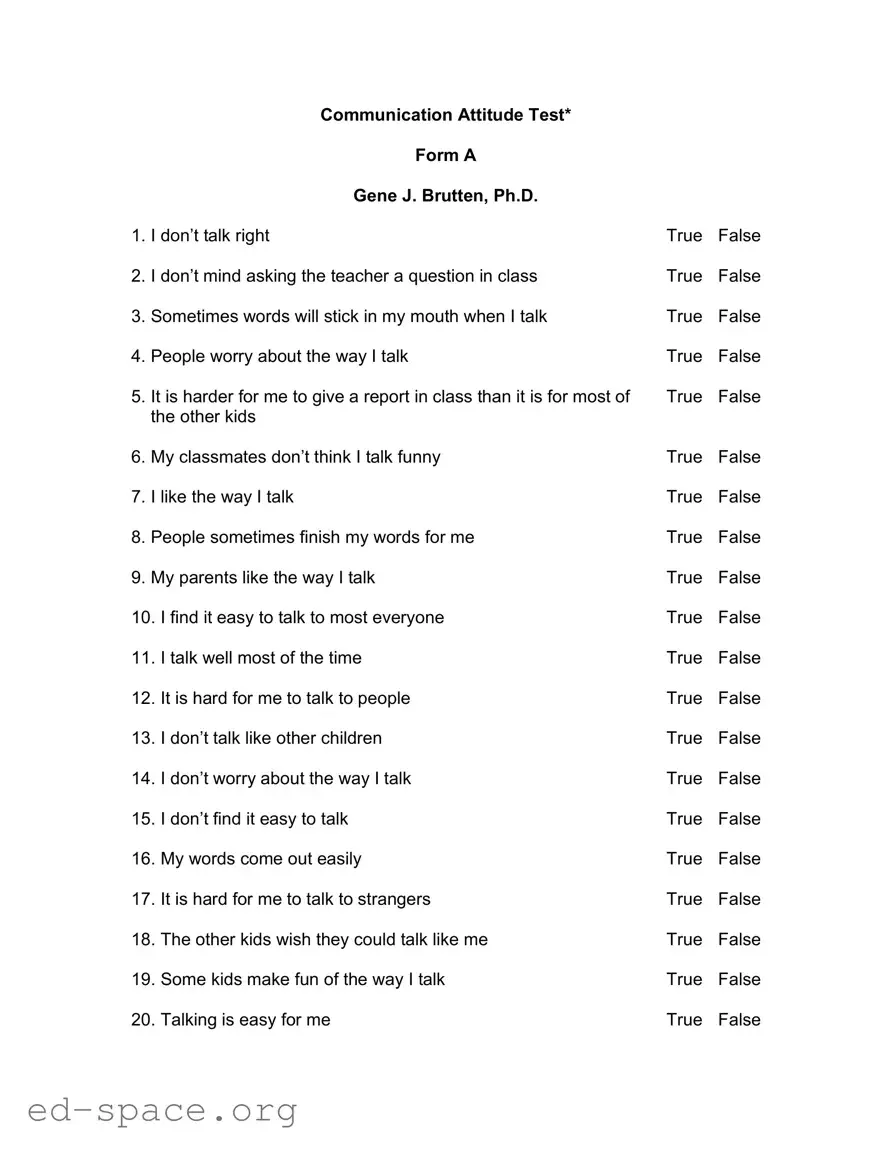
The Communication Attitude Test A form, developed by Dr. Gene J. Brutten, serves as a valuable tool for assessing an individual's feelings and attitudes toward their communication skills. This form consists of a series of statements that participants respond to with a simple "True" or "False," allowing for an easy and straightforward evaluation process. The questions cover various aspects of communication, including comfort levels when speaking in front of others, perceptions of how others view their speech, and the ease with which they express themselves. By addressing topics such as anxiety about public speaking, the tendency to stutter, and the desire to communicate effectively, the test provides insights into both self-perception and social interaction. It is designed for individuals, particularly children, who may struggle with communication, helping to identify areas where support and improvement may be needed. The results can guide educators, parents, and therapists in understanding a child's communication challenges and strengths, ultimately fostering better communication skills and confidence.
|
|
COMMUNICATION ATTITUDE TEST* |
|
|
|
|
FORM A |
|
|
|
|
GENE J. BRUTTEN, PH.D. |
|
|
1. |
I don’t talk right |
True |
False |
|
2. |
I don’t mind asking the teacher a question in class |
True |
False |
|
3. |
Sometimes words will stick in my mouth when I talk |
True |
False |
|
4. |
People worry about the way I talk |
True |
False |
|
5. |
It is harder for me to give a report in class than it is for most of |
True |
False |
|
|
the other kids |
|
|
|
6. |
My classmates don’t think I talk funny |
True |
False |
|
7. |
I like the way I talk |
True |
False |
|
8. |
People sometimes finish my words for me |
True |
False |
|
9. |
My parents like the way I talk |
True |
False |
|
10. |
I find it easy to talk to most everyone |
True |
False |
|
11. |
I talk well most of the time |
True |
False |
|
12. |
It is hard for me to talk to people |
True |
False |
|
13. |
I don’t talk like other children |
True |
False |
|
14. |
I don’t worry about the way I talk |
True |
False |
|
15. |
I don’t find it easy to talk |
True |
False |
|
16. |
My words come out easily |
True |
False |
|
17. |
It is hard for me to talk to strangers |
True |
False |
|
18. |
The other kids wish they could talk like me |
True |
False |
|
19. |
Some kids make fun of the way I talk |
True |
False |
|
20. |
Talking is easy for me |
True |
False |
|
21. |
Telling someone my name is hard for me |
True |
False |
22. |
Words are hard for me to say |
True |
False |
23. |
I talk well with most everyone |
True |
False |
24. |
Sometimes I have trouble talking |
True |
False |
25. |
I would rather talk than write |
True |
False |
26. |
I like to talk |
True |
False |
27. |
I am not a good talker |
True |
False |
28. |
I wish I could talk like other children |
True |
False |
29. |
My words do not come out easily |
True |
False |
30. |
My friends don’t talk as well as I do |
True |
False |
31. |
I don’t worry about talking on the phone |
True |
False |
32. |
I talk better with a friend |
True |
False |
33. |
People don’t seem to like the way I talk |
True |
False |
34. |
I let others talk for me |
True |
False |
35. |
Reading out loud in class is easy for me |
True |
False |
*Copyright, Gene J. Brutten, 1985 – Revised 1997
| Fact Name | Fact Description |
|---|---|
| Test Purpose | The Communication Attitude Test A form is designed to assess an individual's feelings and attitudes toward their own communication abilities. |
| Target Audience | This test is primarily aimed at children and young adults who may experience difficulties in communication. |
| True/False Format | The test consists of 35 statements, each requiring a response of either "True" or "False," allowing for straightforward self-assessment. |
| Copyright Information | This test is copyrighted by Gene J. Brutten, Ph.D., with the original copyright established in 1985 and revised in 1997. |
| Administration | The test can be administered in various settings, including schools and clinical environments, to help identify communication challenges. |
| Scoring | Responses are typically scored to determine the level of communication anxiety or confidence, which can guide further intervention if necessary. |
| State-Specific Forms | Some states may have specific guidelines or laws governing the use of this test in educational or therapeutic contexts. |
| Use in Therapy | Speech-language pathologists often utilize this test as part of a comprehensive evaluation to inform treatment planning. |
Filling out the Communication Attitude Test A form involves answering a series of statements about your communication experiences and feelings. Each statement requires a simple "True" or "False" response. Follow these steps to complete the form accurately.
What is the Communication Attitude Test A form?
The Communication Attitude Test A form is an assessment tool developed by Dr. Gene J. Brutten. It is designed to evaluate an individual's attitudes towards their own communication abilities. The test consists of a series of statements to which respondents answer "True" or "False." The responses help identify areas of concern related to communication, such as anxiety or confidence in speaking situations.
Who can use the Communication Attitude Test A form?
This test can be utilized by educators, speech-language pathologists, and psychologists. It is particularly useful for children who may experience challenges with communication. The test can help professionals understand a child's self-perception regarding their speaking abilities, which can inform intervention strategies and support tailored to the individual's needs.
How is the Communication Attitude Test A form administered?
The test is typically administered in a one-on-one setting, allowing for a comfortable environment for the child. An adult, such as a teacher or therapist, reads the statements to the child, who then indicates their response. It is important to ensure that the child understands each statement clearly before responding. The entire process usually takes about 10 to 15 minutes.
What do the results of the Communication Attitude Test A form indicate?
The results of the test provide insights into the child's attitudes toward communication. A higher number of "True" responses may indicate negative feelings about their speaking abilities, while a higher number of "False" responses may suggest a more positive self-image. These results can guide further assessment and intervention strategies to enhance the child's communication skills and confidence.
Is the Communication Attitude Test A form scientifically validated?
The Communication Attitude Test A form has undergone revisions and is based on research conducted by Dr. Brutten. While it is widely used in educational and clinical settings, users should be aware that it is one of many tools available for assessing communication attitudes. It is recommended to use the test in conjunction with other assessments and observations to obtain a comprehensive understanding of a child's communication abilities.
Failing to read the instructions carefully can lead to misunderstandings about how to answer the questions.
Marking answers without considering their true feelings may result in inaccurate responses.
Not answering every question can lead to incomplete data, which affects the overall assessment.
Confusing "True" and "False" can lead to misinterpretation of the results.
Rushing through the test can cause individuals to overlook questions that may be significant to their communication experiences.
Not discussing feelings about communication with a trusted person beforehand may prevent honest responses.
Overthinking answers can create unnecessary stress, impacting the authenticity of the responses.
Neglecting to reflect on past experiences related to communication may lead to a lack of insight into personal attitudes.
The Communication Attitude Test A form is an important tool used to assess a person's feelings about their communication skills. Along with this form, several other documents are commonly utilized to provide a comprehensive understanding of an individual's communication abilities and challenges. Here’s a list of those documents, each serving a unique purpose.
Each of these documents plays a crucial role in understanding and supporting communication skills. Together, they create a holistic view of an individual's abilities and needs, ensuring that appropriate interventions and support can be provided.
The Communication Attitude Test A form is a valuable tool for assessing an individual's feelings and attitudes toward communication. Several other documents share similarities in purpose and structure. Here are four of them:
When filling out the Communication Attitude Test A form, consider the following guidelines:
The Communication Attitude Test A (CAT-A) is a tool designed to assess an individual's feelings and attitudes toward communication. However, several misconceptions surround this assessment. Here’s a closer look at some of these misunderstandings:
Understanding these misconceptions can lead to a more accurate interpretation of the Communication Attitude Test A and its implications for personal and educational growth.
The Communication Attitude Test A form is a valuable tool for assessing an individual's perceptions and feelings about their communication abilities. Below are key takeaways regarding its completion and application: