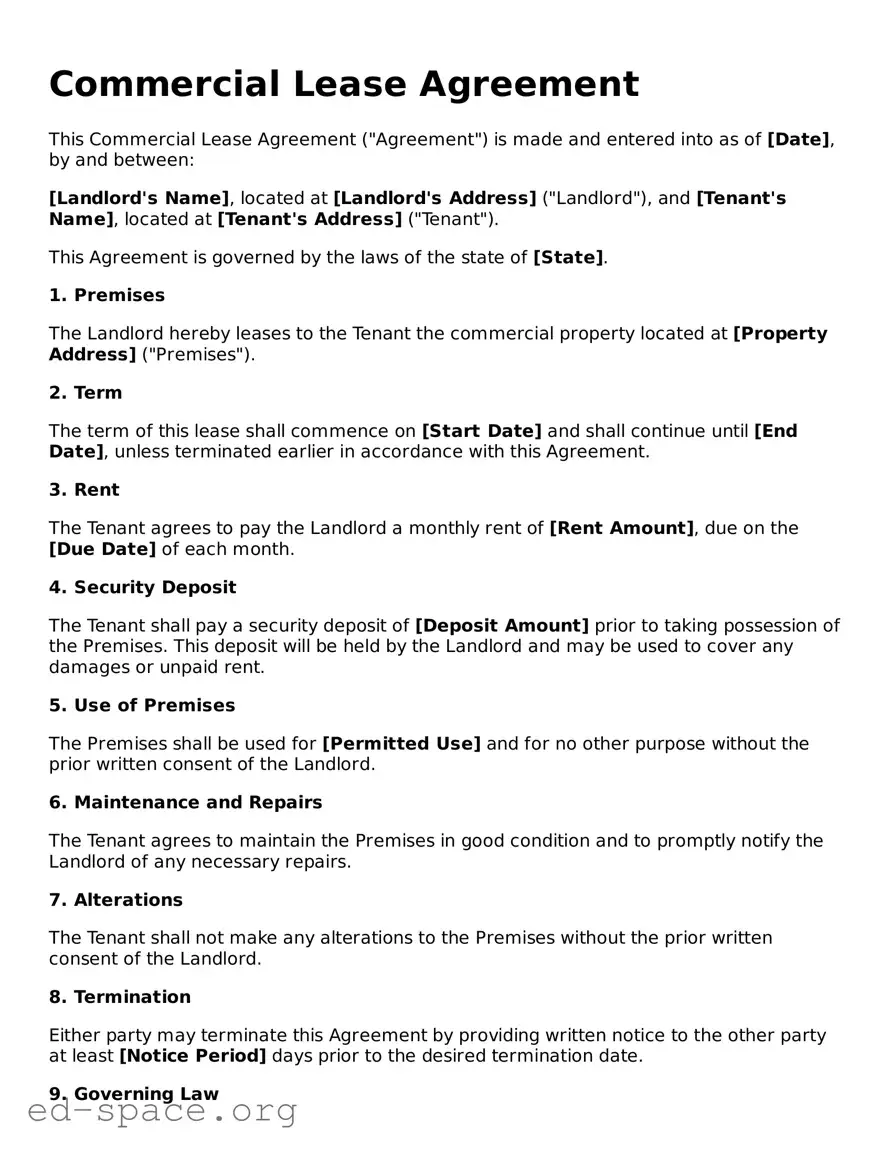
When it comes to securing a space for your business, a Commercial Lease Agreement is a vital document that outlines the relationship between a landlord and a tenant. This agreement sets the stage for a successful occupancy by detailing essential elements such as the lease term, rental amount, and payment schedule. It also addresses the responsibilities of both parties, including maintenance obligations and permitted uses of the property. Additionally, the agreement may include provisions for renewals, security deposits, and potential penalties for breaking the lease. Understanding these components is crucial for both landlords and tenants, as they help prevent misunderstandings and foster a positive working relationship. By carefully reviewing and negotiating the terms of the lease, businesses can ensure they are making a sound investment while landlords can protect their property and income.
Commercial Lease Agreement
This Commercial Lease Agreement ("Agreement") is made and entered into as of [Date], by and between:
[Landlord's Name], located at [Landlord's Address] ("Landlord"), and [Tenant's Name], located at [Tenant's Address] ("Tenant").
This Agreement is governed by the laws of the state of [State].
1. Premises
The Landlord hereby leases to the Tenant the commercial property located at [Property Address] ("Premises").
2. Term
The term of this lease shall commence on [Start Date] and shall continue until [End Date], unless terminated earlier in accordance with this Agreement.
3. Rent
The Tenant agrees to pay the Landlord a monthly rent of [Rent Amount], due on the [Due Date] of each month.
4. Security Deposit
The Tenant shall pay a security deposit of [Deposit Amount] prior to taking possession of the Premises. This deposit will be held by the Landlord and may be used to cover any damages or unpaid rent.
5. Use of Premises
The Premises shall be used for [Permitted Use] and for no other purpose without the prior written consent of the Landlord.
6. Maintenance and Repairs
The Tenant agrees to maintain the Premises in good condition and to promptly notify the Landlord of any necessary repairs.
7. Alterations
The Tenant shall not make any alterations to the Premises without the prior written consent of the Landlord.
8. Termination
Either party may terminate this Agreement by providing written notice to the other party at least [Notice Period] days prior to the desired termination date.
9. Governing Law
This Agreement shall be governed by and construed in accordance with the laws of the state of [State].
10. Signatures
In witness whereof, the parties have executed this Agreement as of the date first above written.
__________________________
[Landlord's Name]
Landlord
__________________________
[Tenant's Name]
Tenant
| Fact Name | Description |
|---|---|
| Purpose | A Commercial Lease Agreement outlines the terms under which a tenant can rent commercial property from a landlord. |
| Key Components | This agreement typically includes details about rent, lease duration, maintenance responsibilities, and renewal options. |
| Governing Law | Each state has its own laws governing commercial leases, such as California Civil Code or New York Real Property Law. |
| Enforceability | For a Commercial Lease Agreement to be enforceable, it must be in writing and signed by both parties. |
Filling out a Commercial Lease Agreement form is an important step in establishing the terms of a rental relationship between a landlord and a tenant. Completing this form accurately ensures that both parties understand their rights and responsibilities. Follow these steps to fill out the form properly.
What is a Commercial Lease Agreement?
A Commercial Lease Agreement is a legal document that outlines the terms under which a landlord allows a business to use a property for commercial purposes. This agreement specifies the rights and responsibilities of both the landlord and the tenant, including details about rent, duration, and maintenance obligations.
What are the key components of a Commercial Lease Agreement?
Key components typically include the lease term, rental amount, payment schedule, security deposit requirements, maintenance responsibilities, and clauses regarding termination and renewal. Additional provisions may address permitted uses of the property and restrictions on modifications.
How long does a Commercial Lease Agreement usually last?
The duration of a Commercial Lease Agreement can vary widely. Some leases are short-term, lasting only a year or two, while others may extend for five, ten, or even twenty years. The length often depends on the type of business and the property involved.
What happens if a tenant wants to terminate the lease early?
If a tenant wishes to terminate the lease early, they must review the agreement for any early termination clauses. Some leases may allow for early termination under specific conditions, while others may impose penalties or require the tenant to pay rent until the end of the lease term.
Can a Commercial Lease Agreement be modified?
Yes, a Commercial Lease Agreement can be modified, but any changes must be documented in writing and signed by both parties. This ensures that all parties are aware of the new terms and helps prevent misunderstandings in the future.
What is a security deposit, and how is it handled?
A security deposit is a sum of money paid by the tenant to the landlord to cover potential damages or unpaid rent. The amount is typically specified in the lease agreement. Upon lease termination, the landlord must return the deposit, minus any deductions for damages, within a specified timeframe.
Are there any restrictions on the use of the property?
Yes, the lease agreement may include restrictions on how the tenant can use the property. For instance, certain types of businesses may be prohibited, or there may be limitations on hours of operation. It is crucial for tenants to understand these restrictions to avoid breaching the lease.
What should a tenant do if they encounter issues with the property?
If a tenant encounters issues with the property, such as maintenance problems or safety hazards, they should notify the landlord promptly. The lease may outline specific procedures for reporting issues. Timely communication can help ensure that problems are addressed quickly and effectively.
Failing to provide accurate property information. This includes the address, square footage, and specific details about the leased premises.
Not specifying the lease term. It is crucial to indicate the start and end dates of the lease to avoid confusion.
Overlooking the rent amount and payment schedule. Clearly stating the monthly rent and due dates prevents misunderstandings.
Neglecting to outline maintenance responsibilities. Both landlord and tenant should understand who is responsible for repairs and upkeep.
Inadequately addressing renewal options. If there are options to renew the lease, these should be clearly defined in the agreement.
Ignoring the terms of termination. Clearly stating how either party can terminate the lease protects both parties' interests.
Not including provisions for subleasing. If subleasing is allowed, the terms should be explicitly stated to avoid future issues.
Forgetting to sign and date the agreement. Without signatures, the lease is not legally binding.
A Commercial Lease Agreement is a critical document that outlines the terms and conditions between a landlord and a tenant for renting commercial property. However, several other forms and documents often accompany this agreement to ensure clarity and legal compliance. Below is a list of these related documents, each serving a specific purpose.
These documents are essential for a comprehensive understanding of the leasing arrangement and help protect the rights and responsibilities of both parties involved. Proper attention to these forms can mitigate disputes and enhance the overall leasing experience.
When filling out a Commercial Lease Agreement form, it's important to be careful and thorough. Here are some things to keep in mind:
Commercial lease agreements are crucial documents in the world of business. However, several misconceptions often cloud understanding of these agreements. Here are eight common misunderstandings:
All commercial leases are the same. This is a significant misconception. Each commercial lease can vary widely based on the type of property, the needs of the tenant, and the goals of the landlord. Customization is common, and it is essential to read each lease carefully.
Only landlords need to understand the lease. Tenants often believe that the responsibility lies solely with the landlord. However, it is equally important for tenants to comprehend the terms and conditions to protect their interests.
Verbal agreements are sufficient. Many assume that a handshake or verbal agreement is enough. In reality, commercial leases should always be in writing to ensure clarity and enforceability.
All lease terms are negotiable. While many terms can be negotiated, some aspects may be non-negotiable, especially in highly competitive markets. Understanding which terms are flexible is crucial for both parties.
Security deposits are always refundable. Tenants often think that they will automatically receive their security deposit back at the end of the lease. However, landlords may retain part or all of the deposit for damages or unpaid rent, depending on the lease terms.
Lease length is always fixed. Some believe that the duration of a lease cannot be altered. In reality, many leases offer options for renewal or termination, allowing for flexibility based on the tenant's business needs.
Maintenance responsibilities are always the landlord's. This is not universally true. Depending on the lease agreement, tenants may be responsible for certain maintenance tasks, such as repairs or upkeep of the property.
Commercial leases do not require legal review. Some tenants and landlords underestimate the importance of having a legal professional review the lease. A thorough review can uncover potential issues and protect both parties from future disputes.
Understanding these misconceptions can lead to better decision-making and a more successful leasing experience for both landlords and tenants.
When filling out and using a Commercial Lease Agreement form, keep these key takeaways in mind:
Taking the time to understand these points can make the leasing process smoother for everyone involved.