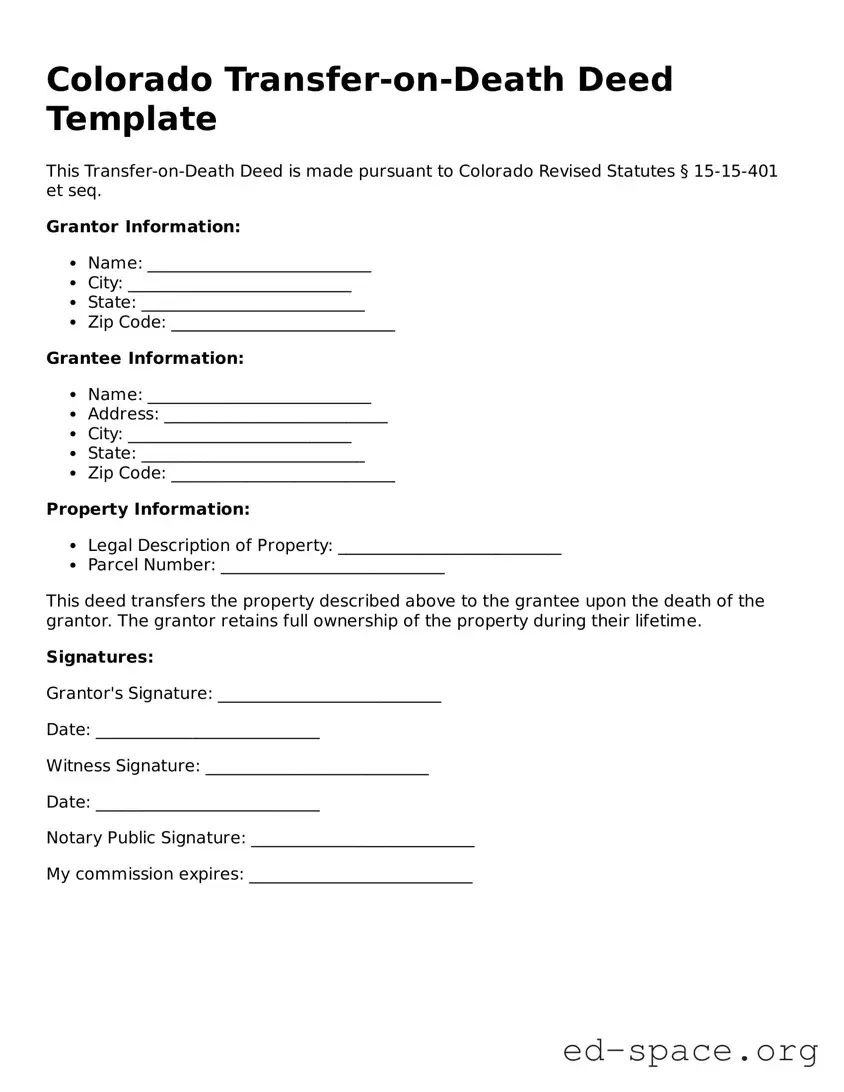
In Colorado, the Transfer-on-Death Deed (TODD) form serves as a valuable tool for property owners looking to simplify the transfer of real estate upon their passing. This form allows individuals to designate a beneficiary who will automatically inherit the property, bypassing the often lengthy and costly probate process. By filling out this deed, property owners can retain full control over their real estate during their lifetime, ensuring that their wishes are honored after they are gone. The TODD must be properly executed and recorded with the county clerk and recorder to be valid. It’s important to note that the transfer only takes effect upon the owner's death, and the owner can revoke or change the deed at any time before that. Understanding the intricacies of this form can help individuals make informed decisions about their estate planning and provide peace of mind for themselves and their loved ones.
Colorado Transfer-on-Death Deed Template
This Transfer-on-Death Deed is made pursuant to Colorado Revised Statutes § 15-15-401 et seq.
Grantor Information:
Grantee Information:
Property Information:
This deed transfers the property described above to the grantee upon the death of the grantor. The grantor retains full ownership of the property during their lifetime.
Signatures:
Grantor's Signature: ___________________________
Date: ___________________________
Witness Signature: ___________________________
Date: ___________________________
Notary Public Signature: ___________________________
My commission expires: ___________________________
| Fact Name | Description |
|---|---|
| Definition | A Transfer-on-Death Deed allows an individual to transfer real property to a beneficiary upon their death without going through probate. |
| Governing Law | The Transfer-on-Death Deed in Colorado is governed by Colorado Revised Statutes § 15-15-401 to § 15-15-404. |
| Beneficiary Designation | Individuals can designate one or more beneficiaries in the deed, providing flexibility in property transfer. |
| Revocation | The deed can be revoked at any time during the grantor's lifetime, allowing for changes in beneficiary designation. |
| Property Types | Only real property can be transferred using a Transfer-on-Death Deed; personal property is not eligible. |
After obtaining the Colorado Transfer-on-Death Deed form, it is essential to complete it accurately to ensure that your property transfers as intended. Following the steps below will guide you through the process of filling out the form correctly.
What is a Transfer-on-Death Deed in Colorado?
A Transfer-on-Death Deed (TOD Deed) is a legal document that allows a property owner in Colorado to designate one or more beneficiaries to receive their property upon their death. This deed enables the transfer of property outside of probate, simplifying the process for heirs and ensuring that the property passes directly to the named beneficiaries without the need for court intervention.
How does a Transfer-on-Death Deed work?
When a property owner executes a TOD Deed, they retain full ownership and control of the property during their lifetime. The designated beneficiaries do not have any rights to the property until the owner's death. Upon the owner's passing, the property automatically transfers to the beneficiaries named in the deed, making it a straightforward method for transferring property to heirs.
What are the benefits of using a Transfer-on-Death Deed?
The primary advantage of a TOD Deed is that it allows for the seamless transfer of property without going through probate. This can save time and money for the beneficiaries. Additionally, the property owner can change or revoke the deed at any time during their lifetime, providing flexibility. It also helps to avoid potential disputes among heirs, as the transfer is clearly outlined in the deed.
Are there any limitations on who can be named as a beneficiary?
In Colorado, beneficiaries of a TOD Deed can be individuals, such as family members or friends, or entities, like trusts or organizations. However, it is important to note that the beneficiaries must be alive at the time of the property owner's death to inherit the property. If a named beneficiary predeceases the owner, their share may not automatically pass to their heirs unless specifically stated in the deed.
How do I create a Transfer-on-Death Deed?
To create a TOD Deed, the property owner must complete the appropriate form, which includes details such as the property description and the names of the beneficiaries. After filling out the form, the owner must sign it in the presence of a notary public. Finally, the deed must be recorded with the county clerk and recorder's office in the county where the property is located to be legally effective.
Can I revoke a Transfer-on-Death Deed?
Yes, a property owner can revoke a TOD Deed at any time during their lifetime. This can be done by executing a new deed that explicitly revokes the previous one or by recording a formal revocation document with the county clerk and recorder's office. It is crucial to ensure that the revocation is properly documented to avoid confusion for the beneficiaries.
What happens if the property owner has debts at the time of death?
While a TOD Deed facilitates the transfer of property directly to beneficiaries, it does not shield the property from the owner's debts. Creditors may still make claims against the estate for outstanding debts. If the property is subject to liens or mortgages, those obligations will need to be addressed, potentially affecting the beneficiaries’ ability to retain the property without settling those debts.
Is a Transfer-on-Death Deed the right choice for everyone?
A TOD Deed can be an excellent option for many property owners, particularly those looking to simplify the transfer of property to heirs. However, it may not be suitable for everyone. Individuals with complex estates, significant debts, or those who wish to impose conditions on the transfer may benefit from other estate planning tools, such as trusts or wills. Consulting with an estate planning attorney can help determine the best approach for individual circumstances.
What should I do after creating a Transfer-on-Death Deed?
After creating and recording a TOD Deed, it is important to inform the beneficiaries about the deed and its implications. Keeping a copy of the recorded deed in a safe place and ensuring that it is accessible to the beneficiaries is also advisable. Regularly reviewing the deed to ensure that it reflects current wishes and circumstances is essential, especially if life changes occur, such as marriage, divorce, or the birth of children.
Incorrect Property Description: Many individuals fail to provide a precise description of the property. It's essential to include the full legal description, which can often be found in the property deed. Omitting details can lead to confusion or disputes later on.
Not Identifying Beneficiaries Clearly: When listing beneficiaries, some people use vague terms or nicknames. It is crucial to use the full legal names of the beneficiaries to avoid any potential issues regarding who is entitled to the property.
Failure to Sign and Date: A common oversight is neglecting to sign and date the form. Without a signature, the deed is not valid. Ensure that all required parties sign the document to make it legally binding.
Not Notarizing the Document: Some individuals forget the importance of having the deed notarized. In Colorado, notarization is necessary for the deed to be effective. Without it, the transfer may not be recognized.
Improperly Recording the Deed: After completing the form, it must be recorded with the appropriate county clerk and recorder's office. Failing to do so can result in the deed not being recognized, which defeats its purpose.
Ignoring State-Specific Requirements: Each state has its own rules regarding Transfer-on-Death Deeds. Some individuals overlook specific Colorado requirements, such as deadlines for recording the deed after signing. Familiarity with these regulations is essential to ensure compliance.
When preparing to use a Colorado Transfer-on-Death Deed, several additional forms and documents may be necessary to ensure a smooth transition of property ownership. Understanding these documents can help simplify the process and provide clarity for all parties involved.
Being aware of these forms and documents can help facilitate a smoother transition when using a Colorado Transfer-on-Death Deed. Each document plays a role in ensuring that the wishes of the property owner are honored and that the process is legally sound.
The Transfer-on-Death Deed (TOD Deed) is a useful estate planning tool, allowing individuals to transfer property directly to beneficiaries upon their death without going through probate. Here are nine documents that share similarities with the TOD Deed, highlighting how they function in estate planning and property transfer.
When filling out the Colorado Transfer-on-Death Deed form, it is important to follow certain guidelines to ensure everything is completed correctly. Here are some key points to consider:
Taking these steps will help ensure that the Transfer-on-Death Deed is valid and meets all necessary requirements.
Understanding the Colorado Transfer-on-Death Deed (TOD) can be challenging due to common misconceptions. Here are seven prevalent misunderstandings that people often have about this legal tool:
While the TOD deed does allow for the transfer of property outside of probate, it only takes effect when the owner passes away. Until that point, the owner retains full control of the property.
This is not entirely accurate. A TOD deed can only be used for real estate and does not apply to personal property, such as vehicles or bank accounts.
While a TOD deed can simplify the transfer of specific real estate, it does not replace the need for a will. A will is still essential for addressing other assets and making final wishes known.
This is a misconception. The property owner can revoke or modify the TOD deed at any time before their death, as long as they follow the proper procedures.
The property specified in a TOD deed goes directly to the named beneficiary. Other heirs may not have any claim to it unless they are also named in the deed.
This is not true. Anyone who owns real estate can benefit from a TOD deed, regardless of their financial status. It can be a useful estate planning tool for a wide range of property owners.
While a TOD deed can help avoid probate, it does not eliminate potential tax obligations. Beneficiaries may still be responsible for property taxes or capital gains taxes upon the transfer of the property.
By understanding these misconceptions, individuals can make more informed decisions regarding their estate planning and the use of Transfer-on-Death Deeds in Colorado.
Filling out and using the Colorado Transfer-on-Death Deed form can be a straightforward process, but it is essential to understand the key elements involved. Here are some important takeaways:
Understanding these key points can help ensure that the Transfer-on-Death Deed serves its intended purpose effectively. It is crucial to approach this process with care and attention to detail.