When someone passes away in Colorado, their estate may be subject to various legal processes. However, if the total value of the estate is below a certain threshold, heirs can simplify the transfer of assets through the Colorado Small Estate Affidavit. This form is particularly useful for individuals who want to avoid the lengthy and often costly probate process. With the Small Estate Affidavit, beneficiaries can claim personal property, bank accounts, and other assets without the need for a formal court proceeding. The affidavit allows heirs to assert their rights and responsibilities, making it easier to access what they are entitled to. It’s important to understand the eligibility criteria, required information, and the steps involved in completing this form. By following the correct procedures, heirs can efficiently settle the estate and ensure that the deceased’s wishes are honored.
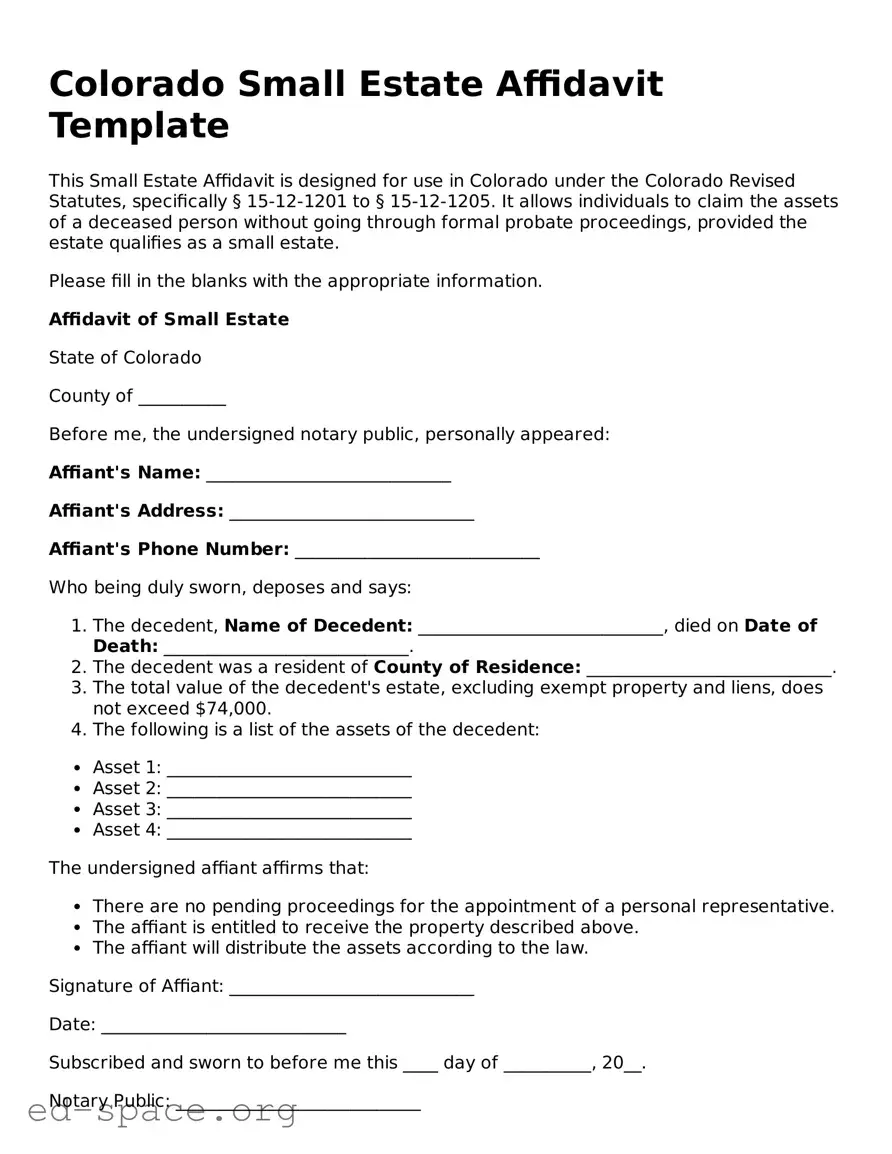
Colorado Small Estate Affidavit Template
This Small Estate Affidavit is designed for use in Colorado under the Colorado Revised Statutes, specifically § 15-12-1201 to § 15-12-1205. It allows individuals to claim the assets of a deceased person without going through formal probate proceedings, provided the estate qualifies as a small estate.
Please fill in the blanks with the appropriate information.
Affidavit of Small Estate
State of Colorado
County of __________
Before me, the undersigned notary public, personally appeared:
Affiant's Name: ____________________________
Affiant's Address: ____________________________
Affiant's Phone Number: ____________________________
Who being duly sworn, deposes and says:
The undersigned affiant affirms that:
Signature of Affiant: ____________________________
Date: ____________________________
Subscribed and sworn to before me this ____ day of __________, 20__.
Notary Public: ____________________________
My commission expires: ____________________________
| Fact Name | Description |
|---|---|
| Purpose | The Colorado Small Estate Affidavit allows individuals to claim assets of a deceased person without going through formal probate. |
| Eligibility | To use this affidavit, the total value of the deceased's assets must not exceed $66,000, excluding certain exempt property. |
| Governing Law | The affidavit is governed by Colorado Revised Statutes, specifically C.R.S. § 15-12-120. |
| Filing Requirements | The form must be signed by the person claiming the assets and may need to be notarized. |
| Assets Included | Eligible assets can include bank accounts, personal property, and vehicles, but not real estate. |
| Timeframe | It is advisable to file the affidavit within one year of the deceased's passing to avoid complications. |
| Limitations | The Small Estate Affidavit cannot be used if the deceased had a will that specifies a different process for asset distribution. |
After gathering the necessary information and documents, you are ready to complete the Colorado Small Estate Affidavit form. This form will allow you to claim assets of a deceased person without going through a lengthy probate process. Follow these steps carefully to ensure accurate completion.
What is a Colorado Small Estate Affidavit?
The Colorado Small Estate Affidavit is a legal document that allows individuals to settle the estate of a deceased person without going through the full probate process. This is typically used when the total value of the estate is below a certain threshold, making it a simpler and faster option for heirs and beneficiaries.
Who can use the Small Estate Affidavit?
Any individual who is entitled to inherit from the deceased person can use the Small Estate Affidavit. This includes heirs, beneficiaries named in a will, or any person who can prove they have a right to the deceased's assets. However, the total value of the estate must be under the specified limit set by Colorado law.
What is the value limit for using the Small Estate Affidavit?
As of 2023, the total value of the estate must be less than $74,000 for personal property and less than $200,000 for real property. It's essential to check the current limits, as these amounts can change over time.
How do I complete the Small Estate Affidavit?
To complete the Small Estate Affidavit, you will need to fill out the form with accurate information about the deceased, their assets, and your relationship to them. Be sure to include details such as the date of death, the names of heirs, and a description of the assets. Once filled out, it must be signed in front of a notary public.
Do I need to file the Small Estate Affidavit with the court?
No, the Small Estate Affidavit does not need to be filed with the court. Instead, you will present it to the financial institutions, title companies, or other entities that hold the deceased's assets. They will use the affidavit to transfer the assets to you or the other beneficiaries.
Is there a fee for using the Small Estate Affidavit?
There is no specific fee for using the Small Estate Affidavit itself. However, some institutions may charge fees for processing the transfer of assets. It's a good idea to check with each entity to understand any potential costs involved.
Can I use the Small Estate Affidavit if there is a will?
Yes, you can use the Small Estate Affidavit even if there is a will. If the estate qualifies under the small estate limits, the affidavit can be used to transfer assets as specified in the will. However, if the estate exceeds the limits, probate may be necessary.
What if there are debts owed by the deceased?
Debts must be addressed before distributing assets. The Small Estate Affidavit does not shield you from the deceased's debts. Creditors have a right to claim against the estate, and you may need to settle these debts before transferring assets to beneficiaries.
How long does the Small Estate Affidavit process take?
The process can be relatively quick, often taking just a few days to complete the affidavit and gather the necessary information. However, the actual transfer of assets may take longer, depending on the policies of the institutions involved.
Incorrect Value of the Estate: Many people underestimate or overestimate the total value of the estate. It's crucial to include all assets and accurately assess their worth. Missing even one item can lead to complications.
Not Including All Heirs: Some individuals forget to list all the heirs or beneficiaries. It's important to ensure that everyone entitled to a share is mentioned in the affidavit. Omitting an heir can cause disputes later on.
Signature Issues: Failing to sign the affidavit or having it signed by someone who is not authorized can invalidate the document. Make sure that the right person signs and dates the form.
Inaccurate Information: Providing incorrect information about the deceased or the estate can lead to delays. Double-check names, dates, and other details to avoid errors that could complicate the process.
The Colorado Small Estate Affidavit is a useful tool for settling the estate of a deceased person when the total value of the estate is below a certain threshold. However, there are several other forms and documents that may be necessary to complete the process effectively. Below is a list of related documents that are often used alongside the Small Estate Affidavit.
Having these documents ready can streamline the process of settling an estate using the Colorado Small Estate Affidavit. Each document plays a crucial role in ensuring that the estate is handled properly and in accordance with the law.
Filling out the Colorado Small Estate Affidavit form can be straightforward if you keep a few important points in mind. Here’s a list of things to do and things to avoid:
By following these guidelines, you can navigate the Small Estate Affidavit process more smoothly and efficiently.
Many people hold misconceptions about the Colorado Small Estate Affidavit form. These misunderstandings can lead to confusion and potential legal issues. Here are six common misconceptions:
Understanding these misconceptions can help individuals make informed decisions when dealing with small estates in Colorado.
Filling out and using the Colorado Small Estate Affidavit form can be a straightforward process if you keep a few key points in mind. Here are some important takeaways:
By keeping these points in mind, the process of using the Small Estate Affidavit can become much simpler and more manageable.