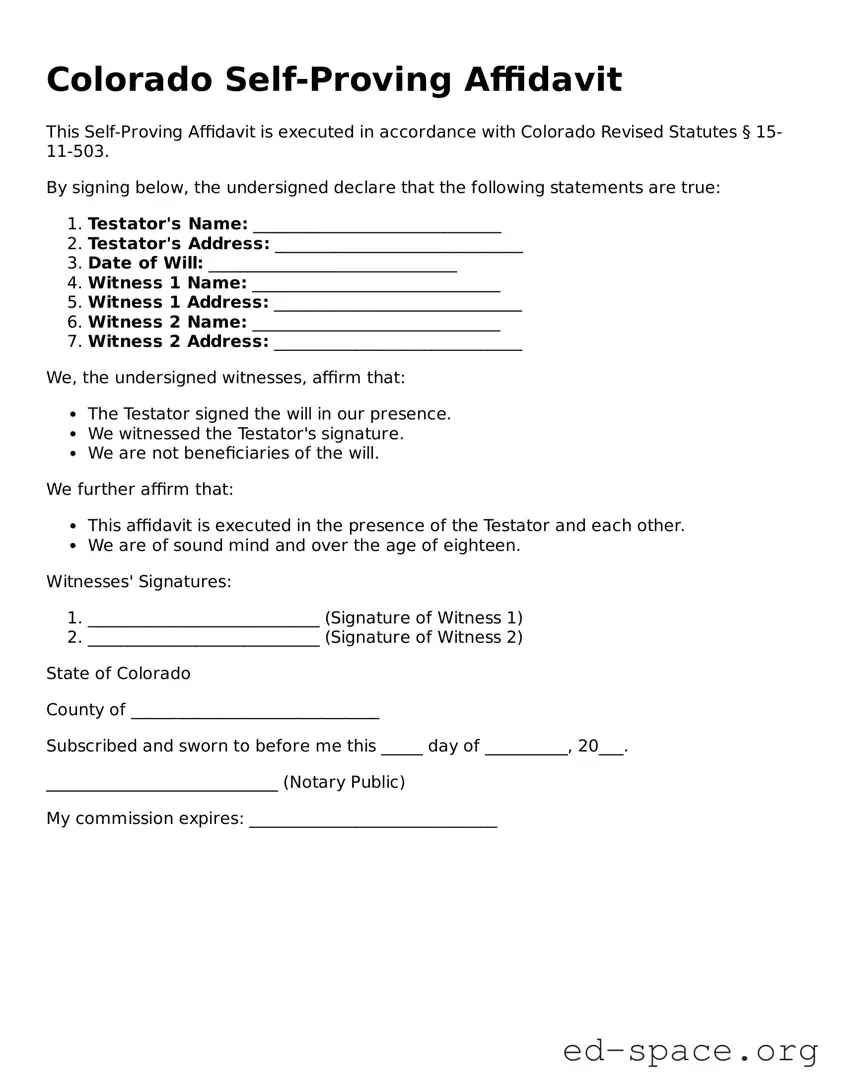
In Colorado, the Self-Proving Affidavit form serves as a vital tool for individuals looking to streamline the probate process of a will. This form allows a testator—someone who has made a will—to affirm the validity of their will in a straightforward manner. By signing this affidavit in the presence of a notary public, the testator and witnesses can confirm that the will was executed according to state laws, eliminating the need for witnesses to testify in court later. This not only simplifies the process but also provides peace of mind to the family members left behind. The Self-Proving Affidavit can be attached to the will, ensuring that its contents are recognized without further complications. Understanding how to properly complete and file this form is essential for anyone preparing their estate plans in Colorado, as it can save time and reduce potential disputes among heirs. With careful attention to detail, individuals can navigate this aspect of estate planning with confidence.
Colorado Self-Proving Affidavit
This Self-Proving Affidavit is executed in accordance with Colorado Revised Statutes § 15-11-503.
By signing below, the undersigned declare that the following statements are true:
We, the undersigned witnesses, affirm that:
We further affirm that:
Witnesses' Signatures:
State of Colorado
County of ______________________________
Subscribed and sworn to before me this _____ day of __________, 20___.
____________________________ (Notary Public)
My commission expires: ______________________________
| Fact Name | Description |
|---|---|
| Purpose | The Colorado Self-Proving Affidavit is used to simplify the probate process by affirming the validity of a will. |
| Governing Law | This affidavit is governed by Colorado Revised Statutes, specifically § 15-11-503. |
| Signatories | The affidavit must be signed by the testator and two witnesses. |
| Notarization | A notary public must also acknowledge the signatures on the affidavit. |
| Effectiveness | Once executed, the affidavit allows the will to be accepted in probate without the need for witness testimony. |
| Revocation | The affidavit does not revoke the will; it merely enhances its validity during probate. |
| Filing | The self-proving affidavit is typically filed with the will in the probate court. |
| Eligibility | Any individual over the age of 18 can serve as a witness, provided they are not beneficiaries of the will. |
| Form Accessibility | The Colorado Self-Proving Affidavit form is available online and can be filled out and printed for use. |
Once you have gathered the necessary information and documents, you can proceed to fill out the Colorado Self-Proving Affidavit form. This form is a key component in ensuring that your will is recognized as valid without the need for witnesses to testify in court. Follow these steps carefully to complete the form accurately.
With the form filled out correctly, it will be ready for submission alongside the will. Ensure that all parties involved understand the next steps in the process, as this will help facilitate a smoother transition through the legalities of estate management.
What is a Colorado Self-Proving Affidavit?
A Colorado Self-Proving Affidavit is a legal document that allows a will to be validated without requiring the witnesses to appear in court after the testator's death. This affidavit is typically signed by the testator and the witnesses in the presence of a notary public. By completing this form, the parties affirm that the will was executed properly, ensuring a smoother probate process.
Who needs to use a Self-Proving Affidavit?
Individuals creating a will in Colorado may choose to use a Self-Proving Affidavit to simplify the probate process for their heirs. This document is particularly beneficial for those who want to avoid the potential complications of having witnesses testify about the will's authenticity. It is advisable for anyone who wants to ensure that their final wishes are honored without unnecessary delays.
How is the Self-Proving Affidavit completed?
To complete a Self-Proving Affidavit, the testator and the witnesses must sign the affidavit in front of a notary public. The notary will then verify the identities of the signers and affix their seal. It is essential to ensure that the affidavit is signed at the same time as the will or shortly thereafter to maintain its validity. Proper execution is crucial for the affidavit to serve its intended purpose.
Is a Self-Proving Affidavit legally required in Colorado?
Incorrect Signatures: One of the most common mistakes is failing to have the required witnesses sign the affidavit. All signatures must be present for the affidavit to be valid.
Notarization Issues: Some individuals forget to have the affidavit notarized. A notary public must witness the signing of the document to ensure its authenticity.
Incomplete Information: Leaving out essential details, such as the names of the testator or witnesses, can render the affidavit ineffective. Ensure all fields are filled out completely.
Wrong Dates: Mistakes in dating the document can lead to confusion. It’s crucial to accurately record the date of signing.
Using Incorrect Language: Some may use informal language instead of the formal language required. The affidavit must be clear and precise to avoid any misinterpretation.
Failure to Follow State Guidelines: Each state has specific requirements for self-proving affidavits. Not adhering to Colorado's guidelines can invalidate the document.
Not Reviewing the Document: Rushing through the process often leads to errors. It’s essential to review the completed affidavit for accuracy before submission.
Assuming It's Optional: Some people mistakenly believe that a self-proving affidavit is not necessary. However, it can simplify the probate process significantly.
Filing the Affidavit Incorrectly: Once completed, the affidavit must be filed correctly with the appropriate court or included with the will. Misfiling can delay the probate process.
The Colorado Self-Proving Affidavit is a valuable document that helps validate a will by providing evidence that the testator signed the will in the presence of witnesses. However, there are several other forms and documents that are often used in conjunction with this affidavit. Each serves a specific purpose in the estate planning and probate process.
Utilizing these documents alongside the Colorado Self-Proving Affidavit can streamline the estate planning process and ensure that an individual's wishes are honored. Each document plays a crucial role in managing legal and financial matters related to an estate.
When filling out the Colorado Self-Proving Affidavit form, there are important guidelines to follow. Here is a list of things you should and shouldn't do:
The Colorado Self-Proving Affidavit form is a useful tool for individuals creating a will. However, there are several misconceptions that can lead to confusion. Below are five common misunderstandings about this form, along with clarifications to help you navigate its use.
This is not true. The Self-Proving Affidavit can be beneficial for anyone who wants to ensure their will is accepted without the need for witnesses to testify in court. It simplifies the probate process, regardless of the estate's size.
While legal advice can be helpful, it is not a requirement. Individuals can fill out the Self-Proving Affidavit themselves, as long as they follow the correct procedures and guidelines.
This is incorrect. A will can still be valid even if a Self-Proving Affidavit is not included. The affidavit simply makes the probate process easier and faster.
While it is most effective to complete the affidavit at the same time as signing the will, it can also be executed later, as long as the will is still valid and the necessary parties are available.
This is a misunderstanding. The Self-Proving Affidavit does not replace a will; it is simply an addendum that aids in the probate process. A valid will is still essential for determining how an individual's assets will be distributed after their passing.
Understanding these misconceptions can help clarify the purpose and function of the Colorado Self-Proving Affidavit. It is a valuable tool for ensuring your wishes are honored while making the legal process smoother for your loved ones.
When filling out and using the Colorado Self-Proving Affidavit form, it is important to keep several key points in mind. This form can simplify the process of validating a will, making it easier for your wishes to be honored after your passing.
By understanding these key takeaways, you can navigate the process of creating and using a Self-Proving Affidavit with confidence. Taking these steps will help ensure that your final wishes are respected and that your loved ones are supported during a challenging time.