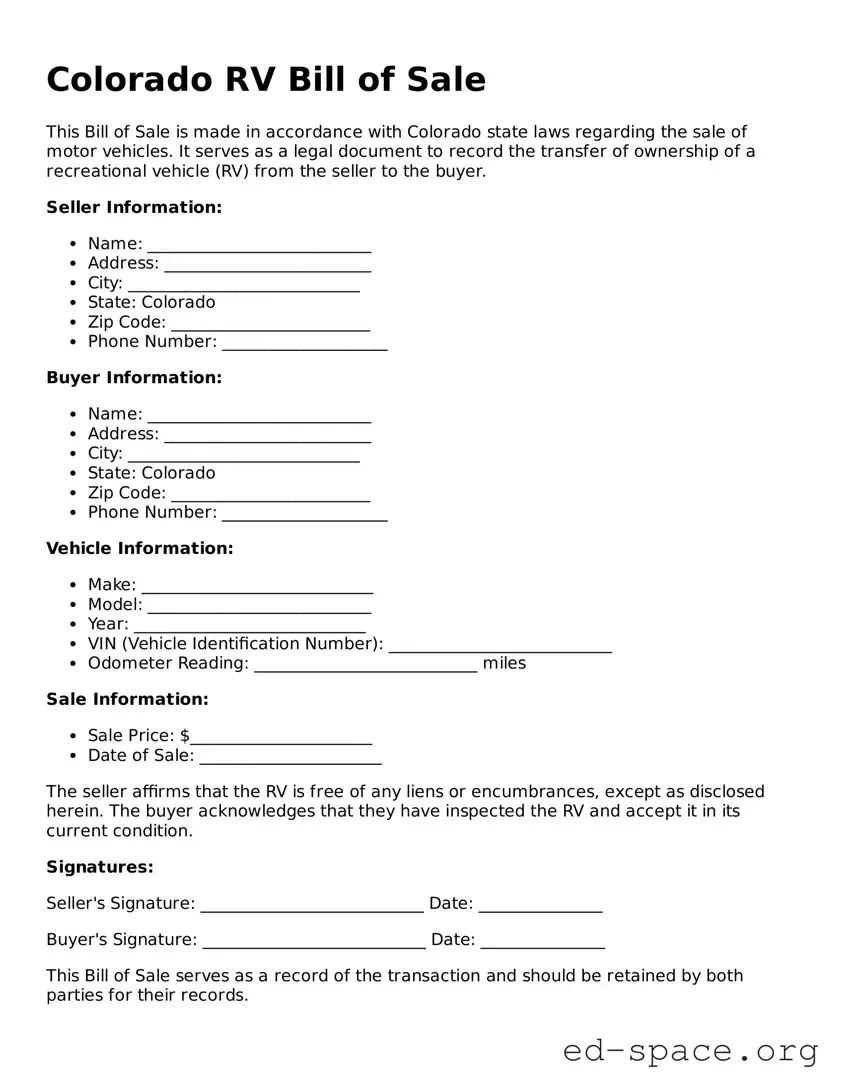
When buying or selling an RV in Colorado, having the right documentation is essential for a smooth transaction. The Colorado RV Bill of Sale form serves as a vital record of the transfer of ownership between the seller and the buyer. This document typically includes key details such as the names and addresses of both parties, a description of the RV, including its make, model, year, and Vehicle Identification Number (VIN), as well as the sale price. Additionally, the form may outline any warranties or representations made by the seller, ensuring both parties are clear on the terms of the sale. By properly completing this form, you can protect your interests and provide proof of ownership, which is crucial for registration and future transactions. Understanding the importance of this document can help facilitate a hassle-free experience, whether you’re embarking on an exciting new adventure or parting ways with your beloved RV.
Colorado RV Bill of Sale
This Bill of Sale is made in accordance with Colorado state laws regarding the sale of motor vehicles. It serves as a legal document to record the transfer of ownership of a recreational vehicle (RV) from the seller to the buyer.
Seller Information:
Buyer Information:
Vehicle Information:
Sale Information:
The seller affirms that the RV is free of any liens or encumbrances, except as disclosed herein. The buyer acknowledges that they have inspected the RV and accept it in its current condition.
Signatures:
Seller's Signature: ___________________________ Date: _______________
Buyer's Signature: ___________________________ Date: _______________
This Bill of Sale serves as a record of the transaction and should be retained by both parties for their records.
| Fact Name | Description |
|---|---|
| Purpose | The Colorado RV Bill of Sale form is used to document the sale and transfer of ownership of a recreational vehicle. |
| Governing Law | This form is governed by Colorado state law, specifically the Colorado Revised Statutes Title 42. |
| Parties Involved | The form requires information from both the seller and the buyer, including names and addresses. |
| Vehicle Information | Details about the RV, such as the make, model, year, and Vehicle Identification Number (VIN), must be included. |
| Purchase Price | The sale price of the RV must be clearly stated on the form to establish the financial terms of the transaction. |
| Signatures | Both parties must sign the form to validate the sale and transfer of ownership. |
| Date of Sale | The date when the transaction occurs must be recorded on the form for legal and record-keeping purposes. |
| Notarization | While notarization is not always required, it can add an extra layer of authenticity to the document. |
| Record Keeping | Both the buyer and seller should keep a copy of the completed Bill of Sale for their records. |
| State Requirements | Some counties in Colorado may have additional requirements, so it’s wise to check local regulations. |
Once you have the Colorado RV Bill of Sale form in hand, you are ready to begin the process of filling it out. This document will serve as a record of the sale, ensuring that both the buyer and seller have a clear understanding of the transaction. Follow the steps below to complete the form accurately.
After completing the form, both parties should review it for accuracy. Once signed, the document serves as proof of the sale and can be used for registration and title transfer purposes.
What is a Colorado RV Bill of Sale?
A Colorado RV Bill of Sale is a legal document that records the sale of a recreational vehicle in the state of Colorado. It serves as proof of the transaction between the buyer and seller, detailing the terms of the sale and identifying both parties involved.
Why do I need a Bill of Sale for my RV?
The Bill of Sale is essential for several reasons. It provides a record of the transaction, which is useful for both the buyer and seller. For the buyer, it proves ownership and can be necessary for registration and titling. For the seller, it protects against future claims of ownership and serves as a receipt for the sale.
What information is included in the Colorado RV Bill of Sale?
The form typically includes details such as the names and addresses of the buyer and seller, the RV's make, model, year, Vehicle Identification Number (VIN), and the sale price. It may also contain the date of the transaction and any warranties or conditions agreed upon by both parties.
Do I need to have the Bill of Sale notarized?
In Colorado, notarization is not required for the Bill of Sale to be valid. However, having it notarized can add an extra layer of protection and authenticity, especially if the transaction involves a significant amount of money or if either party has concerns about the sale.
Can I create my own Bill of Sale?
Yes, you can create your own Bill of Sale as long as it includes all the necessary information. However, using a standard form can help ensure that you don’t miss any important details and that the document meets state requirements.
Is a Bill of Sale the same as a title?
No, a Bill of Sale is not the same as a title. The Bill of Sale is a record of the sale, while the title is the legal document that proves ownership of the RV. After purchasing the RV, the buyer will need to transfer the title into their name through the Colorado Department of Motor Vehicles (DMV).
How do I transfer ownership of my RV in Colorado?
To transfer ownership, both the buyer and seller should complete the Bill of Sale. The seller must sign the title over to the buyer, and the buyer must take both the signed title and the Bill of Sale to the DMV to register the RV in their name.
Are there any fees associated with the Bill of Sale?
There are no fees specifically for creating a Bill of Sale. However, when registering the RV with the DMV, there may be fees associated with title transfer and registration. It's advisable to check with the DMV for the most current fee schedule.
What if I lose my Bill of Sale?
If you lose your Bill of Sale, it’s best to contact the seller to obtain a copy if possible. If that’s not an option, you may need to create a new Bill of Sale and have both parties sign it again to document the transaction properly.
Can I use a Colorado RV Bill of Sale in another state?
A Colorado RV Bill of Sale may be accepted in another state, but it's essential to check the specific requirements of that state. Some states have their own forms or additional requirements for vehicle sales, so it’s wise to confirm before proceeding.
Incomplete Information: Many individuals forget to fill out all required fields. It’s crucial to provide complete details about the buyer, seller, and the RV itself. Missing information can lead to delays or complications in the transfer process.
Incorrect Vehicle Identification Number (VIN): The VIN is a unique identifier for the RV. Double-checking this number is essential, as any discrepancies can cause issues with registration or ownership verification.
Not Including Purchase Price: Some people neglect to state the purchase price of the RV. This information is important for both parties and may be necessary for tax purposes.
Failure to Sign: A common oversight is forgetting to sign the document. Both the buyer and seller must sign the Bill of Sale for it to be valid. Without signatures, the document holds no legal weight.
Ignoring Local Requirements: Different counties or municipalities may have specific requirements for RV sales. Not checking local regulations can lead to additional hurdles in the process.
When purchasing or selling a recreational vehicle (RV) in Colorado, several documents complement the RV Bill of Sale form. These forms help ensure a smooth transaction and provide necessary legal protections for both parties involved. Below is a list of commonly used documents.
Having these documents prepared and organized can simplify the buying or selling process of an RV in Colorado. Ensuring that all paperwork is in order protects both the buyer and seller, paving the way for a successful transaction.
The RV Bill of Sale form is a crucial document for transferring ownership of a recreational vehicle. Several other documents serve similar purposes in different contexts. Here’s a list of those documents and how they relate to the RV Bill of Sale:
Each of these documents plays a vital role in ensuring that transactions are clear and legally binding, protecting both buyers and sellers in their respective agreements.
When filling out the Colorado RV Bill of Sale form, there are several important dos and don'ts to keep in mind. Following these guidelines will help ensure a smooth transaction and proper documentation.
By following these tips, you can help ensure that your RV sale goes smoothly and that all necessary information is accurately documented.
Many people have misunderstandings about the Colorado RV Bill of Sale form. Here are nine common misconceptions, along with clarifications to help you understand the truth.
In Colorado, a Bill of Sale is crucial for documenting the sale of an RV. It serves as proof of ownership transfer and can be important for tax purposes.
Both the seller and the buyer should sign the Bill of Sale. This ensures that both parties agree to the terms of the sale.
While verbal agreements can be made, they are not legally binding in the same way a written Bill of Sale is. Having a written document protects both parties.
The Colorado RV Bill of Sale can be used for both new and used RVs. It applies to any transfer of ownership, regardless of the vehicle's age.
Even if the RV is registered in another state, a Bill of Sale is still recommended for any sale. It provides a clear record of the transaction.
It is best to complete the Bill of Sale at the time of the transaction. This helps avoid disputes or confusion later on.
While notarization is not required for the Bill of Sale in Colorado, having it notarized can add an extra layer of security and authenticity.
While the Bill of Sale should include key information, there is flexibility in how it is formatted. As long as it contains the necessary details, it is valid.
The Bill of Sale can be crucial for tax purposes. It helps establish the sale price and can be used when calculating sales tax.
Understanding these misconceptions can help ensure a smooth transaction when buying or selling an RV in Colorado.
When it comes to buying or selling an RV in Colorado, the RV Bill of Sale is an essential document. Here are some key takeaways to keep in mind:
Filling out the Colorado RV Bill of Sale accurately can make the buying or selling experience smooth and hassle-free. Keep these takeaways in mind to ensure a successful transaction!