The Colorado Residential Lease Agreement form serves as a vital document in the rental process, outlining the rights and responsibilities of both landlords and tenants. This legally binding agreement details essential aspects such as the duration of the lease, rental payment terms, and security deposit requirements. Additionally, it specifies the rules regarding property maintenance, utilities, and any restrictions on tenant activities. The form also addresses procedures for lease termination, renewal options, and the handling of disputes. By clearly defining these elements, the agreement aims to foster a transparent and respectful relationship between the parties involved, ensuring that both landlords and tenants understand their obligations and rights throughout the lease term.
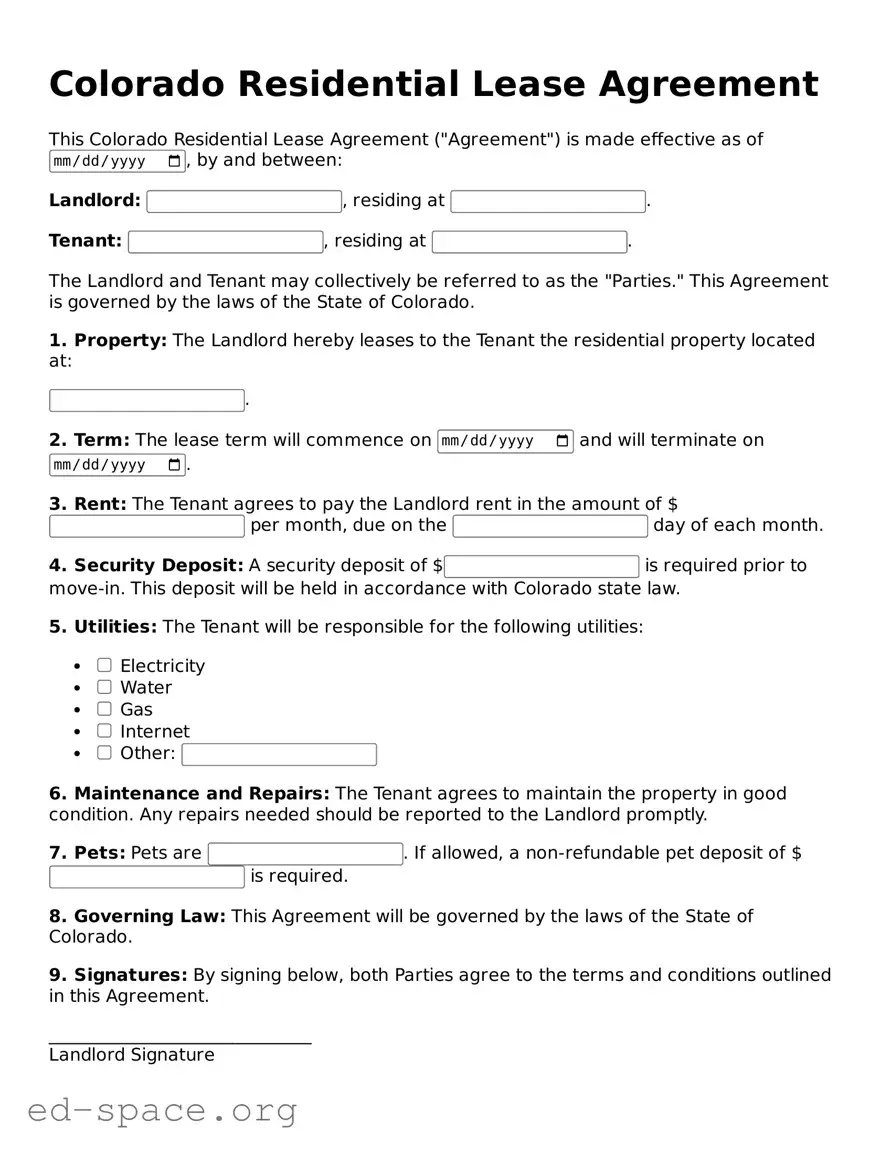
Colorado Residential Lease Agreement
This Colorado Residential Lease Agreement ("Agreement") is made effective as of , by and between:
Landlord: , residing at .
Tenant: , residing at .
The Landlord and Tenant may collectively be referred to as the "Parties." This Agreement is governed by the laws of the State of Colorado.
1. Property: The Landlord hereby leases to the Tenant the residential property located at:
.
2. Term: The lease term will commence on and will terminate on .
3. Rent: The Tenant agrees to pay the Landlord rent in the amount of $ per month, due on the day of each month.
4. Security Deposit: A security deposit of $ is required prior to move-in. This deposit will be held in accordance with Colorado state law.
5. Utilities: The Tenant will be responsible for the following utilities:
6. Maintenance and Repairs: The Tenant agrees to maintain the property in good condition. Any repairs needed should be reported to the Landlord promptly.
7. Pets: Pets are . If allowed, a non-refundable pet deposit of $ is required.
8. Governing Law: This Agreement will be governed by the laws of the State of Colorado.
9. Signatures: By signing below, both Parties agree to the terms and conditions outlined in this Agreement.
______________________________
Landlord Signature
______________________________
Tenant Signature
Date:
| Fact Name | Description |
|---|---|
| Governing Law | The Colorado Residential Lease Agreement is governed by the Colorado Revised Statutes, particularly Title 38, which covers landlord-tenant relations. |
| Duration of Lease | The lease agreement can be for a fixed term, typically one year, or it can be a month-to-month arrangement, depending on the preferences of both parties. |
| Security Deposit | Landlords may require a security deposit, which cannot exceed one month's rent unless otherwise specified. This deposit must be returned within 60 days after the lease ends, barring any deductions. |
| Notice Requirements | Both landlords and tenants must provide written notice to terminate the lease. For month-to-month leases, a notice period of at least 21 days is required. |
| Habitability Standards | Landlords are required to maintain the property in a habitable condition, ensuring that it meets health and safety standards throughout the duration of the lease. |
Filling out the Colorado Residential Lease Agreement form is an important step in establishing a rental relationship. This document outlines the terms and conditions of the lease, ensuring that both the landlord and tenant understand their rights and responsibilities. Carefully following the steps below will help ensure that the form is completed accurately.
Once the form is filled out and signed, both the landlord and tenant should retain a copy for their records. This ensures that everyone is on the same page regarding the lease agreement.
What is a Colorado Residential Lease Agreement?
A Colorado Residential Lease Agreement is a legal document that outlines the terms and conditions of renting a residential property. This agreement is signed by both the landlord and the tenant. It includes details such as the rental amount, duration of the lease, and responsibilities of both parties.
What information is typically included in the lease agreement?
The lease agreement usually contains the names of the landlord and tenant, the property address, the lease term, rent amount, security deposit details, maintenance responsibilities, and rules regarding pets or smoking. It may also include information about late fees and procedures for terminating the lease.
How long does a typical lease last?
A typical lease in Colorado can last for various durations, but most commonly, it is for one year. However, leases can be month-to-month or for shorter or longer terms based on the agreement between the landlord and tenant.
Can a lease be modified after it has been signed?
What happens if a tenant needs to break the lease early?
If a tenant needs to break the lease early, they should review the lease agreement for any specific terms regarding early termination. Often, tenants may need to provide notice and possibly pay a fee. Communication with the landlord is important to discuss options and avoid penalties.
Are there any specific tenant rights in Colorado?
Failing to include all tenant names. It's essential to list every adult who will reside in the property. Omitting a name can lead to complications later.
Not specifying the lease term. Clearly stating the duration of the lease helps avoid misunderstandings about when the agreement begins and ends.
Overlooking the security deposit details. Tenants should know the amount required, the conditions for its return, and how it will be held.
Neglecting to outline maintenance responsibilities. Both landlords and tenants should understand who is responsible for repairs and upkeep.
Missing the rental payment details. This includes the amount due, payment methods accepted, and any late fees that may apply.
Not addressing pets in the agreement. If pets are allowed, their types and any associated fees should be clearly stated.
Failing to include rules regarding alterations to the property. Tenants need to know if they can make changes, such as painting or installing fixtures.
Ignoring the process for lease termination. Clear instructions on how either party can end the lease are crucial for avoiding disputes.
Not providing emergency contact information. Both parties should have a way to reach each other in case of urgent issues.
Forgetting to sign and date the agreement. Without signatures, the lease may not be enforceable, leaving both parties vulnerable.
The Colorado Residential Lease Agreement is a critical document for landlords and tenants, outlining the terms of a rental arrangement. Alongside this agreement, several other forms and documents are commonly utilized to ensure clarity and protect the rights of both parties. Below is a list of related documents that may accompany the lease agreement.
These documents work in conjunction with the Colorado Residential Lease Agreement to create a comprehensive framework for the rental relationship. Utilizing these forms can help avoid misunderstandings and protect the interests of both landlords and tenants.
When filling out the Colorado Residential Lease Agreement form, it's important to follow certain guidelines to ensure accuracy and compliance. Here are five things you should and shouldn't do:
Understanding the Colorado Residential Lease Agreement is crucial for both landlords and tenants. However, several misconceptions can lead to confusion. Here are four common myths:
This is not true. While verbal agreements can be legally binding in some situations, they are often difficult to enforce. A written lease provides clear terms and protects both parties in case of disputes.
This is a common misunderstanding. In Colorado, leases can be for any duration agreed upon by both parties. This could be a month-to-month arrangement or a multi-year lease, depending on what the landlord and tenant decide.
This is misleading. Colorado law requires landlords to provide reasonable notice—typically 24 hours—before entering a tenant’s space, except in emergencies. Respecting privacy is important for a healthy landlord-tenant relationship.
This is not accurate. In Colorado, security deposits are refundable, provided that the tenant meets the terms of the lease and leaves the property in good condition. Landlords must return the deposit within a specified timeframe after the lease ends.
By clarifying these misconceptions, both landlords and tenants can navigate their agreements with greater confidence and understanding.
When filling out and using the Colorado Residential Lease Agreement form, several important points should be considered. Here are key takeaways to keep in mind:
By adhering to these key points, both landlords and tenants can ensure a clear understanding of their rights and responsibilities throughout the rental period.